
Teach-Now Unit 3 Module 6 Activity 1
Lesson Plan
Teacher Candidate: Ye Won Maing Date Lesson Taught: 2020-05-28
Name of Mentor: Cheryl Waters
Lesson Title: GRIT Discussion Activity
Grade Level and Course: Secondary 2: English
Time Segment of Lesson: ___60______ minutes (Edit video to 10-15 minutes)
Standard(s) Addressed in Lesson:
Objective(s) of the Lesson: Students will be able to … articulate their ideas on what GRIT means to them with reference to their personal experiences or experiences of those people for whom GRIT has been an integral part of their lives.
Vocabulary (and other literacy skills): Perseverance, resilience, autonomy, risk-taking (note-taking skills, forming their ideas into articulate sentences, public speaking skills, presentation skills, writing essay skills)
Student Diversity and Differentiation of Instruction
| Student Diversity | Differentiation of Instruction |
| Students with English as Second Langauge | Relevant expectations when assessing their written skills; understanding of their vocabulary or maneuvering of language when it comes to understanding their ideas |
Formative and Summative Assessments
| Formative Assessment | Summative Assessment |
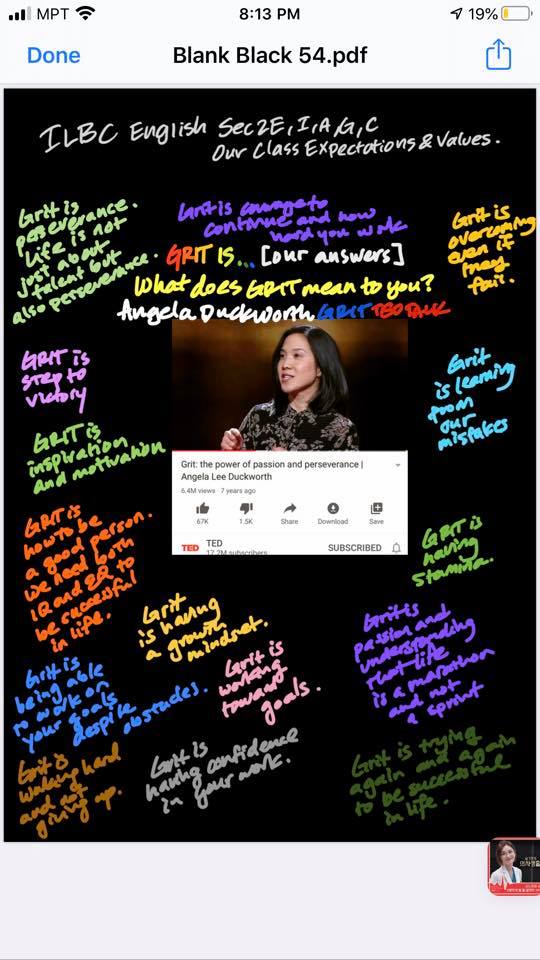
| Students will be annotating the video while watching Angela Duckworth’s Tedtalk on GRIT | We will come up with a group work of GRIT wall where we will compile every one’s ideas on the notion of GRIT and set it up as set of class expectations and norms for class. |
| Students will be sharing to the class what they make of the idea of GRIT after having watched the video twice | |
| Students will submit a written assignment on GRIT as their final assessment |
● If there is no summative assessment in this lesson, what/when will the summative
assessment be/take place
Big Ideas to be Addressed in the Lesson: The notion of GRIT, perseverance and resilience as characteristics leading up to success
Discussion Questions
Write out questions that you would like students to discuss in class, before class or after class because they are interesting, support higher order thinking, and make for a lively and engaging discussion. If discussions must happen outside class, what tool will you use to facilitate the discussion (e.g. Twitter)?
I would like students to discuss what are Angela Duckworth’s ideas and what do you make of them? What does GRIT mean to you and will you say GRIT has impacted your life in some way, or have you had people around you who have shown GRIT in their lives who have inspired you, and can you think of successful people who have been able to achieve success by exemplifying GRIT in their lives?
21st Century Knowledge and Skills
| 21st Century Knowledge and Skills | Teaching Strategies |
| Critical Thinking | Students will be using critical skills in order to apply the notion of GRIT onto their lives or other peoples’ lives. |
| Collaboration | Students will be listening to one another’s opinion and thereby practicing collaboration. We will also come up with class norms and expectations for our class as a group to come up with what GRIT means to us as a class. |
| Technology Literacy | Students will be expected to annotate the video, and also use technology to be typing up their written assignments on GRIT and submitting their assignments on the ILBC Microsoft Teams platform. |
Teaching Strategies and Related Student Activities (Include Web 2.0 activities as appropriate):
Preparing the tedtalk in advance and screen sharing the ted talk and making sure subtitles are on for the students who have English as their second language.
Making sure that the audio function is working ahead of time for the online platform.
Providing sample responses and essays from previous students in the chatbox for them to be able to read and prepare their own responses for their individual responses and public speaking.
Teaching Strategies and Activities: What are the teaching strategies and activities that you plan to use to help students meet the lesson’s objectives? What are the steps that you will take to deliver this lesson (e.g., introduce the author, read the poem, ask students to…)?
Teacher/Student Input: Write a note on what you expect the teacher and students to do as a part of this activity. Include a note on whether this is an “I do it”, “We do it” or “You do it” type of activity.
“I do it”
Introduce to them what the talk would be about. Introduce Angela Duckworth, her study and significance of her study, and what students would be paying attention to while listening to her talk.
Play the video twice for them to fully comprehend and absorb the material.
Ask questions on what they made of the video, and what they make of the quality called GRIT
You do it:
Take notes on what Angela Duckworth is arguing concerning the notion of GRIT. Prepare your individual responses on the notion of GRIT.
We do it:
As a class, make presentations on what they make of the notion of GRIT.
We will come up with a GRIT Poster we will have on our wall where we come up with class expectations and values on what we think of GRIT and attitude we should have towards learning as a group.
Review: Write down ideas on how you will review the topic, including notes on types of formative assessments that you will use during the lesson.
As final part of the activity, they will be assigned to write an essay concerning the notion of GRIT where they will be referring to individual reflections on their lives and experiences of various people who have exemplified GRIT to achieve their own kind of success in their lives. They will be assessed on their critical thinking skills, and also the development, organization and logic of their arguments.
Materials and Resources for Lesson
| Materials, Technology, and Websites | Required Preparation |
| Microsoft Teams: The school online learning platform | checking with the IT department if there are any other errors |
| Link of the tedtalk, making sure the audio works and screenshare works | checking with the other teacher on technology |
Use this space to write a paragraph or two discussion how the lesson went. Be honest — you can use this information in your reflections for Module 8.
The activity went more smoothly and effortlessly than as was anticipated. Students were actually very vibrant and eager to be sharing their opinions about what GRIT means to them and informing us of well-articulated, lengthy, prepared responses of what GRIT could mean to people. The level of energy and enthusiasm in class seem to have worn off from Angela Duckworth’s passion and commitment to her research and theory, and students seem to have really bought into and have been inspired by the arguments she had made and the research she had provided to substantiate her stance. Overall, I was really impressed by the level of passion and interest students had on the discussion topic.
Use this space to write notes on how you might change this lesson when you teach it again:
I think I would provide more sample responses of other class and students on what they made of the topic of GRIT. A wider array of responses would enrich the class discussion and allow fruition of a more diverse debate.
References
Teach-Now Unit 2 Module 6 Activity 1
Unit Plan Template
Teacher Candidate Name: Ye Won Maing
Unit Name: Covid Reading
Subject and Grade Level: English Secondary 2 (Grade 7)
Standard: Reading Standards
Overarching Goals: What would you expect for mastery?
Reading comprehension, book review skills
Objectives: Identify the objectives for the unit and a table that shows 21st Century skills addressed. Use the objectives that you created in Unit 1.
| Objective | 21st Century Skills Addressed |
| To be able to comprehend reading materials with understanding of the conflicts, character development, and other literary features associated with the books | Comprehension/ Creativity |
| To be able to report back to class what they have read, and understood while reading | Communication Skills |
| To be able to listen to book reports of one another and respond with any questions and relevant feedback | Communication Skills |
Prerequisite Skills: What skills do students need to have before beginning this unit?
Students should have some enthusiasm for reading and hence be able to initiate reading on their own, being able to analyze and comprehend some of the important components within the book.
Summative Assessment: What evidence or project will students submit to demonstrate that they have met the standard and objectives? How will you assess these products? How will you differentiate the assessments based on varying reading levels of students?
Students will be presenting book reports on books that they have read for the week and hence the criteria of reading comprehension, level of analysis, organization of ideas, efficacy of presentation will be assessed. The book reports will be based on books that they have chosen (while the reading list with book reviews would be provided to ease their choice of book selection). Yet, since the books will be chosen by the students, they would be assessed on the books that they have chosen, and hence these varying reading levels will be taken into consideration and also their individual reading levels while assessing each criteria.
Formative Assessment: How will you monitor and track student progress?
Lessons:What are the lessons that you will teach for this unit? How will you sequence the lessons that you will teach for this unit? Will your lessons be goal oriented, theme-based, or project-based? What strategies will you use to teach vocabulary to students of varying reading levels? Mention any other literacy skill covered in a lesson. What follows this unit?
- Lesson 1 (Week 1) : For lesson 1 they would be provided with the list of books that they would be encouraged to read on their own. But their own individual book selection would be encouraged.
- Lesson 2 (Week 2) : For second lesson, we will be going through the drama unit, specifically Shakespearean drama including Macbeth, King Lear, and Othello.
- Lesson 3 (Week 3) : For third lesson, we will be continuing with the drama unit, continuing discussion of Macbeth, King Lear, and Othello and writing individual passage analysis or commentary relevant to the individual drama.
- Lesson 4 (Week 4) : For fourth lesson, we will be going through detective stories, where we would be going through detective stories written by Edgar Allan Poe and analyzing literary devices specifically concerning the genre of detective stories..
- Lesson 5 (Week 5) : We would have students present their book reports of the book choices of their own. I would be providing them individual feedback, and students will be providing them with individual feedback as well.
Differentiating Instruction: How will you differentiate the product, content, and/or process for the various needs, preferences and readiness levels of your students? How will you differentiate the lesson for students with varying reading levels, disabilities and English language learners?
For students with varying reading levels, they will be provided again the choice to choose books appropriate to their reading levels concerning the book reports. For more difficult reading that we would be covering like Shakespeare drama in class, relatively easy to understand summaries would be provided to help with their understanding.
Next Steps: What will you do after the unit? Review, re-teach, extend, or move to the next unit?
I will try to review what they have learned by giving short quizzes, or giving written assignments to make sure they have acquired the necessary skills for the given unit. And then I would re-teach any recurring themes or areas that many of the students struggle to understand, extending the unit by relevant time period. And then if I find that the majority of the class have acquired most of the skills necessary for the given unit, I would be moving ahead with the next relevant class material.
References: Add resources you used to create this unit plan (preferably in APA format).
https://educationcontents.school.blog/2020/04/22/edureading-book-summary-annotations-part-3
Refer to two of these blog posts websites for annotations of all reading materials recommended for the book review activity. The individual files can be manually downloaded from the blog.
YouTube video summarizing these review materialshttps://www.youtube.com/embed/oeFgQx3odAs?version=3&rel=1&fs=1&autohide=2&showsearch=0&showinfo=1&iv_load_policy=1&wmode=transparentAdvertisements
Module 6 Unit 1 Activity 3
Overall feedback for the lesson would be that the teacher had effectively executed the lesson plan for the pertaining classroom. The level of enthusiasm or attention of the students could have been higher yet the subject matter and the level of difficulty could have been factors contributing to the relatively low energy level within the classroom. But the teacher’s ability to lead the classroom was effective in that he wasn’t distracted by the people moving in and out of the classroom, and had his whiteboard in place in order to explain all the different mathematical concepts that students might have difficulties understanding and acquiring especially if they were to be encountering these concepts for the first time. Also, his calling out of names, and answering questions, and leading classroom discussions by referring to student X or Y as he is answering their questions or commenting on their comments have all been effective ways in which to move the class forward by engaging the students and having them feel like they are part of the class, especially when concerning concepts which might be difficult for the students if they are acquiring these concepts for the first time. Also, though the sitting of the students were not explicitly explained or mentioned, yet the lesson plan had clearly stated that the gifted or strong students would be helping out ELL students or students who might be having difficulties grasping these mathematical concepts, and hence, more peer to peer interactions and making use of the sitting in groups could have been area of improvement if it had not been already done so in the first place. The teaching material would have scored upper-middle score on the rubric if I had been evaluating the class. And since our school would be opening on the 25th with Home Based Learning Program with online classes, I thought having a whiteboard at my home would be an effective way to lead the class, and for students to stay attuned with visuals, since we would not be at school to be making use of the various tools and devices, and concentration and interactions within online classes can be relatively less engaging. Use of the various visuals and visual tools would be effective components of classroom teaching for online classes.
 EduContents