
Module 5 Activity 4 Activity 1
- Discuss with your Cohort in the Virtual Classroom and Discussion Forum strategies for pre-assessment and tracking student progress that you have used or would like to use in your classroom or in a topic in the subject area and grade level that you wish to teach.
- Create a flowchart or mind map that (a) outlines an innovative differentiation strategy for the three groups of students below (see the article, “Differentiation: It Starts with Pre-Assessment,” in the Activity Resources for an example of an innovative strategy) and (b) identifies the assessments that you will use to track students’ learning throughout the unit:
- the 5 students who answered most, including the most difficult, of the pre-assessment questions correctly
- the 12 students who have some knowledge about the topic as shown in their score, but need to develop higher order thinking skills
- the 5 students who appear to have limited knowledge about the topic, of which 3 are struggling with language and are at different reading levels and 2 students who have little to no comprehension of the the topic and need to be tested further for special needs
- Write a blog post introducing your pre-assessment and the innovative differentiation strategy for the three groups of students described above. Include links or embed your pre-assessment and mind maps within the blog post, to create a comprehensive report.
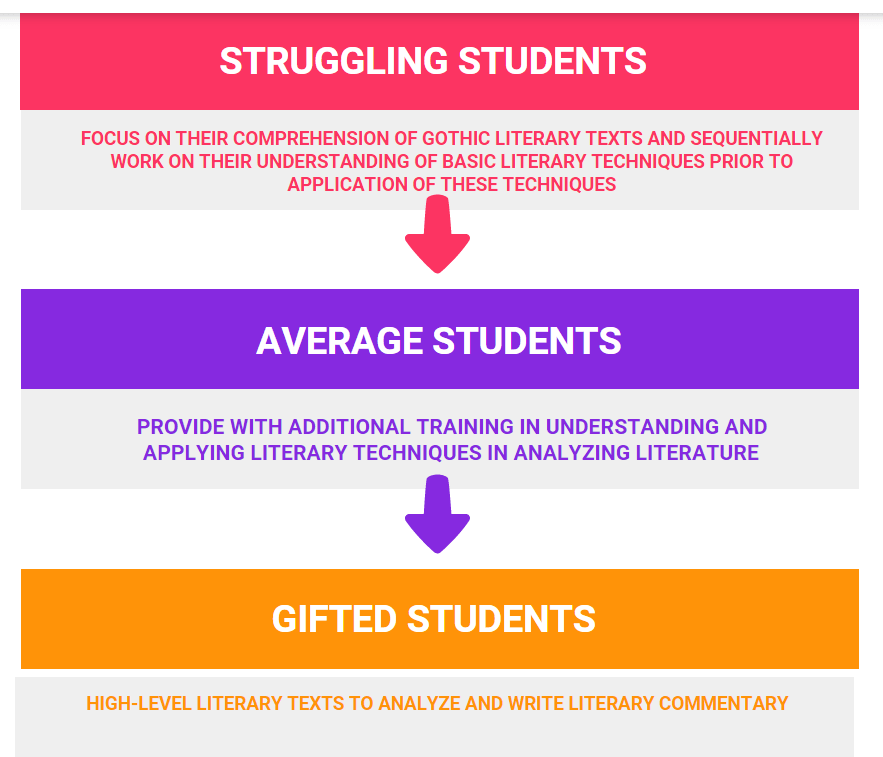
I would like to be using the teaching material that I would be using while working as a Secondary English teacher starting soon at an international school in Yangon, Myanmar called International Language Business Center (ILBC) which uses the IGCSE curriculum. I would be using the chapter on Features of Gothic Stories from the textbook in order to complete this assignment. For the pre-assessment exercise, we would be looking at various Gothic literature and films that they watched concerning the genre (Mary Shelley’s Frankentstein, Edgar Allan Poe’s Poems and short stories) and appropriate literary devices (setting, motifs, characterization) as part of the pre-assessment exercise. In this assignment, our assignment would be differentiated to include three types of students: the gifted students who are excelling in the topic, the students who have knowledge yet show room for critical thinking skills in the topic, and students who may be struggling as they are trying to keep with the work. And as to cater to the needs and learning patterns of all three types of students, differentiated learning would be made: the gifted students would be given passages from these Gothic literature texts to analyze with the expectations that they already are familiar with the literary techniques and can apply these techniques to analyze the given passage and complete writing a commentary paper (literary analysis). As for the second group of students, they would be given Gothic literature texts, yet since they require additional training in literary analysis, they would be provided with sample papers on how to do literary analysis and would be reading and mastering these skills in order to apply them at a more extensive level to analyze Gothic literature texts using the literary techniques. For those students who may be struggling, they may be given Gothic literature to first or all comprehend these texts first hand, and then given sequential training in learning and acquiring these literary techniques, and then using these literary techniques to be analyzing the literary texts. Sequential training would be provided to these students in the third tier.

 EduContents