TEACHNOW Module 6 Unit 3 Activity 2

PEER REVIEW OF LESSON PLANS

Given this lesson plan, could you step in for a day, or take over this course?

I think the lesson plan provides ample explanations and details for substitution teaching viable.

Please make notes on this chart AND directly on the Lesson Plan

Course:

Trainer:

Peer: Channing Jones

ELEMENTCLEAR AS ISPLEASE JUST ADD…UNCLEAR/ NEEDS MUCH MORE… SUGGESTIONS/ QUESTIONS
TitlePerhaps a more straightforward title like Vocabulary Exercise could be helpful in terms of understanding the task of the assignment and have what you have provided (Say what you mean and mean what you have) be the catchy sub-title for the title that may be more straightforward to the audience
Time/ timing(overall + per topic)Yes
60 minutes seem ample time to carry out the lesson plan
Purpose Statement (Why?)Objectives of the assignment were clearly laid out: to find vocabulary using digital and manual resources
Goals(Trainer’s plan)Again the goals have been well laid out well (the skills to find meaning of vocabulary in class)
Objectives (What the learner does)Yes. Find meaning of words.
Pre-training/ PreparationYes.
Materials (which used per topic and where to locate)Yes.
EquipmentYes. The digital resources (including individual iPads) and manual glossaries are available for usage.
References/ Web-linksYes.
Flow of course – Order/ sequenceYes.
Strategies/ ActivitiesRoot words and highlighting techniques can be very effective strategies and techniques but perhaps more visual elements such as posters, diagrams, mind map could be implemented for increased participation and interest.
Talking points/ Lecture notesYes.
Passion/ Key Learning PointsYes.
Samples/ Answer Keys/ Highlighted NotesYes.

Teach-Now Unit 3 Module 6 Activity 1

Lesson Plan

Teacher Candidate: Ye Won Maing Date Lesson Taught: 2020-05-28

Name of Mentor: Cheryl Waters

Lesson Title: GRIT Discussion Activity

Grade Level and Course: Secondary 2: English

Time Segment of Lesson: ___60______ minutes   (Edit video to 10-15 minutes)

Standard(s) Addressed in Lesson:  

Objective(s) of the Lesson:  Students will be able to … articulate their ideas on what GRIT means to them with reference to their personal experiences or experiences of those people for whom GRIT has been an integral part of their lives.

Vocabulary (and other literacy skills): Perseverance, resilience, autonomy, risk-taking (note-taking skills, forming their ideas into articulate sentences, public speaking skills, presentation skills, writing essay skills)

Student Diversity and Differentiation of Instruction

Student DiversityDifferentiation of Instruction
Students with English as Second LangaugeRelevant expectations when assessing their written skills; understanding of their vocabulary or maneuvering of language when it comes to understanding their ideas

Formative and Summative Assessments

Formative Assessment Summative Assessment
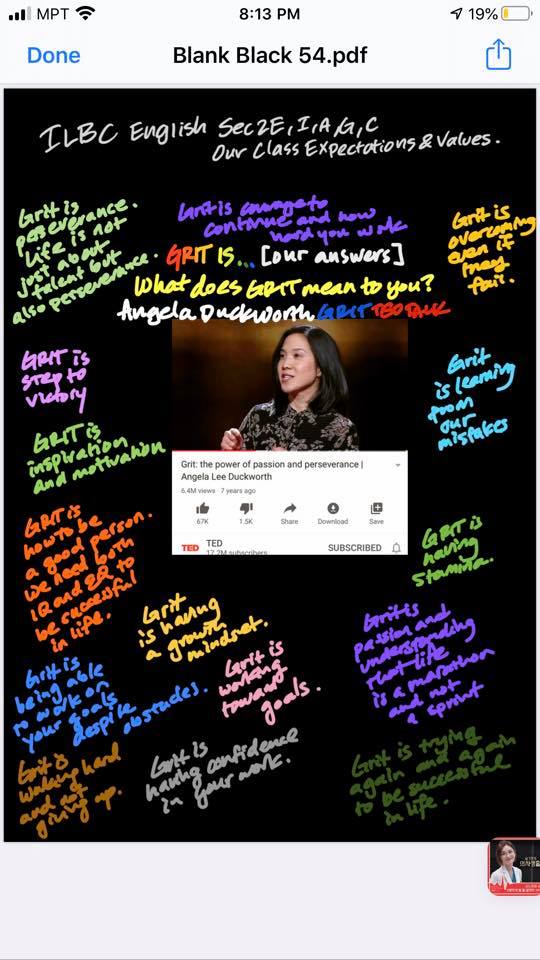
Students will be annotating the video while watching Angela Duckworth’s Tedtalk on GRITWe will come up with a group work of GRIT wall where we will compile every one’s ideas on the notion of GRIT and set it up as set of class expectations and norms for class.
Students will be sharing to the class what they make of the idea of GRIT after having watched the video twice
Students will submit a written assignment on GRIT as their final assessment

● If there is no summative assessment in this lesson, what/when will the summative

assessment be/take place

Big Ideas to be Addressed in the Lesson: The notion of GRIT, perseverance and resilience as characteristics leading up to success

Discussion Questions

Write out questions that you would like students to discuss in class, before class or after class because they are interesting, support higher order thinking, and make for a lively and engaging discussion. If discussions must happen outside class, what tool will you use to facilitate the discussion (e.g. Twitter)?

I would like students to discuss what are Angela Duckworth’s ideas and what do you make of them? What does GRIT mean to you and will you say GRIT has impacted your life in some way, or have you had people around you who have shown GRIT in their lives who have inspired you, and can you think of successful people who have been able to achieve success by exemplifying GRIT in their lives?

21st Century Knowledge and Skills

21st Century Knowledge and SkillsTeaching Strategies
Critical Thinking Students will be using critical skills in order to apply the notion of GRIT onto their lives or other peoples’ lives.
Collaboration Students will be listening to one another’s opinion and thereby practicing collaboration. We will also come up with class norms and expectations for our class as a group to come up with what GRIT means to us as a class.
Technology Literacy Students will be expected to annotate the video, and also use technology to be typing up their written assignments on GRIT and submitting their assignments on the ILBC Microsoft Teams platform.

Teaching Strategies and Related Student Activities (Include Web 2.0 activities as appropriate): 

Preparing the tedtalk in advance and screen sharing the ted talk and making sure subtitles are on for the students who have English as their second language.

Making sure that the audio function is working ahead of time for the online platform.

Providing sample responses and essays from previous students in the chatbox for them to be able to read and prepare their own responses for their individual responses and public speaking.

Teaching Strategies and Activities: What are the teaching strategies and activities that you plan to use to help students meet the lesson’s objectives? What are the steps that you will take to deliver this lesson (e.g., introduce the author, read the poem, ask students to…)?

Teacher/Student Input: Write a note on what you expect the teacher and students to do as a part of this activity. Include a note on whether this is an “I do it”, “We do it” or “You do it” type of activity.

“I do it”

Introduce to them what the talk would be about. Introduce Angela Duckworth, her study and significance of her study, and what students would be paying attention to while listening to her talk.

Play the video twice for them to fully comprehend and absorb the material.

Ask questions on what they made of the video, and what they make of the quality called GRIT

You do it:

Take notes on what Angela Duckworth is arguing concerning the notion of GRIT. Prepare your individual responses on the notion of GRIT.

We do it:

As a class, make presentations on what they make of the notion of GRIT.

We will come up with a GRIT Poster we will have on our wall where we come up with class expectations and values on what we think of GRIT and attitude we should have towards learning as a group.

Review: Write down ideas on how you will review the topic, including notes on types of formative assessments that you will use during the lesson.

As final part of the activity, they will be assigned to write an essay concerning the notion of GRIT where they will be referring to individual reflections on their lives and experiences of various people who have exemplified GRIT to achieve their own kind of success in their lives. They will be assessed on their critical thinking skills, and also the development, organization and logic of their arguments.

Materials and Resources for Lesson 

Materials, Technology, and WebsitesRequired Preparation
Microsoft Teams: The school online learning platform checking with the IT department if there are any other errors
Link of the tedtalk, making sure the audio works and screenshare workschecking with the other teacher on technology

Use this space to write a paragraph or two discussion how the lesson went. Be honest — you can use this information in your reflections for Module 8.

The activity went more smoothly and effortlessly than as was anticipated. Students were actually very vibrant and eager to be sharing their opinions about what GRIT means to them and informing us of well-articulated, lengthy, prepared responses of what GRIT could mean to people. The level of energy and enthusiasm in class seem to have worn off from Angela Duckworth’s passion and commitment to her research and theory, and students seem to have really bought into and have been inspired by the arguments she had made and the research she had provided to substantiate her stance. Overall, I was really impressed by the level of passion and interest students had on the discussion topic.

Use this space to write notes on how you might change this lesson when you teach it again:

I think I would provide more sample responses of other class and students on what they made of the topic of GRIT. A wider array of responses would enrich the class discussion and allow fruition of a more diverse debate.

References

Teach-Now Unit 2 Module 6 Activity 1

Unit Plan Template 

Teacher Candidate Name:  Ye Won Maing

Unit Name: Covid Reading

Subject and Grade Level: English Secondary 2 (Grade 7)

Standard: Reading Standards

Overarching Goals: What would you expect for mastery? 

Reading comprehension, book review skills

Objectives: Identify the objectives for the unit and a table that shows 21st Century skills addressed. Use the objectives that you created in Unit 1.

Objective21st Century Skills Addressed
To be able to comprehend reading materials with understanding of the conflicts, character development, and other literary features associated with the booksComprehension/ Creativity
To be able to report back to class what they have read, and understood while readingCommunication Skills
To be able to listen to book reports of one another and respond with any questions and relevant feedbackCommunication Skills

Prerequisite Skills: What skills do students need to have before beginning this unit?

Students should have some enthusiasm for reading and hence be able to initiate reading on their own, being able to analyze and comprehend some of the important components within the book.

Summative Assessment: What evidence or project will students submit to demonstrate that they have met the standard and objectives? How will you assess these products? How will you differentiate the assessments based on varying reading levels of students?

Students will be presenting book reports on books that they have read for the week and hence the criteria of reading comprehension, level of analysis, organization of ideas, efficacy of presentation will be assessed. The book reports will be based on books that they have chosen (while the reading list with book reviews would be provided to ease their choice of book selection). Yet, since the books will be chosen by the students, they would be assessed on the books that they have chosen, and hence these varying reading levels will be taken into consideration and also their individual reading levels while assessing each criteria.

Formative Assessment: How will you monitor and track student progress? 

Lessons:What are the lessons that you will teach for this unit? How will you sequence the lessons that you will teach for this unit? Will your lessons be goal oriented, theme-based, or project-based? What strategies will you use to teach vocabulary to students of varying reading levels? Mention any other literacy skill covered in a lesson. What follows this unit?

  1. Lesson 1 (Week 1) : For lesson 1 they would be provided with the list of books that they would be encouraged to read on their own. But their own individual book selection would be encouraged.
  2. Lesson 2 (Week 2) : For second lesson, we will be going through the drama unit, specifically Shakespearean drama including Macbeth, King Lear, and Othello.
  3. Lesson 3 (Week 3) : For third lesson, we will be continuing with the drama unit, continuing discussion of Macbeth, King Lear, and Othello and writing individual passage analysis or commentary relevant to the individual drama.
  4. Lesson 4 (Week 4) : For fourth lesson, we will be going through detective stories, where we would be going through detective stories written by Edgar Allan Poe and analyzing literary devices specifically concerning the genre of detective stories..
  5. Lesson 5 (Week 5) : We would have students present their book reports of the book choices of their own. I would be providing them individual feedback, and students will be providing them with individual feedback as well.

Differentiating Instruction: How will you differentiate the product, content, and/or process for the various needs, preferences and readiness levels of your students? How will you differentiate the lesson for students with varying reading levels, disabilities and English language learners?

For students with varying reading levels, they will be provided again the choice to choose books appropriate to their reading levels concerning the book reports. For more difficult reading that we would be covering like Shakespeare drama in class, relatively easy to understand summaries would be provided to help with their understanding.

Next Steps: What will you do after the unit? Review, re-teach, extend, or move to the next unit?

I will try to review what they have learned by giving short quizzes, or giving written assignments to make sure they have acquired the necessary skills for the given unit. And then I would re-teach any recurring themes or areas that many of the students struggle to understand, extending the unit by relevant time period. And then if I find that the majority of the class have acquired most of the skills necessary for the given unit, I would be moving ahead with the next relevant class material.

References: Add resources you used to create this unit plan (preferably in APA format).

https://educationcontents.school.blog/2020/04/22/edureading-book-summary-annotations-part-3

Refer to two of these blog posts websites for annotations of all reading materials recommended for the book review activity. The individual files can be manually downloaded from the blog.

YouTube video summarizing these review materialshttps://www.youtube.com/embed/oeFgQx3odAs?version=3&rel=1&fs=1&autohide=2&showsearch=0&showinfo=1&iv_load_policy=1&wmode=transparentAdvertisements

Teach-Now Unit 2 Module 6 Activity 1

Unit Plan Template 

Teacher Candidate Name:  Ye Won Maing

Unit Name: Covid Reading

Subject and Grade Level: English Secondary 2 (Grade 7)

Standard: Reading Standards

Overarching Goals: What would you expect for mastery? 

Reading comprehension, book review skills

Objectives: Identify the objectives for the unit and a table that shows 21st Century skills addressed. Use the objectives that you created in Unit 1.

Objective21st Century Skills Addressed
To be able to comprehend reading materials with understanding of the conflicts, character development, and other literary features associated with the booksComprehension/ Creativity
To be able to report back to class what they have read, and understood while reading Communication Skills
To be able to listen to book reports of one another and respond with any questions and relevant feedback Communication Skills

Prerequisite Skills: What skills do students need to have before beginning this unit?

Students should have some enthusiasm for reading and hence be able to initiate reading on their own, being able to analyze and comprehend some of the important components within the book.

Summative Assessment: What evidence or project will students submit to demonstrate that they have met the standard and objectives? How will you assess these products? How will you differentiate the assessments based on varying reading levels of students?

Students will be presenting book reports on books that they have read for the week and hence the criteria of reading comprehension, level of analysis, organization of ideas, efficacy of presentation will be assessed. The book reports will be based on books that they have chosen (while the reading list with book reviews would be provided to ease their choice of book selection). Yet, since the books will be chosen by the students, they would be assessed on the books that they have chosen, and hence these varying reading levels will be taken into consideration and also their individual reading levels while assessing each criteria.

Formative Assessment: How will you monitor and track student progress? 

Lessons: What are the lessons that you will teach for this unit? How will you sequence the lessons that you will teach for this unit? Will your lessons be goal oriented, theme-based, or project-based? What strategies will you use to teach vocabulary to students of varying reading levels? Mention any other literacy skill covered in a lesson. What follows this unit?

  1. Lesson 1: For lesson 1 they would be provided with the list of books that they would be encouraged to read on their own. But their own individual book selection would be encouraged.
  2. Lesson 2: For second lesson, we will be going through the drama unit, specifically Shakespearean drama including Macbeth, King Lear, and Othello.
  3. Lesson 3: For third lesson, we will be continuing with the drama unit, continuing discussion of Macbeth, King Lear, and Othello and writing individual passage analysis or commentary relevant to the individual drama.
  4. Lesson 4: For fourth lesson, we will be going through detective stories, where we would be going through detective stories written by Edgar Allan Poe and analyzing literary devices specifically concerning the genre of detective stories..
  5. Lesson 5: We would have students present their book reports of the book choices of their own. I would be providing them individual feedback, and students will be providing them with individual feedback as well.

Differentiating Instruction: How will you differentiate the product, content, and/or process for the various needs, preferences and readiness levels of your students? How will you differentiate the lesson for students with varying reading levels, disabilities and English language learners?

For students with varying reading levels, they will be provided again the choice to choose books appropriate to their reading levels concerning the book reports. For more difficult reading that we would be covering like Shakespeare drama in class, relatively easy to understand summaries would be provided to help with their understanding.

Next Steps: What will you do after the unit? Review, re-teach, extend, or move to the next unit?

I will try to review what they have learned by giving short quizzes, or giving written assignments to make sure they have acquired the necessary skills for the given unit. And then I would re-teach any recurring themes or areas that many of the students struggle to understand, extending the unit by relevant time period. And then if I find that the majority of the class have acquired most of the skills necessary for the given unit, I would be moving ahead with the next relevant class material.

References: Add resources you used to create this unit plan (preferably in APA format).

https://wordpress.com/read/blogs/171403953/posts/1668

https://educationcontents.school.blog/2020/04/22/edureading-book-summary-annotations-part-3/

Refer to two of these blog posts websites for annotations of all reading materials recommended for the book review activity. The individual files can be manually downloaded from the blog.

YouTube video summarizing these review materials

Module 6 Unit 1 Activity 3

Overall feedback for the lesson would be that the teacher had effectively executed the lesson plan for the pertaining classroom. The level of enthusiasm or attention of the students could have been higher yet the subject matter and the level of difficulty could have been factors contributing to the relatively low energy level within the classroom. But the teacher’s ability to lead the classroom was effective in that he wasn’t distracted by the people moving in and out of the classroom, and had his whiteboard in place in order to explain all the different mathematical concepts that students might have difficulties understanding and acquiring especially if they were to be encountering these concepts for the first time. Also, his calling out of names, and answering questions, and leading classroom discussions by referring to student X or Y as he is answering their questions or commenting on their comments have all been effective ways in which to move the class forward by engaging the students and having them feel like they are part of the class, especially when concerning concepts which might be difficult for the students if they are acquiring these concepts for the first time. Also, though the sitting of the students were not explicitly explained or mentioned, yet the lesson plan had clearly stated that the gifted or strong students would be helping out ELL students or students who might be having difficulties grasping these mathematical concepts, and hence, more peer to peer interactions and making use of the sitting in groups could have been area of improvement if it had not been already done so in the first place. The teaching material would have scored upper-middle score on the rubric if I had been evaluating the class. And since our school would be opening on the 25th with Home Based Learning Program with online classes, I thought having a whiteboard at my home would be an effective way to lead the class, and for students to stay attuned with visuals, since we would not be at school to be making use of the various tools and devices, and concentration and interactions within online classes can be relatively less engaging. Use of the various visuals and visual tools would be effective components of classroom teaching for online classes.

Module 5 Activity 4 Activity 1

  1. Discuss with your Cohort in the Virtual Classroom and Discussion Forum strategies for pre-assessment and tracking student progress that you have used or would like to use in your classroom or in a topic in the subject area and grade level that you wish to teach.
  2. Create a flowchart or mind map that (a) outlines an innovative differentiation strategy for the three groups of students below (see the article, “Differentiation: It Starts with Pre-Assessment,” in the Activity Resources for an example of an innovative strategy) and (b) identifies the assessments that you will use to track students’ learning throughout the unit:
    1. the 5 students who answered most, including the most difficult, of the pre-assessment questions correctly
    2. the 12 students who have some knowledge about the topic as shown in their score, but need to develop higher order thinking skills
    3. the 5 students who appear to have limited knowledge about the topic, of which 3 are struggling with language and are at different reading levels and 2 students who have little to no comprehension of the the topic and need to be tested further for special needs
  3. Write a blog post introducing your pre-assessment and the innovative differentiation strategy for the three groups of students described above. Include links or embed your pre-assessment and mind maps within the blog post, to create a comprehensive report.

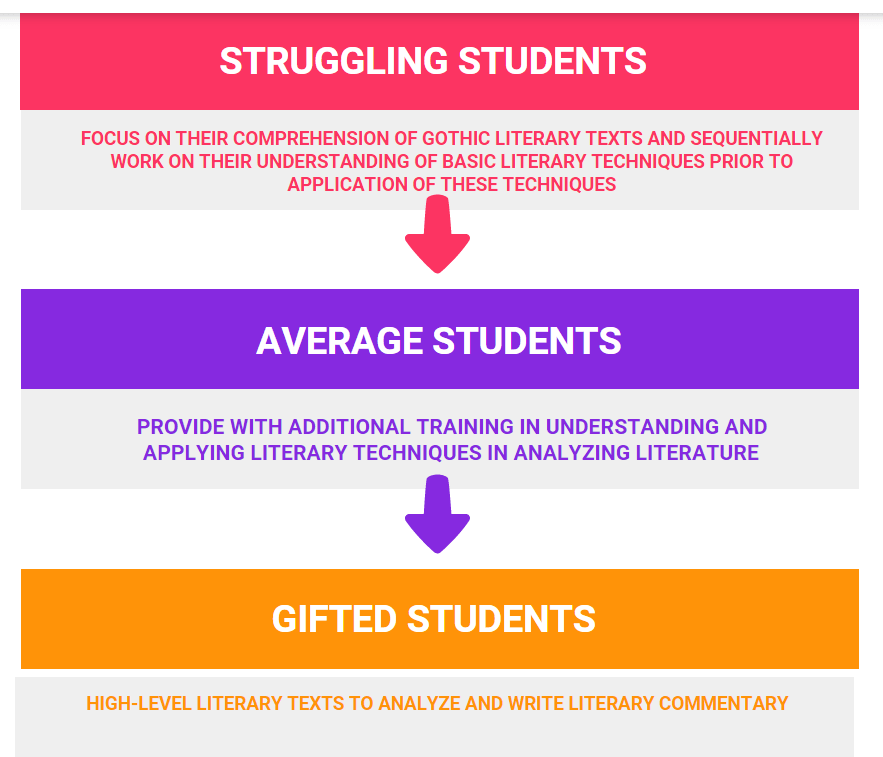
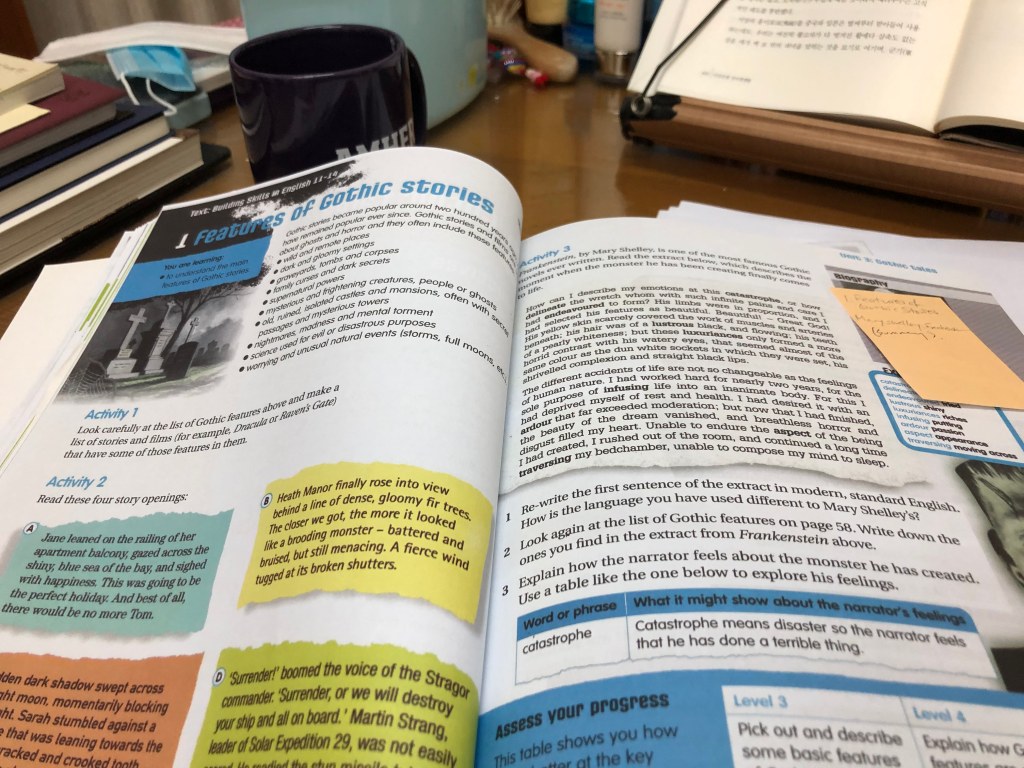
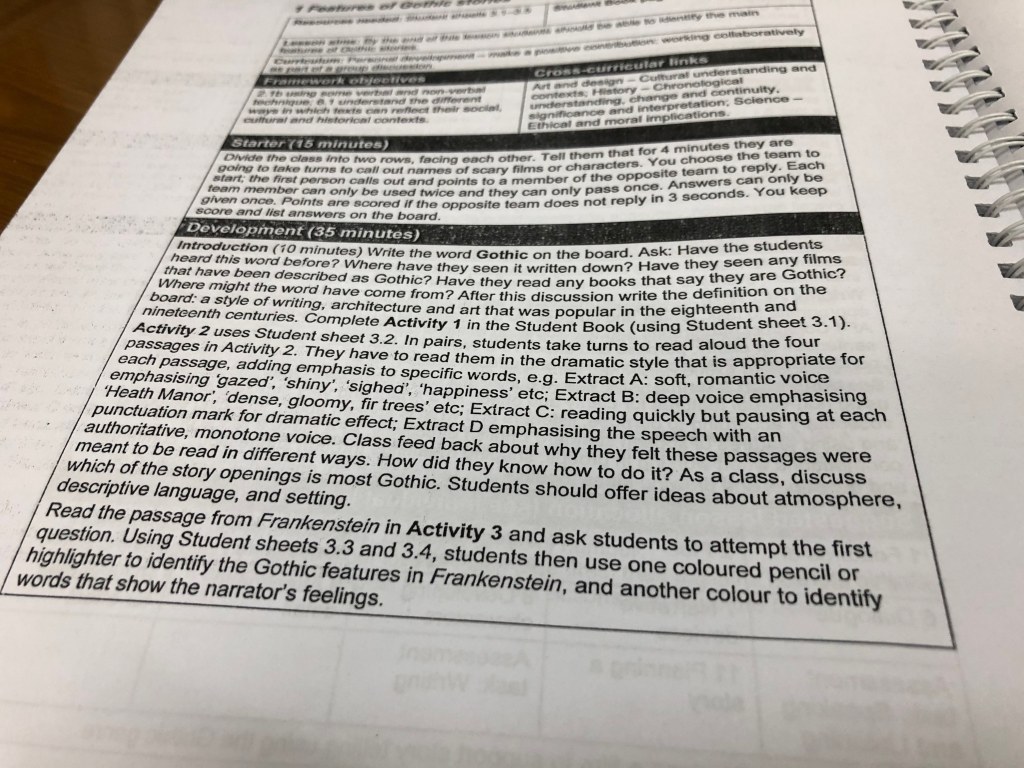
I would like to be using the teaching material that I would be using while working as a Secondary English teacher starting soon at an international school in Yangon, Myanmar called International Language Business Center (ILBC) which uses the IGCSE curriculum. I would be using the chapter on Features of Gothic Stories from the textbook in order to complete this assignment. For the pre-assessment exercise, we would be looking at various Gothic literature and films that they watched concerning the genre (Mary Shelley’s Frankentstein, Edgar Allan Poe’s Poems and short stories) and appropriate literary devices (setting, motifs, characterization) as part of the pre-assessment exercise. In this assignment, our assignment would be differentiated to include three types of students: the gifted students who are excelling in the topic, the students who have knowledge yet show room for critical thinking skills in the topic, and students who may be struggling as they are trying to keep with the work. And as to cater to the needs and learning patterns of all three types of students, differentiated learning would be made: the gifted students would be given passages from these Gothic literature texts to analyze with the expectations that they already are familiar with the literary techniques and can apply these techniques to analyze the given passage and complete writing a commentary paper (literary analysis). As for the second group of students, they would be given Gothic literature texts, yet since they require additional training in literary analysis, they would be provided with sample papers on how to do literary analysis and would be reading and mastering these skills in order to apply them at a more extensive level to analyze Gothic literature texts using the literary techniques. For those students who may be struggling, they may be given Gothic literature to first or all comprehend these texts first hand, and then given sequential training in learning and acquiring these literary techniques, and then using these literary techniques to be analyzing the literary texts. Sequential training would be provided to these students in the third tier.

Module 5 Unit 4 Activity 2: Designing Differentiated Assessments

  1. Select a student with special needs and one ELL student from your classroom or from a case study. Specify both students’ reading level. Describe the special needs student’s learning disability or difficulty either from a clinical diagnosis or from your own observations.
  2. Write or select an assessment in your subject matter and create two alternate assessments using vocabulary from the appropriate reading level of the two students so that you are only assessing the concepts of the subject matter that you are teaching. If the student has an IEP (individualized education program), refer to it while creating the assessment.
  3. Write a brief summary of the changes you made to the original assessment, explaining reasons for change.
  4. Make a note of the following as applicable:
    1. Special provisions for the student within the test
    2. Special considerations while delivering or administering the test
  5. Peer review at least one other cohort member’s alternate assessments for an ELL student as well as a special needs student. Leave your feedback comments on your peer’s activity submission page.

The assessment that we would be taking a look at for this given assignment would be The Giver Assignment, where students in grade 7 of International School of Yangon were given an assignment where they had to analyze the book and complete the assignment where they were to imagine and construct a utopian community in the project where they had to design and construct the five main sectors of a given community/country: government, education, family, and employment & money. The assignment had been inspired by the book where a dystopian community with authoritarian government system had been depicted with various restrictions and hypocrisies such as euthanasia, infanticide and various systematic injustice in how the government is ran. And so the students had to imagine for themselves in this project where they had to write about various components within the country including government, education, family, and employment & money, trying to imagine for themselves what an ideal, utopian community would look like as opposed to the dystopian community that The Giver depicts.

Perhaps, given the nature of these two students (ELL student and student with cognitive or physical disabilities), I would be altering the assessment by perhaps changing the nature of the project by making it more first-dimensional by making the project analyze the dystopian elements of the world that The Giver depicts. So rather than having to take the next step to construct for themselves an utopian community, they would be given the choice to analyze the dystopian nature of the community depicted in The Giver as we have discussed in class rather than having them come up with themselves a completely new utopian community that they have to not only imagine for themselves but also write extensive paragraphs and reports concerning about. Yet, I would have this be optional, as the creative writing assignment might be easier for students to complete as opposed to the dystopian community analysis of the book, though would only require them to synthesize what had been taught during class. And so, the students would have the option, but perhaps what would be differentiated would be the assessment rubric that would be provided to the students where they would have lower expectations in order to score points on a given rubric, where their relative language drawbacks would be accounted for while making assessment on a given rubric. Perhaps their progress and growth would be prioritized over absolute standards and assessment scores, in order to provide incentives to their learning and growth. (The reasons would be supported by my own personal encounters with an ELL student I have had while instructing them on this The Giver Project while working as a personal tutor)

And as for the differentiated assessment for this given project, I was able to work with an ELL student where I was able to instruct her on the use of vocabulary and encourage her how she has all the ideas within her, but that her ideas have to be formulated into sentences and arguments that the student might feel less confident in doing so. Being a self-assertive, creative and bold young lady, I see great potential in her ability to learn and lead her peers, yet her relative shortage in English compared to her peers which put her in a state of disadvantage when it comes to articulating her ideas could come as a setback in her self-expression, and hence I try to encourage her as much as she can that she has all the answers within her, and she has those creative ideas yet her hesitation to make bold attempts might be hindering her from completing her assessment. Hence, when it comes with ELL students, not only grammatical help and help with articulation of ideas and formulating ideas into sentences but also teachers’ belief in the students’ ability to succeed and thrive in the school environment. Both emotional and technical help and support is necessary when it comes to ELL students.

For students with disabilities, due to my short experience in the field of teaching, I haven’t had direct encounters and first-hand experiences with any of the students with physical, or cognitive disabilities. And the schools and academies I have worked at did not have any students with physical or cognitive disabilities. I had had an interview to work as a shadow teacher for one of the students at school who had mild symptoms of dyslexia. And from the very limited experience I have had, I can only imagine that similar principles would apply for students with disabilities but only in a more extensive level where both emotional and cognitive support and help would be necessary especially as they may be encountering difficulties understanding the assignment and potentially could be encountering problems working together with other students. And hence the teachers’ role as both mentors and coaches in helping them with their cognitive abilities as well as their social, emotional well-being and success.

The Giver Utopian Community Project (This is the sample of what we worked on)

We read about a book named “The Giver” that discusses the dystopian community. A dystopian community is a community with problems like a country that is unfavourable. For this essay it is about the utopian community, which is a community with no problems or with increased freedom than dystopian. There are many components that make up the community, they are government, Education, Family, Employments, and Money. 

Government
First of all, the government is the most important component that helps make up a good community. In my utopian community it is a democracy which means that people in the community are able to vote for a person that mostly fits to become part of the government of the country. In the community, people that are in parliament make laws by talking with each other and if citizens have dissatisfaction with the laws of the country then they will have a discussion about the laws to decide if they need to change the laws for the country. In the utopia community there are 6 laws; no litter or trash throwing on the street, no bullying, no criminals, no ( eating, using, harming ) animals and plants, clean streets, no throwing trash on flow. Role of the police is to watch out if citizens break the laws of the community and decrease the criminals and breaking laws by finding them if they had broken the law. Police decide with a lawyer if the criminal should go to jail or not depending if it’s a big crime or small crime. 

Education
The second component that makes up the community is Education. Education is a first step for children to learn how the community works and how people need to treat other people like learning about courtesy. In the utopian community, children in this community only have to come to school on Saturday and Sunday. There could be good reasons and bad reasons for going to school on Saturday and Sunday only. A bad reason is if students come to school only Saturday and Sunday their school progress would be slower than others and students will get more homeworks for 5 days no school, and the good reason that 2 days for school is because sometimes student get stressed for going to school and if they come school only for 2 days and homeworks for 5 days it could be less stressful than 5 day school and homework. 

In my utopian community there are 3 buildings for one school. They have elementary, middle school and high school. On Friday they don’t go to school but they have volunteering, and helping children that need help or provide food for them. On school days, Saturday and Sunday for lunch they provide food in the cafeteria for free and there are some sports matches from different schools for example Volleyball, Badminton, Soccer, and other more. There are some events like the Olympics like our school, International day when people wear their traditional clothes and share their cultures to other and Band concerts, when children practice their parts and play their parts on the stage and other more events that build relationships between different classes and to build school spirit.

Family
The third component that makes up the community is Family. Family is the most important thing in this community. In this community the family is controlled by both the mother and father. There would be 100 different apartments and two villas. A swimming pool would be in the town center. And there would be restaurants with international cuisine like you could find on an international day. The houses would be kept the same in order to have it be equal among different people living in the neighborhood. 

Employment & Money
The Last component that makes up the community is Employment and Money. In this utopia community there are important jobs like lawyers, doctors, police, teachers, fire fighters, movie directors and businessmen. The lawyers would be defending the rights of people in the courts. They will first have to go to law school in order to become a lawyer. They will be going through an interview process at the court to be a certified lawyer. The doctors would be curing patients in the hospitals and they will be picked through the interviews and they will have to graduate from medical school and go through internship and residency in order to work at the hospital as a doctor. They will have to work in the hospital for a couple years to become a real doctor. 

The teachers would be teaching students at school and they will be picked by the school through the interview process. The right teacher who has studied English, Math or what they are teaching in college or grad school would be needed for the job. And they would be chosen based on their knowledge and skill, and type of experiences they had in other schools. The people will be trained through online teaching programs and colleges that train teachers for schools. The fire fighters would be putting off the fire in emergency cases and they will have to go through many different practices of putting off the fire in many houses for them to become real firefighters working at the fire station. And they would have to be really brave and courageous in order to work at the fire station. 

The businessmen would be running business and they will be going to business school or learning from their own parents how to do business. They will have to learn from books as well as other people in the companies in order to run a good business. The people who will make good businessmen will be people with best personal skills and relationships. In this utopia community people choose their job that mostly fits to themselves. They get trained with their job from 13 years old to 18 years old and they get kind of a test and teachers decide if they could do their job or they need to get trained more. 

Module 4 Unit 5 Activity 1

  1. Explore various digital tools from the list below, from recommendations by teachers, and from your own research for managing classrooms and monitoring student behavior. Some potential technology tools include, but are not limited to, the following:
    • TeacherKit
    • Too Noisy Pro
    • Super Duper Data Tracker
    • Teacher’s Class BEHAVIOR Free
    • Class Dojo
    • Stop-Go
    • Best Sand Timer
    • Instant Classroom
    • Smart Seat

The two digital tools I have chosen to review are Best Sand Timer and Class Dojo. As for Best Sand Timer, the application would come handy with exercises and assignments that need to be completed under time constraints. Hence, any type of presentation, piece of writing that need to be completed under certain of time could be time using the application on an iPad, iPhone or relevant device. Yet the cons of the application could be that there are not that many usages that the application could be used for other than for the use of timing in comparison to other applications that might serve multipurpose. And the other I would like to review would be Class Dojo. When I signed into the application with the school that I would be start working at starting June, there were 10 other teachers who were already signed up to the application. The application was really intriguing in that you could be awarding points for various characters (students) and these point system would be reported back to parents for reflection and assessment of student behavior in classrooms. I have found such interactive and fun application to be actually really effective in terms of providing feedback to both parents and students and there was also the option of reporting just the positive points being rewarded, as worrisome behaviors would be better reported in letters or emails or in person, rather than in point systems being reported back to parents. The application could be also effective in collecting and tracking students’ behavior and progress, and hence good way to be monitoring students’ behavioral data for a given period of time. And this application would be especially effective for students who have behavioral concerns and issues (who we have tried to address in previous assignments) where point system/reward system was being made to compensate for any behavioral changes or positive behaviors they were engaging in the classroom. These applications would be really effective in collecting, tracking and monitoring those students’ behaviors and students would also gain momentum and interest in being part of a point system where they are being rewarded points as if they were playing a game, and hence would gain more incentives and momentum to be changing their behaviors in order to gain those points within the application. (as they would be sent to the parents)

  1. Comment on at least two peers’ tool reviews, preferably of peers who reviewed different tools than you. Ask questions of your peers to determine if the tools they reviewed would effectively collect, track, and monitor student behavioral data. 
  2. Complete item number six, Management Technology in your Learning Environment Management Plan.

Plan for Managing the Learning Environment

  1. Management Technology: Technology can improve the way you manage the learning environment by helping save instructional time, track trends in student behavior, create lines of communication with families, and even empower students to take leadership roles. Integrate some technology tools for managing the learning environment into this planning document and explain how you plan to use each. 
tManagement Technology
TechnologyRationale and Use
Class Dojo I will use Class Dojo to reward students for their positive behaviors and also to promote certain behaviors in classroom that align with the classroom culture and norms of the classroom. For instance, students would be rewarded Teamwork points every time they would be seen helping other students out, and this would be a perfect example of how I could be promoting a classroom culture and norm using the application.
Class DojoClass Dojo could also be used to encourage students with behavioral problems to engage in positive behaviors using the reward system. The application would be effective in collecting, tracking, and monitoring behaviors of these students and informing positive behaviors to their parents.
Best Sand TimerI will make use of Best Sand Timer for written assignments that need to be completed under time constraint. And I will make use of the application also for timed answers or presentations that need to be completed under time constraint. Quizzes and tests could be also completed while using Best Sand Timer.

Module 3: The Learner and Learning in a Digital Age Unit 2: Learning in a Digital Age

Student Case Study (Student R)

Background: 

R is in 8th grade and she has recently moved school as her family has moved to the country due to her dad’s work. English is her second language and she requires extra work with grammar, writing composition.

Targeted Behaviors:

To be able to complete her assignments on time.

To articulate her ideas and arguments logically and comprehensibly.

Student Strengths:

Has innovative ideas and eager and quick to learn.

Desired Outcome

Confidence in English

Forming sentences and paragraphs following grammatical rules

Environment 

An encouraging environment where she can receive help from other students or teacher (me) about vocabulary or sentence writing

Procedures

Provide more extensive comments and feedback for Y’s papers, annotating all the grammatical errors and how she could improve them.

Correcting any misuse of words, or providing synonyms as necessary.

Providing her with extra grammar books and vocabulary books for extra work if requested by the parents during parents teacher conference.

Complimenting and rewarding her for her improvement and raising awareness that students with English as second language all go through similar processes and showing successful cases where they have achieved mastery in English.

Providing opportunities for editing her work and resubmitting them for extra credit.

Providing extra reading and writing assignments from class library as necessary for topics requiring additional practice.

Instruction

Make efficient use of class or your own dictionary and thesaurus in completing assignments.

Ask questions for clarification even if after class for additional explanations regarding assignments if any.

Write rewrites incorporating comments and feedback for additional points to be provided for the assignment.

L is in 6th grade and she has recently moved school as her family has moved to the country due to her dad’s work. English is her second language and she requires extra work with grammar, writing composition.

Targeted Behaviors:

To be able to complete her assignments on time.

To articulate her ideas and arguments logically and comprehensibly.

Student Strengths:

Has innovative ideas and eager and quick to learn.

Desired Outcome

Confidence in English

Forming sentences and paragraphs following grammatical rules

Environment 

An encouraging environment where she can receive help from other students or teacher (me) about vocabulary or sentence writing

Procedures

Provide more extensive comments and feedback for Y’s papers, annotating all the grammatical errors and how she could improve them.

Correcting any misuse of words, or providing synonyms as necessary.

Providing her with extra grammar books and vocabulary books for extra work if requested by the parents during parents teacher conference.

Complimenting and rewarding her for her improvement and raising awareness that students with English as second language all go through similar processes and showing successful cases where they have achieved mastery in English.

Providing opportunities for editing her work and resubmitting them for extra credit.

Providing extra reading and writing assignments from class library as necessary for topics requiring additional practice.

Instruction

Make efficient use of class or your own dictionary and thesaurus in completing assignments.

Ask questions for clarification even if after class for additional explanations regarding assignments if any.

Write rewrites incorporating comments and feedback for additional points to be provided for the assignment.

Module 5 Unit 2 Activity 1: Assessing Project Based Learning

Project Objective: To research about a recent current events topic and make a presentation about the topic as a group to present during class.

Project Description: The project would involve researching in depth about the chosen current events topic of choice and creating a creative presentation involving powerpoint, videos, movies, role plays, visuals, posters or any other visual elements to best embody the collected research. The project would be geared towards students from 6th to 8th grade. Students would have three weeks to prepare for the final presentation.

Monitoring Plan: Students would have three weeks to prepare for the final presentation, and students would be given class time during the week (three blocks) to prepare for the presentation as a group. We would be going over expecations and the rubric as a class, and clarifying any points of questions concerning the expecations of the project. And class time would be dedicated towards group work and collaboration where students would bring in their individual research and merge with one another to create the final presentation material for the final presentation at the very end. Hence the instructor (I) would be there to rotate around different groups and also to help answer questions if there arise any. They would be instructed to check regularly with the rubric if they are meeting all the requirements and expecation of the project as well.

Feedback Plan: The feedback plan would include students assessing one another with their group project (peer evaluation) as well as the evaluation that the instructor (I) would be providing. The peer evaluation would also be based on the same rubric I would be using, and would also include written comments students have for the group. I would be individually meeting with each group to discuss their achivements and room for growth with each group and also provide them with peer evaluations they have received from their classmates. And lastly, they would be having to provide group work self-evaluation of how well the group worked as a team, and what they think each member including themselves have contributed towards the project to ensure that the grades they are receiving are fair, and everyone has contributed more or less equally to the completion of the final piece of work.

Oral Presentation Rubric : Current Events Group ProjectTeacher Name: Ms. Maing


Student Name:     ________________________________________
CATEGORY4321
ContentShows a full understanding of the topic.Shows a good understanding of the topic.Shows a good understanding of parts of the topic.Does not seem to understand the topic very well.
PreparednessStudent is completely prepared and has obviously rehearsed.Student seems pretty prepared but might have needed a couple more rehearsals.The student is somewhat prepared, but it is clear that rehearsal was lacking.Student does not seem at all prepared to present.
Collaboration with PeersAlmost always listens to, shares with, and supports the efforts of others in the group. Tries to keep people working well together.Usually listens to, shares with, and supports the efforts of others in the group. Does not cause \”waves\” in the group.Often listens to, shares with, and supports the efforts of others in the group but sometimes is not a good team member.Rarely listens to, shares with, and supports the efforts of others in the group. Often is not a good team member.
ComprehensionStudent is able to accurately answer almost all questions posed by classmates about the topic.Student is able to accurately answer most questions posed by classmates about the topic.Student is able to accurately answer a few questions posed by classmates about the topic.Student is unable to accurately answer questions posed by classmates about the topic.
Speaks ClearlySpeaks clearly and distinctly all (100-95%) the time, and mispronounces no words.Speaks clearly and distinctly all (100-95%) the time, but mispronounces one word.Speaks clearly and distinctly most ( 94-85%) of the time. Mispronounces no more than one word.Often mumbles or can not be understood OR mispronounces more than one word

TEACH-NOW MODULE 5 UNIT 1 ACTIVITY 1

  • Identify three formative assessments that are appropriate for the grade level and subject you are or will be teaching. For example, write an exit ticket for a lesson you will be teaching your students during your clinical practice.

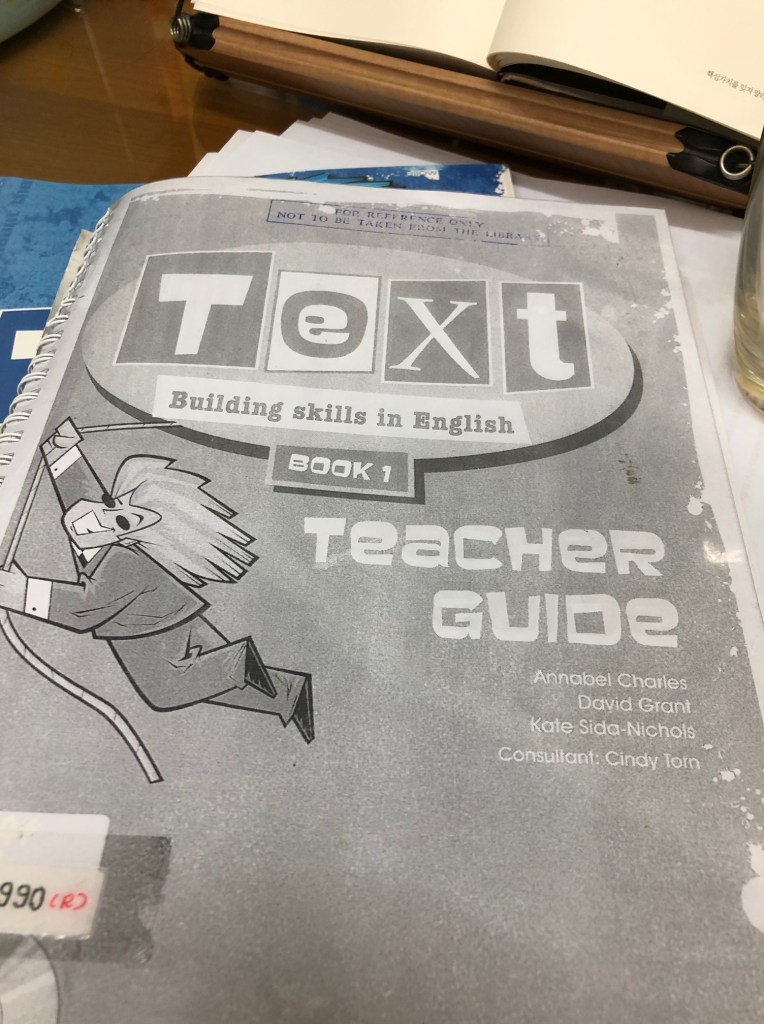
I will be working as a Secondary English teacher starting June at an international school in Yangon, Myanmar called International Language Business Center (ILBC). I was able to meet the respective department heads and chair of English department and received the Student Textbook and the Teacher’s Guide from the school library to prepare for classes in the mean time. I would be using the chapter on Features of Gothic Stories in order to complete this assignment. The three formative assessments I have chosen for this assignment are opening exercises, 3-2-1 countdown exercise, and exit questions. For this Chapter 3, Section 1 Exercise, we would have to be looking at literary devices such as “wild and remote places” (setting), “graveyards, tombs and corpses”(motifs), mysterious and frightening creatures, people or ghosts (characterization) And so for the opening exercise, I would ask the students to think of Gothic stories and/or films they have encountered, and apply these literary devices to these stories and films (Activity 1 of the textbook). And for the second formative assessment, I would be using the 3-2-1 countdown exercise where the students would write about 3 things they didn’t they didn’t know about the nature of Gothic literature and pertaining literary devices, 2 things that surprised them, and 1 thing they could be applying with what they have learned. And for the exit question/essay, I would have them, I would have them read through a passage of a piece of literature (Frankenstein or Edgar Allan Poe’s poem) and apply some of the literary devices they have been studying to understand and analyze the passage/poem as a whole.

Write a description of what you are trying to find out from giving each assessment and how you will determine if students understand the material. Make sure you include the grade and subject area and the corresponding literacy skills assessed. The description should also answer the following questions:

  1. “How will you use the results of this assessment to plan future instruction?”
  2. “How will you modify the assessment to meet the needs of English language learners and special education learners?” You can assume at least one ELL student and one student with special needs in the classroom.

I am trying to test their understanding of literary devices and how they could be applying these devices in order to better understand pieces of Gothic literature for secondary students. I would use the results of this assessment to assess whether they require additional coverage of the literary devices and/or the genre of gothic literature, and see what are the places where students are struggling with in terms of their understanding of various literary devices, or their ability to apply the literary devices to the given Gothic piece of literature. After assessing what the repeated question or room for growth would be, I would design handouts/class lecture on topics that would require additional information and explication.

If there are English language learners and Special education learners who might require additional information or explication of the given material, I would try to individually consult with them and answer any questions that might arise in the process. I might try to encourage use of dictionary for the English language learners to find words that might be confusing or difficult for them in the given passage, and for the special education learner, depending on their specific needs, I would try to cater to their needs on an individual basis.

  • Use an assessment tool such as Kahoot or Edpuzzle to demonstrate at least one of the three identified assessments.

I would use Kahoot to make questions for various Gothic literature and writers that the students might be familiar with. And so for each question, I would have either photos of the relevant writers or books and try to test their general understanding and familiarity with the given literary genre.