
English Life Graph ILBC Online Learning
English Life Graph 영어 인생 그래프 작성해보기📝
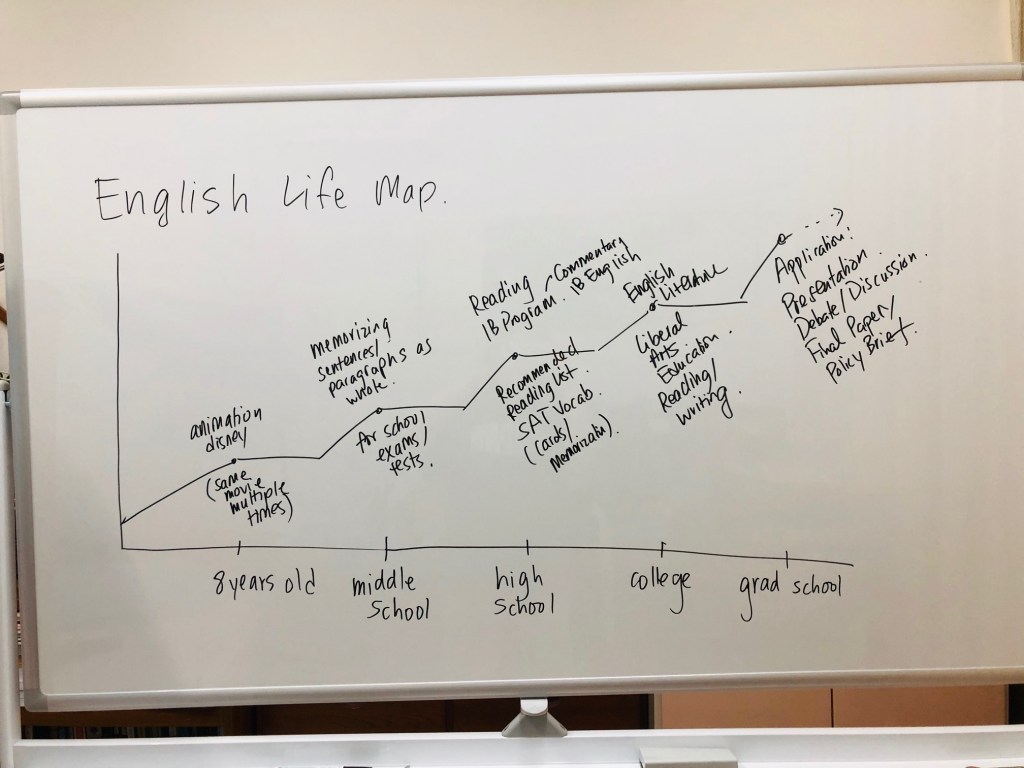
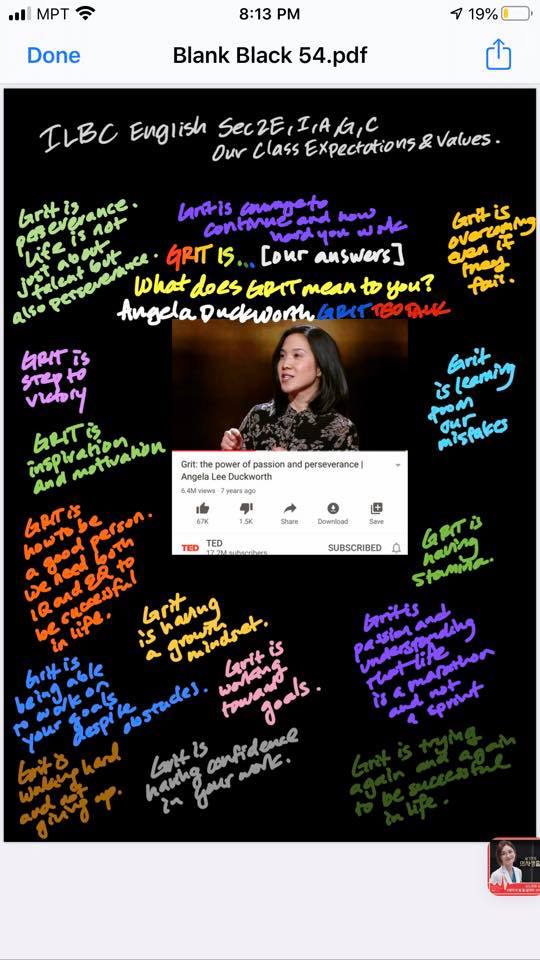
함께 영어 공부 해요~! 오늘은 학교에서 영어 인생 그래프를 그려 보는 시간을 갖었어요. 내가 언제 영어를 잘하게 되었는지 어떻게 하면 영어를 잘하게 될지 함께 토론하는 시간을 갖었어요.
처음으로 영어를 배우는 사람이라면 같은 영화를 여러번 반복해서 보는 것을 추천하고,
그 다음 학교에서 보는 여러 영어로 하는 시험 과목들을 문장과 문단을 외워 보는 방법으로 문장 구조나 문단 구조를 익히는 방법을 사용하며,
그 다음은 학교에서 공부하는 수업 내용으로 영어로 독서와 글쓰기를 연습하며 여름 방학때는 선생님께 추천독서 리스트를 받아 방학때도 독서를 끊임없이 하는 방법을 나누어 보았는데요.
그리고 학교에서 방과후 활동으로 하는 MUN이나 학교 교내 잡지등에 활동함으로 인해서 글쓰기나 스피킹 연습 또한 할 수 있는 방법을 제시해 주기도 하였어요.
또한 학원이나 과외등 개인적으로 SAT시험등을 준비하고 있다면 Reading을 위해 여러가지 Science, Social Science 지문들을 많이 접해보고, Writing을 위해 시험에 나오는 문법 유형을 공부하고 모의고사를 풀어보며 학교 공부에도 도움이 될 단어들을 외우는 방법들을 추천해 주었는데요. (이내용은 다음기회에 더 자세히 다루어보도록 할게요)
그 다음엔 학교 과제나 레포트, 리서치 발표등 계속해서 연습을 해나가는 것이 영어 실력향상에 핵심이라는 점을 강조해 주었어요.
함께 영어 인생 그래프를 그려보며 나의 현위치 또한 내가 달려가야할 목표점을 세움으로 인해 함께 영어 실력을 향상해 보아요~! We were able to share today at school about our individual English Life Graphs where we shared experiences of how we have come to enhance our skills in English.
For beginners, start by watching movies or videos repetitively.
After that, start memorizing all the class material you have for exams (including all subjects) and this would greatly enhance your English skills.
Read and write continuously through your English curriculum at school and ask for recommended reading list from teachers where appropriate. (Summer reading list)
Join extracurriculars like MUN or school magazine to improve on your writing and (public) speaking skills where appropriate.
Where appropriate, when studying for exams like SAT through private tutoring or attending academy or on your own, not only be reading more articles to be improving on your reading skills for the Reading section or studying grammar for Writing and be studying vocabulary to improve on Reading and your overall English skills for school as well.
And overall, presentations, more of reading and writing like research and report writing will help enhance your English to the next level.
Try drawing English Life Graphs for yourselves and setting goals to be improving on your own English skills!
#영어 #영어공부 #온라인수업 #학교 #ILBC #열공 #English #onlinelearning #School #인생 #그래프 #Life #Graph
Teach-Now Unit 3 Module 6 Activity 1
Lesson Plan
Teacher Candidate: Ye Won Maing Date Lesson Taught: 2020-05-28
Name of Mentor: Cheryl Waters
Lesson Title: GRIT Discussion Activity
Grade Level and Course: Secondary 2: English
Time Segment of Lesson: ___60______ minutes (Edit video to 10-15 minutes)
Standard(s) Addressed in Lesson:
Objective(s) of the Lesson: Students will be able to … articulate their ideas on what GRIT means to them with reference to their personal experiences or experiences of those people for whom GRIT has been an integral part of their lives.
Vocabulary (and other literacy skills): Perseverance, resilience, autonomy, risk-taking (note-taking skills, forming their ideas into articulate sentences, public speaking skills, presentation skills, writing essay skills)
Student Diversity and Differentiation of Instruction
| Student Diversity | Differentiation of Instruction |
| Students with English as Second Langauge | Relevant expectations when assessing their written skills; understanding of their vocabulary or maneuvering of language when it comes to understanding their ideas |
Formative and Summative Assessments
| Formative Assessment | Summative Assessment |
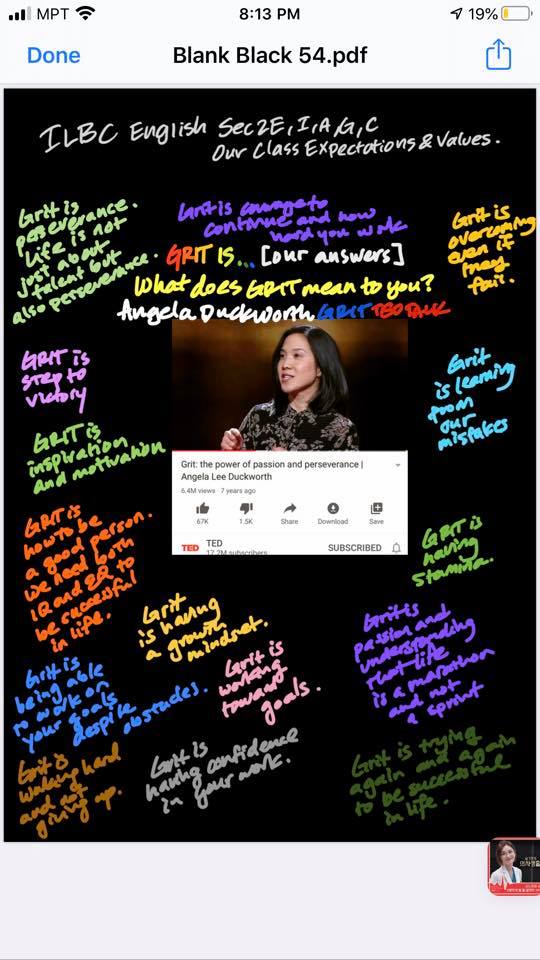
| Students will be annotating the video while watching Angela Duckworth’s Tedtalk on GRIT | We will come up with a group work of GRIT wall where we will compile every one’s ideas on the notion of GRIT and set it up as set of class expectations and norms for class. |
| Students will be sharing to the class what they make of the idea of GRIT after having watched the video twice | |
| Students will submit a written assignment on GRIT as their final assessment |
● If there is no summative assessment in this lesson, what/when will the summative
assessment be/take place
Big Ideas to be Addressed in the Lesson: The notion of GRIT, perseverance and resilience as characteristics leading up to success
Discussion Questions
Write out questions that you would like students to discuss in class, before class or after class because they are interesting, support higher order thinking, and make for a lively and engaging discussion. If discussions must happen outside class, what tool will you use to facilitate the discussion (e.g. Twitter)?
I would like students to discuss what are Angela Duckworth’s ideas and what do you make of them? What does GRIT mean to you and will you say GRIT has impacted your life in some way, or have you had people around you who have shown GRIT in their lives who have inspired you, and can you think of successful people who have been able to achieve success by exemplifying GRIT in their lives?
21st Century Knowledge and Skills
| 21st Century Knowledge and Skills | Teaching Strategies |
| Critical Thinking | Students will be using critical skills in order to apply the notion of GRIT onto their lives or other peoples’ lives. |
| Collaboration | Students will be listening to one another’s opinion and thereby practicing collaboration. We will also come up with class norms and expectations for our class as a group to come up with what GRIT means to us as a class. |
| Technology Literacy | Students will be expected to annotate the video, and also use technology to be typing up their written assignments on GRIT and submitting their assignments on the ILBC Microsoft Teams platform. |
Teaching Strategies and Related Student Activities (Include Web 2.0 activities as appropriate):
Preparing the tedtalk in advance and screen sharing the ted talk and making sure subtitles are on for the students who have English as their second language.
Making sure that the audio function is working ahead of time for the online platform.
Providing sample responses and essays from previous students in the chatbox for them to be able to read and prepare their own responses for their individual responses and public speaking.
Teaching Strategies and Activities: What are the teaching strategies and activities that you plan to use to help students meet the lesson’s objectives? What are the steps that you will take to deliver this lesson (e.g., introduce the author, read the poem, ask students to…)?
Teacher/Student Input: Write a note on what you expect the teacher and students to do as a part of this activity. Include a note on whether this is an “I do it”, “We do it” or “You do it” type of activity.
“I do it”
Introduce to them what the talk would be about. Introduce Angela Duckworth, her study and significance of her study, and what students would be paying attention to while listening to her talk.
Play the video twice for them to fully comprehend and absorb the material.
Ask questions on what they made of the video, and what they make of the quality called GRIT
You do it:
Take notes on what Angela Duckworth is arguing concerning the notion of GRIT. Prepare your individual responses on the notion of GRIT.
We do it:
As a class, make presentations on what they make of the notion of GRIT.
We will come up with a GRIT Poster we will have on our wall where we come up with class expectations and values on what we think of GRIT and attitude we should have towards learning as a group.
Review: Write down ideas on how you will review the topic, including notes on types of formative assessments that you will use during the lesson.
As final part of the activity, they will be assigned to write an essay concerning the notion of GRIT where they will be referring to individual reflections on their lives and experiences of various people who have exemplified GRIT to achieve their own kind of success in their lives. They will be assessed on their critical thinking skills, and also the development, organization and logic of their arguments.
Materials and Resources for Lesson
| Materials, Technology, and Websites | Required Preparation |
| Microsoft Teams: The school online learning platform | checking with the IT department if there are any other errors |
| Link of the tedtalk, making sure the audio works and screenshare works | checking with the other teacher on technology |
Use this space to write a paragraph or two discussion how the lesson went. Be honest — you can use this information in your reflections for Module 8.
The activity went more smoothly and effortlessly than as was anticipated. Students were actually very vibrant and eager to be sharing their opinions about what GRIT means to them and informing us of well-articulated, lengthy, prepared responses of what GRIT could mean to people. The level of energy and enthusiasm in class seem to have worn off from Angela Duckworth’s passion and commitment to her research and theory, and students seem to have really bought into and have been inspired by the arguments she had made and the research she had provided to substantiate her stance. Overall, I was really impressed by the level of passion and interest students had on the discussion topic.
Use this space to write notes on how you might change this lesson when you teach it again:
I think I would provide more sample responses of other class and students on what they made of the topic of GRIT. A wider array of responses would enrich the class discussion and allow fruition of a more diverse debate.
References
Module 6 Unit 1 Activity 3
Overall feedback for the lesson would be that the teacher had effectively executed the lesson plan for the pertaining classroom. The level of enthusiasm or attention of the students could have been higher yet the subject matter and the level of difficulty could have been factors contributing to the relatively low energy level within the classroom. But the teacher’s ability to lead the classroom was effective in that he wasn’t distracted by the people moving in and out of the classroom, and had his whiteboard in place in order to explain all the different mathematical concepts that students might have difficulties understanding and acquiring especially if they were to be encountering these concepts for the first time. Also, his calling out of names, and answering questions, and leading classroom discussions by referring to student X or Y as he is answering their questions or commenting on their comments have all been effective ways in which to move the class forward by engaging the students and having them feel like they are part of the class, especially when concerning concepts which might be difficult for the students if they are acquiring these concepts for the first time. Also, though the sitting of the students were not explicitly explained or mentioned, yet the lesson plan had clearly stated that the gifted or strong students would be helping out ELL students or students who might be having difficulties grasping these mathematical concepts, and hence, more peer to peer interactions and making use of the sitting in groups could have been area of improvement if it had not been already done so in the first place. The teaching material would have scored upper-middle score on the rubric if I had been evaluating the class. And since our school would be opening on the 25th with Home Based Learning Program with online classes, I thought having a whiteboard at my home would be an effective way to lead the class, and for students to stay attuned with visuals, since we would not be at school to be making use of the various tools and devices, and concentration and interactions within online classes can be relatively less engaging. Use of the various visuals and visual tools would be effective components of classroom teaching for online classes.
Module 5 Activity 4 Activity 1
- Discuss with your Cohort in the Virtual Classroom and Discussion Forum strategies for pre-assessment and tracking student progress that you have used or would like to use in your classroom or in a topic in the subject area and grade level that you wish to teach.
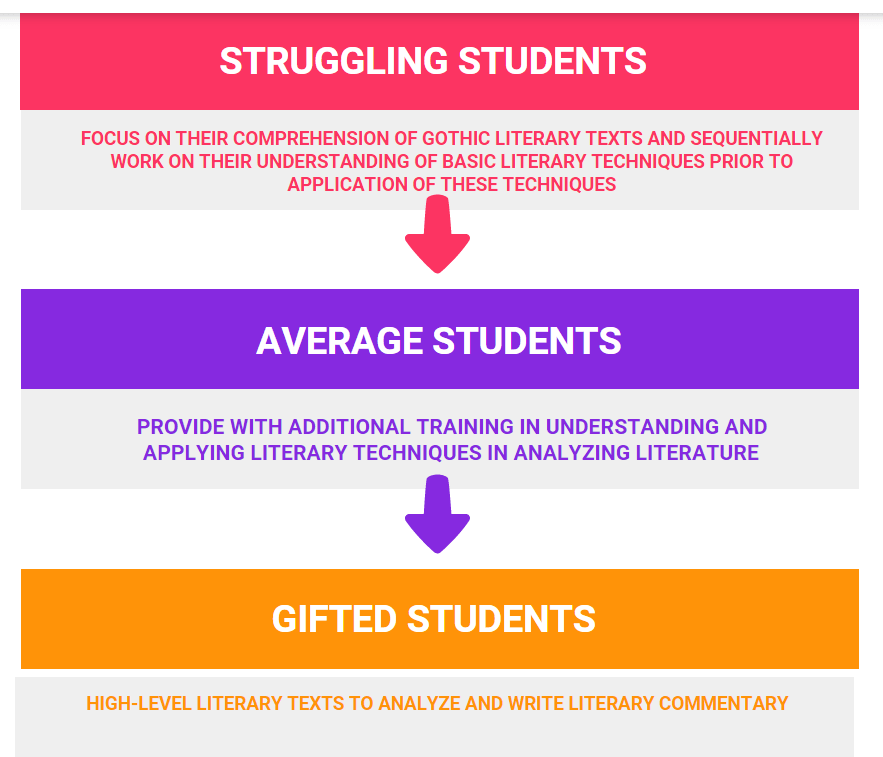
- Create a flowchart or mind map that (a) outlines an innovative differentiation strategy for the three groups of students below (see the article, “Differentiation: It Starts with Pre-Assessment,” in the Activity Resources for an example of an innovative strategy) and (b) identifies the assessments that you will use to track students’ learning throughout the unit:
- the 5 students who answered most, including the most difficult, of the pre-assessment questions correctly
- the 12 students who have some knowledge about the topic as shown in their score, but need to develop higher order thinking skills
- the 5 students who appear to have limited knowledge about the topic, of which 3 are struggling with language and are at different reading levels and 2 students who have little to no comprehension of the the topic and need to be tested further for special needs
- Write a blog post introducing your pre-assessment and the innovative differentiation strategy for the three groups of students described above. Include links or embed your pre-assessment and mind maps within the blog post, to create a comprehensive report.
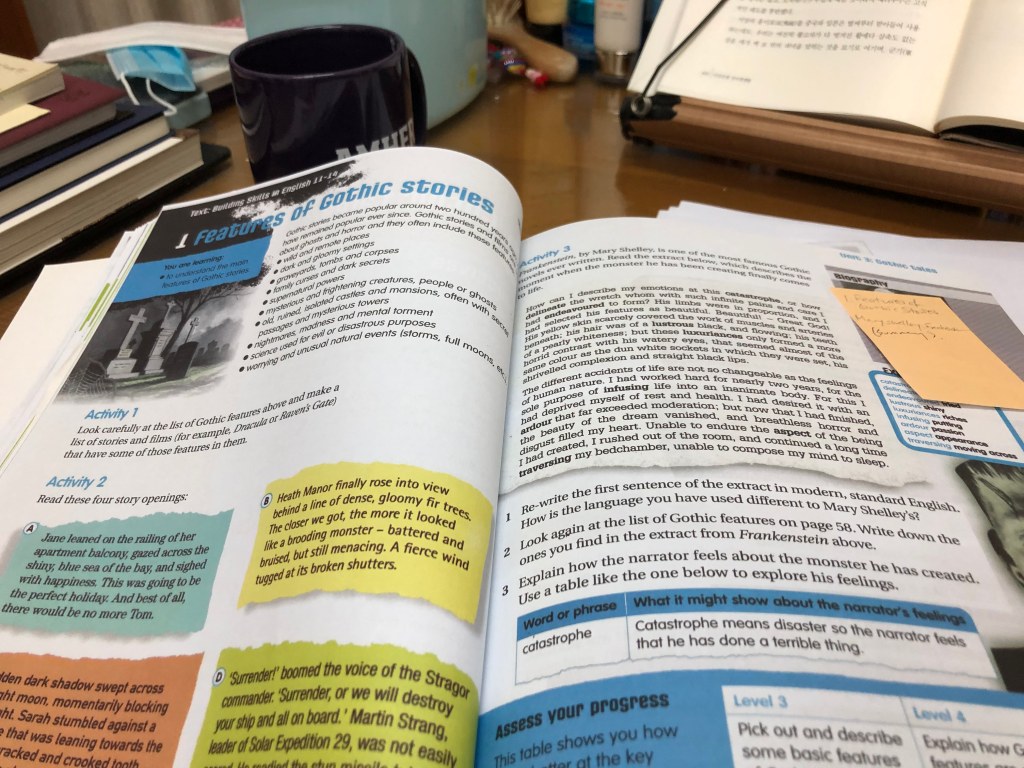
I would like to be using the teaching material that I would be using while working as a Secondary English teacher starting soon at an international school in Yangon, Myanmar called International Language Business Center (ILBC) which uses the IGCSE curriculum. I would be using the chapter on Features of Gothic Stories from the textbook in order to complete this assignment. For the pre-assessment exercise, we would be looking at various Gothic literature and films that they watched concerning the genre (Mary Shelley’s Frankentstein, Edgar Allan Poe’s Poems and short stories) and appropriate literary devices (setting, motifs, characterization) as part of the pre-assessment exercise. In this assignment, our assignment would be differentiated to include three types of students: the gifted students who are excelling in the topic, the students who have knowledge yet show room for critical thinking skills in the topic, and students who may be struggling as they are trying to keep with the work. And as to cater to the needs and learning patterns of all three types of students, differentiated learning would be made: the gifted students would be given passages from these Gothic literature texts to analyze with the expectations that they already are familiar with the literary techniques and can apply these techniques to analyze the given passage and complete writing a commentary paper (literary analysis). As for the second group of students, they would be given Gothic literature texts, yet since they require additional training in literary analysis, they would be provided with sample papers on how to do literary analysis and would be reading and mastering these skills in order to apply them at a more extensive level to analyze Gothic literature texts using the literary techniques. For those students who may be struggling, they may be given Gothic literature to first or all comprehend these texts first hand, and then given sequential training in learning and acquiring these literary techniques, and then using these literary techniques to be analyzing the literary texts. Sequential training would be provided to these students in the third tier.

TEACH-NOW MODULE 5 UNIT 1 ACTIVITY 1
- Identify three formative assessments that are appropriate for the grade level and subject you are or will be teaching. For example, write an exit ticket for a lesson you will be teaching your students during your clinical practice.
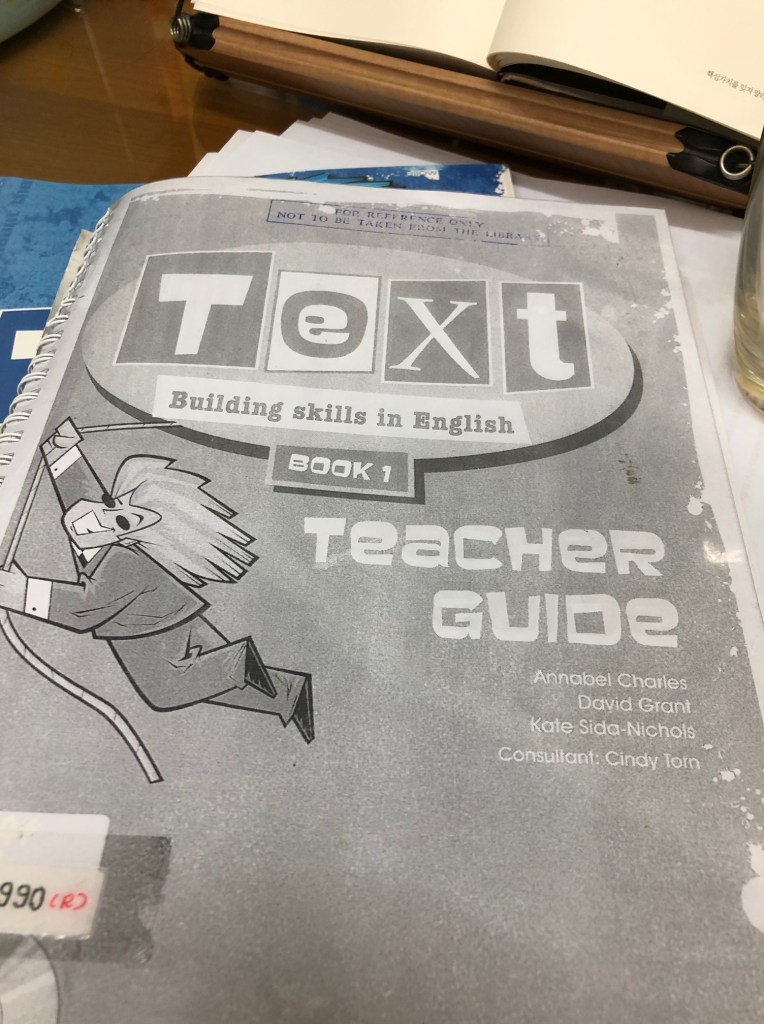
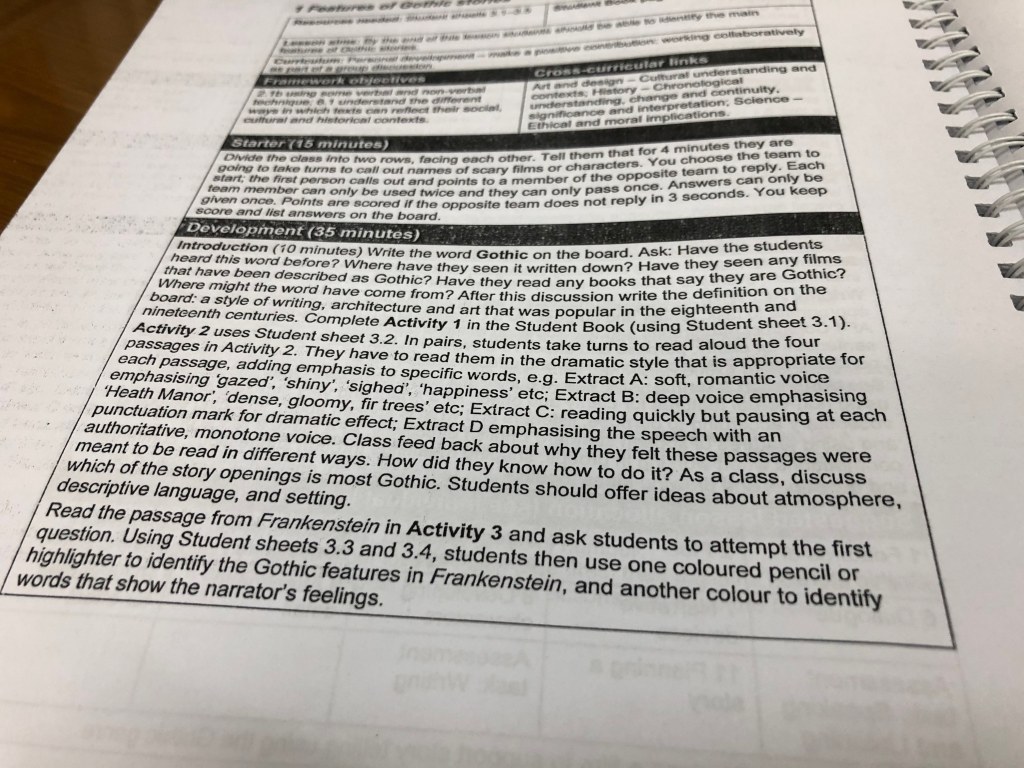
I will be working as a Secondary English teacher starting June at an international school in Yangon, Myanmar called International Language Business Center (ILBC). I was able to meet the respective department heads and chair of English department and received the Student Textbook and the Teacher’s Guide from the school library to prepare for classes in the mean time. I would be using the chapter on Features of Gothic Stories in order to complete this assignment. The three formative assessments I have chosen for this assignment are opening exercises, 3-2-1 countdown exercise, and exit questions. For this Chapter 3, Section 1 Exercise, we would have to be looking at literary devices such as “wild and remote places” (setting), “graveyards, tombs and corpses”(motifs), mysterious and frightening creatures, people or ghosts (characterization) And so for the opening exercise, I would ask the students to think of Gothic stories and/or films they have encountered, and apply these literary devices to these stories and films (Activity 1 of the textbook). And for the second formative assessment, I would be using the 3-2-1 countdown exercise where the students would write about 3 things they didn’t they didn’t know about the nature of Gothic literature and pertaining literary devices, 2 things that surprised them, and 1 thing they could be applying with what they have learned. And for the exit question/essay, I would have them, I would have them read through a passage of a piece of literature (Frankenstein or Edgar Allan Poe’s poem) and apply some of the literary devices they have been studying to understand and analyze the passage/poem as a whole.
Write a description of what you are trying to find out from giving each assessment and how you will determine if students understand the material. Make sure you include the grade and subject area and the corresponding literacy skills assessed. The description should also answer the following questions:
- “How will you use the results of this assessment to plan future instruction?”
- “How will you modify the assessment to meet the needs of English language learners and special education learners?” You can assume at least one ELL student and one student with special needs in the classroom.
I am trying to test their understanding of literary devices and how they could be applying these devices in order to better understand pieces of Gothic literature for secondary students. I would use the results of this assessment to assess whether they require additional coverage of the literary devices and/or the genre of gothic literature, and see what are the places where students are struggling with in terms of their understanding of various literary devices, or their ability to apply the literary devices to the given Gothic piece of literature. After assessing what the repeated question or room for growth would be, I would design handouts/class lecture on topics that would require additional information and explication.
If there are English language learners and Special education learners who might require additional information or explication of the given material, I would try to individually consult with them and answer any questions that might arise in the process. I might try to encourage use of dictionary for the English language learners to find words that might be confusing or difficult for them in the given passage, and for the special education learner, depending on their specific needs, I would try to cater to their needs on an individual basis.
- Use an assessment tool such as Kahoot or Edpuzzle to demonstrate at least one of the three identified assessments.
I would use Kahoot to make questions for various Gothic literature and writers that the students might be familiar with. And so for each question, I would have either photos of the relevant writers or books and try to test their general understanding and familiarity with the given literary genre.
 EduContents