
English Life Graph ILBC Online Learning
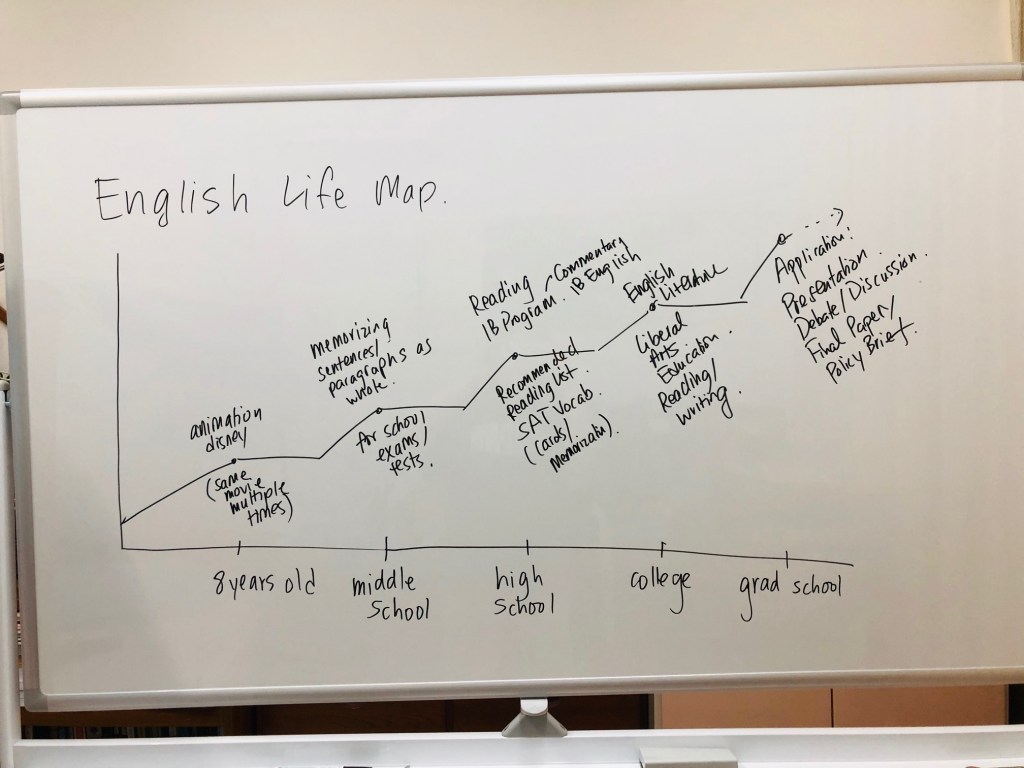
English Life Graph 영어 인생 그래프 작성해보기📝
함께 영어 공부 해요~! 오늘은 학교에서 영어 인생 그래프를 그려 보는 시간을 갖었어요. 내가 언제 영어를 잘하게 되었는지 어떻게 하면 영어를 잘하게 될지 함께 토론하는 시간을 갖었어요.
처음으로 영어를 배우는 사람이라면 같은 영화를 여러번 반복해서 보는 것을 추천하고,
그 다음 학교에서 보는 여러 영어로 하는 시험 과목들을 문장과 문단을 외워 보는 방법으로 문장 구조나 문단 구조를 익히는 방법을 사용하며,
그 다음은 학교에서 공부하는 수업 내용으로 영어로 독서와 글쓰기를 연습하며 여름 방학때는 선생님께 추천독서 리스트를 받아 방학때도 독서를 끊임없이 하는 방법을 나누어 보았는데요.
그리고 학교에서 방과후 활동으로 하는 MUN이나 학교 교내 잡지등에 활동함으로 인해서 글쓰기나 스피킹 연습 또한 할 수 있는 방법을 제시해 주기도 하였어요.
또한 학원이나 과외등 개인적으로 SAT시험등을 준비하고 있다면 Reading을 위해 여러가지 Science, Social Science 지문들을 많이 접해보고, Writing을 위해 시험에 나오는 문법 유형을 공부하고 모의고사를 풀어보며 학교 공부에도 도움이 될 단어들을 외우는 방법들을 추천해 주었는데요. (이내용은 다음기회에 더 자세히 다루어보도록 할게요)
그 다음엔 학교 과제나 레포트, 리서치 발표등 계속해서 연습을 해나가는 것이 영어 실력향상에 핵심이라는 점을 강조해 주었어요.
함께 영어 인생 그래프를 그려보며 나의 현위치 또한 내가 달려가야할 목표점을 세움으로 인해 함께 영어 실력을 향상해 보아요~! We were able to share today at school about our individual English Life Graphs where we shared experiences of how we have come to enhance our skills in English.
For beginners, start by watching movies or videos repetitively.
After that, start memorizing all the class material you have for exams (including all subjects) and this would greatly enhance your English skills.
Read and write continuously through your English curriculum at school and ask for recommended reading list from teachers where appropriate. (Summer reading list)
Join extracurriculars like MUN or school magazine to improve on your writing and (public) speaking skills where appropriate.
Where appropriate, when studying for exams like SAT through private tutoring or attending academy or on your own, not only be reading more articles to be improving on your reading skills for the Reading section or studying grammar for Writing and be studying vocabulary to improve on Reading and your overall English skills for school as well.
And overall, presentations, more of reading and writing like research and report writing will help enhance your English to the next level.
Try drawing English Life Graphs for yourselves and setting goals to be improving on your own English skills!
#영어 #영어공부 #온라인수업 #학교 #ILBC #열공 #English #onlinelearning #School #인생 #그래프 #Life #Graph
Teach-Now Unit 3 Module 6 Activity 1
Lesson Plan
Teacher Candidate: Ye Won Maing Date Lesson Taught: 2020-05-28
Name of Mentor: Cheryl Waters
Lesson Title: GRIT Discussion Activity
Grade Level and Course: Secondary 2: English
Time Segment of Lesson: ___60______ minutes (Edit video to 10-15 minutes)
Standard(s) Addressed in Lesson:
Objective(s) of the Lesson: Students will be able to … articulate their ideas on what GRIT means to them with reference to their personal experiences or experiences of those people for whom GRIT has been an integral part of their lives.
Vocabulary (and other literacy skills): Perseverance, resilience, autonomy, risk-taking (note-taking skills, forming their ideas into articulate sentences, public speaking skills, presentation skills, writing essay skills)
Student Diversity and Differentiation of Instruction
| Student Diversity | Differentiation of Instruction |
| Students with English as Second Langauge | Relevant expectations when assessing their written skills; understanding of their vocabulary or maneuvering of language when it comes to understanding their ideas |
Formative and Summative Assessments
| Formative Assessment | Summative Assessment |
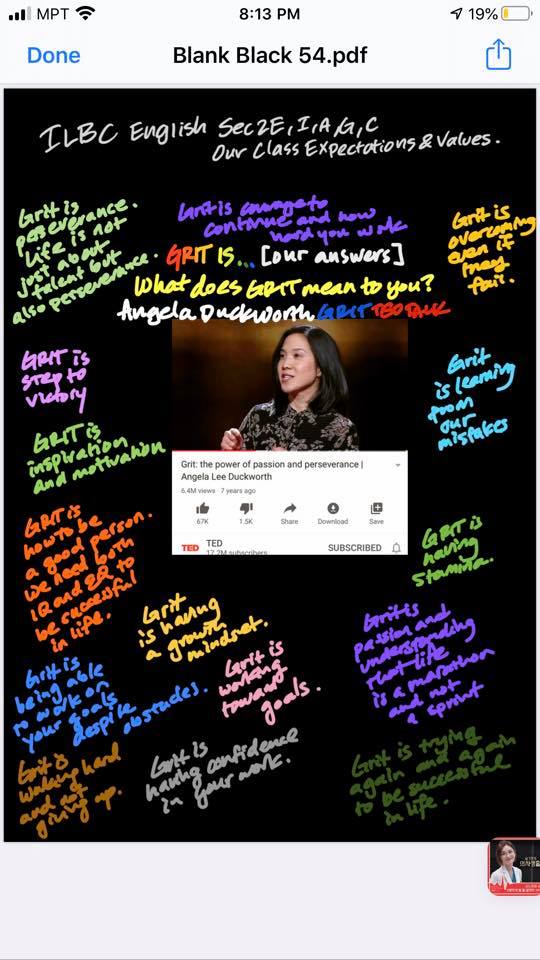
| Students will be annotating the video while watching Angela Duckworth’s Tedtalk on GRIT | We will come up with a group work of GRIT wall where we will compile every one’s ideas on the notion of GRIT and set it up as set of class expectations and norms for class. |
| Students will be sharing to the class what they make of the idea of GRIT after having watched the video twice | |
| Students will submit a written assignment on GRIT as their final assessment |
● If there is no summative assessment in this lesson, what/when will the summative
assessment be/take place
Big Ideas to be Addressed in the Lesson: The notion of GRIT, perseverance and resilience as characteristics leading up to success
Discussion Questions
Write out questions that you would like students to discuss in class, before class or after class because they are interesting, support higher order thinking, and make for a lively and engaging discussion. If discussions must happen outside class, what tool will you use to facilitate the discussion (e.g. Twitter)?
I would like students to discuss what are Angela Duckworth’s ideas and what do you make of them? What does GRIT mean to you and will you say GRIT has impacted your life in some way, or have you had people around you who have shown GRIT in their lives who have inspired you, and can you think of successful people who have been able to achieve success by exemplifying GRIT in their lives?
21st Century Knowledge and Skills
| 21st Century Knowledge and Skills | Teaching Strategies |
| Critical Thinking | Students will be using critical skills in order to apply the notion of GRIT onto their lives or other peoples’ lives. |
| Collaboration | Students will be listening to one another’s opinion and thereby practicing collaboration. We will also come up with class norms and expectations for our class as a group to come up with what GRIT means to us as a class. |
| Technology Literacy | Students will be expected to annotate the video, and also use technology to be typing up their written assignments on GRIT and submitting their assignments on the ILBC Microsoft Teams platform. |
Teaching Strategies and Related Student Activities (Include Web 2.0 activities as appropriate):
Preparing the tedtalk in advance and screen sharing the ted talk and making sure subtitles are on for the students who have English as their second language.
Making sure that the audio function is working ahead of time for the online platform.
Providing sample responses and essays from previous students in the chatbox for them to be able to read and prepare their own responses for their individual responses and public speaking.
Teaching Strategies and Activities: What are the teaching strategies and activities that you plan to use to help students meet the lesson’s objectives? What are the steps that you will take to deliver this lesson (e.g., introduce the author, read the poem, ask students to…)?
Teacher/Student Input: Write a note on what you expect the teacher and students to do as a part of this activity. Include a note on whether this is an “I do it”, “We do it” or “You do it” type of activity.
“I do it”
Introduce to them what the talk would be about. Introduce Angela Duckworth, her study and significance of her study, and what students would be paying attention to while listening to her talk.
Play the video twice for them to fully comprehend and absorb the material.
Ask questions on what they made of the video, and what they make of the quality called GRIT
You do it:
Take notes on what Angela Duckworth is arguing concerning the notion of GRIT. Prepare your individual responses on the notion of GRIT.
We do it:
As a class, make presentations on what they make of the notion of GRIT.
We will come up with a GRIT Poster we will have on our wall where we come up with class expectations and values on what we think of GRIT and attitude we should have towards learning as a group.
Review: Write down ideas on how you will review the topic, including notes on types of formative assessments that you will use during the lesson.
As final part of the activity, they will be assigned to write an essay concerning the notion of GRIT where they will be referring to individual reflections on their lives and experiences of various people who have exemplified GRIT to achieve their own kind of success in their lives. They will be assessed on their critical thinking skills, and also the development, organization and logic of their arguments.
Materials and Resources for Lesson
| Materials, Technology, and Websites | Required Preparation |
| Microsoft Teams: The school online learning platform | checking with the IT department if there are any other errors |
| Link of the tedtalk, making sure the audio works and screenshare works | checking with the other teacher on technology |
Use this space to write a paragraph or two discussion how the lesson went. Be honest — you can use this information in your reflections for Module 8.
The activity went more smoothly and effortlessly than as was anticipated. Students were actually very vibrant and eager to be sharing their opinions about what GRIT means to them and informing us of well-articulated, lengthy, prepared responses of what GRIT could mean to people. The level of energy and enthusiasm in class seem to have worn off from Angela Duckworth’s passion and commitment to her research and theory, and students seem to have really bought into and have been inspired by the arguments she had made and the research she had provided to substantiate her stance. Overall, I was really impressed by the level of passion and interest students had on the discussion topic.
Use this space to write notes on how you might change this lesson when you teach it again:
I think I would provide more sample responses of other class and students on what they made of the topic of GRIT. A wider array of responses would enrich the class discussion and allow fruition of a more diverse debate.
References
Teach-Now Unit 2 Module 6 Activity 1
Unit Plan Template
Teacher Candidate Name: Ye Won Maing
Unit Name: Covid Reading
Subject and Grade Level: English Secondary 2 (Grade 7)
Standard: Reading Standards
Overarching Goals: What would you expect for mastery?
Reading comprehension, book review skills
Objectives: Identify the objectives for the unit and a table that shows 21st Century skills addressed. Use the objectives that you created in Unit 1.
| Objective | 21st Century Skills Addressed |
| To be able to comprehend reading materials with understanding of the conflicts, character development, and other literary features associated with the books | Comprehension/ Creativity |
| To be able to report back to class what they have read, and understood while reading | Communication Skills |
| To be able to listen to book reports of one another and respond with any questions and relevant feedback | Communication Skills |
Prerequisite Skills: What skills do students need to have before beginning this unit?
Students should have some enthusiasm for reading and hence be able to initiate reading on their own, being able to analyze and comprehend some of the important components within the book.
Summative Assessment: What evidence or project will students submit to demonstrate that they have met the standard and objectives? How will you assess these products? How will you differentiate the assessments based on varying reading levels of students?
Students will be presenting book reports on books that they have read for the week and hence the criteria of reading comprehension, level of analysis, organization of ideas, efficacy of presentation will be assessed. The book reports will be based on books that they have chosen (while the reading list with book reviews would be provided to ease their choice of book selection). Yet, since the books will be chosen by the students, they would be assessed on the books that they have chosen, and hence these varying reading levels will be taken into consideration and also their individual reading levels while assessing each criteria.
Formative Assessment: How will you monitor and track student progress?
Lessons:What are the lessons that you will teach for this unit? How will you sequence the lessons that you will teach for this unit? Will your lessons be goal oriented, theme-based, or project-based? What strategies will you use to teach vocabulary to students of varying reading levels? Mention any other literacy skill covered in a lesson. What follows this unit?
- Lesson 1 (Week 1) : For lesson 1 they would be provided with the list of books that they would be encouraged to read on their own. But their own individual book selection would be encouraged.
- Lesson 2 (Week 2) : For second lesson, we will be going through the drama unit, specifically Shakespearean drama including Macbeth, King Lear, and Othello.
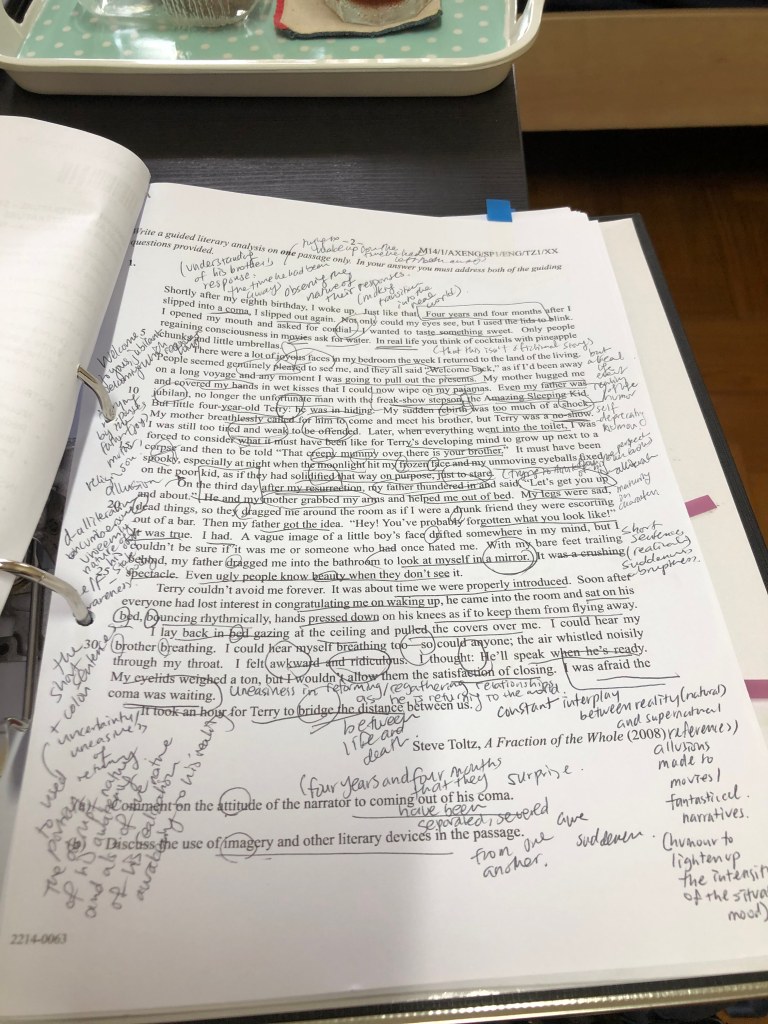
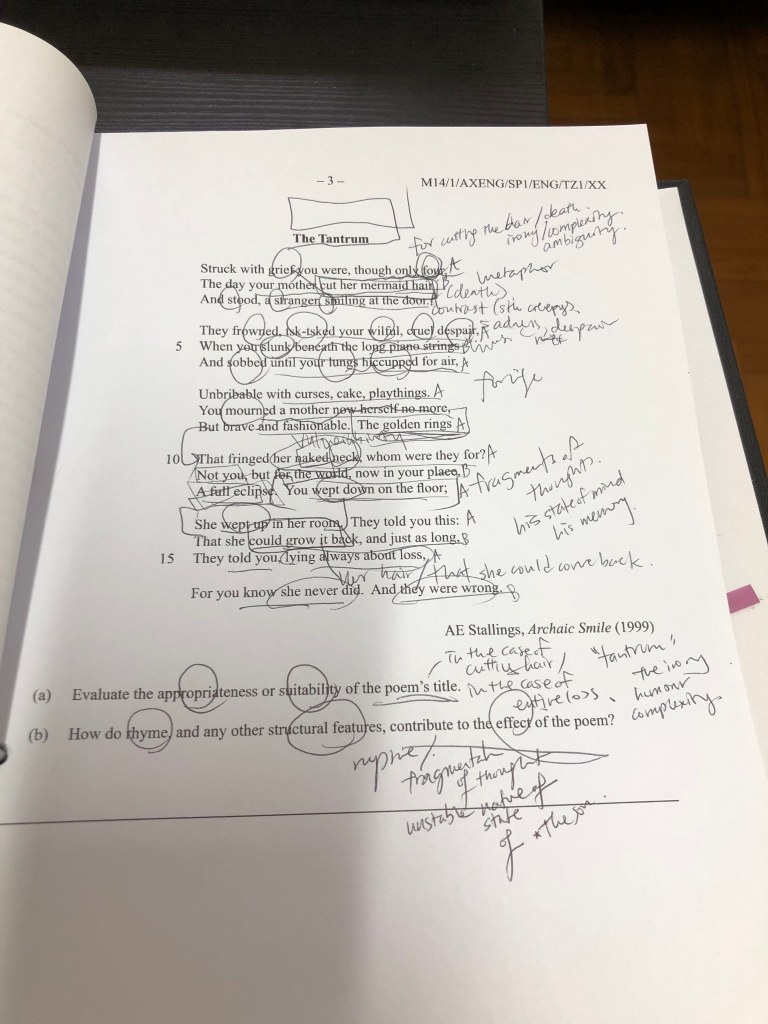
- Lesson 3 (Week 3) : For third lesson, we will be continuing with the drama unit, continuing discussion of Macbeth, King Lear, and Othello and writing individual passage analysis or commentary relevant to the individual drama.
- Lesson 4 (Week 4) : For fourth lesson, we will be going through detective stories, where we would be going through detective stories written by Edgar Allan Poe and analyzing literary devices specifically concerning the genre of detective stories..
- Lesson 5 (Week 5) : We would have students present their book reports of the book choices of their own. I would be providing them individual feedback, and students will be providing them with individual feedback as well.
Differentiating Instruction: How will you differentiate the product, content, and/or process for the various needs, preferences and readiness levels of your students? How will you differentiate the lesson for students with varying reading levels, disabilities and English language learners?
For students with varying reading levels, they will be provided again the choice to choose books appropriate to their reading levels concerning the book reports. For more difficult reading that we would be covering like Shakespeare drama in class, relatively easy to understand summaries would be provided to help with their understanding.
Next Steps: What will you do after the unit? Review, re-teach, extend, or move to the next unit?
I will try to review what they have learned by giving short quizzes, or giving written assignments to make sure they have acquired the necessary skills for the given unit. And then I would re-teach any recurring themes or areas that many of the students struggle to understand, extending the unit by relevant time period. And then if I find that the majority of the class have acquired most of the skills necessary for the given unit, I would be moving ahead with the next relevant class material.
References: Add resources you used to create this unit plan (preferably in APA format).
https://educationcontents.school.blog/2020/04/22/edureading-book-summary-annotations-part-3
Refer to two of these blog posts websites for annotations of all reading materials recommended for the book review activity. The individual files can be manually downloaded from the blog.
YouTube video summarizing these review materialshttps://www.youtube.com/embed/oeFgQx3odAs?version=3&rel=1&fs=1&autohide=2&showsearch=0&showinfo=1&iv_load_policy=1&wmode=transparentAdvertisements
Module 6 Unit 1 Activity 3
Overall feedback for the lesson would be that the teacher had effectively executed the lesson plan for the pertaining classroom. The level of enthusiasm or attention of the students could have been higher yet the subject matter and the level of difficulty could have been factors contributing to the relatively low energy level within the classroom. But the teacher’s ability to lead the classroom was effective in that he wasn’t distracted by the people moving in and out of the classroom, and had his whiteboard in place in order to explain all the different mathematical concepts that students might have difficulties understanding and acquiring especially if they were to be encountering these concepts for the first time. Also, his calling out of names, and answering questions, and leading classroom discussions by referring to student X or Y as he is answering their questions or commenting on their comments have all been effective ways in which to move the class forward by engaging the students and having them feel like they are part of the class, especially when concerning concepts which might be difficult for the students if they are acquiring these concepts for the first time. Also, though the sitting of the students were not explicitly explained or mentioned, yet the lesson plan had clearly stated that the gifted or strong students would be helping out ELL students or students who might be having difficulties grasping these mathematical concepts, and hence, more peer to peer interactions and making use of the sitting in groups could have been area of improvement if it had not been already done so in the first place. The teaching material would have scored upper-middle score on the rubric if I had been evaluating the class. And since our school would be opening on the 25th with Home Based Learning Program with online classes, I thought having a whiteboard at my home would be an effective way to lead the class, and for students to stay attuned with visuals, since we would not be at school to be making use of the various tools and devices, and concentration and interactions within online classes can be relatively less engaging. Use of the various visuals and visual tools would be effective components of classroom teaching for online classes.
Module 5 Activity 4 Activity 1
- Discuss with your Cohort in the Virtual Classroom and Discussion Forum strategies for pre-assessment and tracking student progress that you have used or would like to use in your classroom or in a topic in the subject area and grade level that you wish to teach.
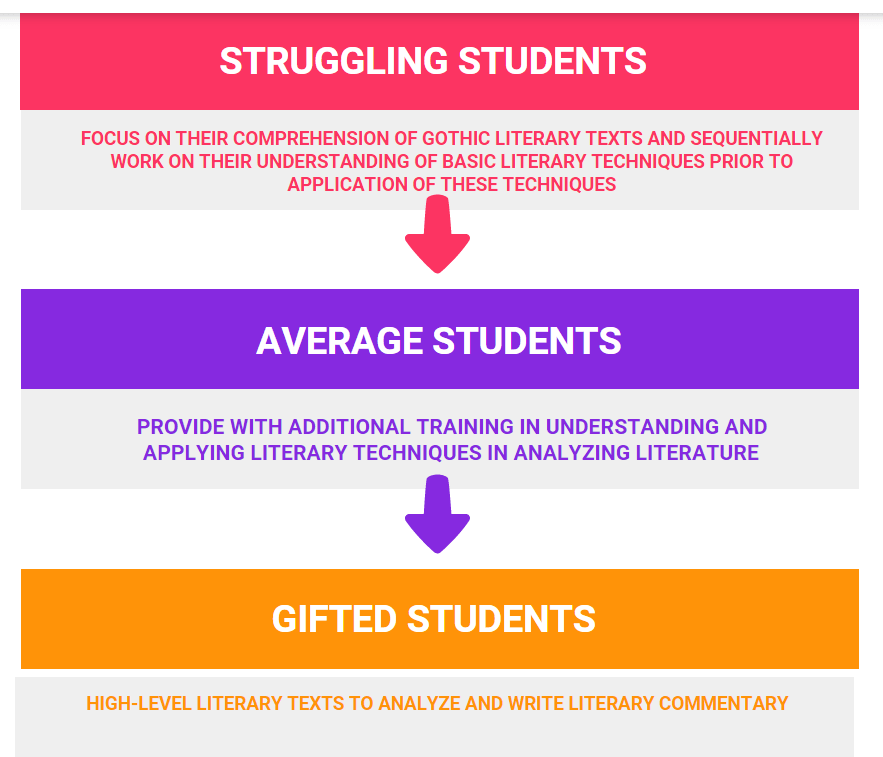
- Create a flowchart or mind map that (a) outlines an innovative differentiation strategy for the three groups of students below (see the article, “Differentiation: It Starts with Pre-Assessment,” in the Activity Resources for an example of an innovative strategy) and (b) identifies the assessments that you will use to track students’ learning throughout the unit:
- the 5 students who answered most, including the most difficult, of the pre-assessment questions correctly
- the 12 students who have some knowledge about the topic as shown in their score, but need to develop higher order thinking skills
- the 5 students who appear to have limited knowledge about the topic, of which 3 are struggling with language and are at different reading levels and 2 students who have little to no comprehension of the the topic and need to be tested further for special needs
- Write a blog post introducing your pre-assessment and the innovative differentiation strategy for the three groups of students described above. Include links or embed your pre-assessment and mind maps within the blog post, to create a comprehensive report.
I would like to be using the teaching material that I would be using while working as a Secondary English teacher starting soon at an international school in Yangon, Myanmar called International Language Business Center (ILBC) which uses the IGCSE curriculum. I would be using the chapter on Features of Gothic Stories from the textbook in order to complete this assignment. For the pre-assessment exercise, we would be looking at various Gothic literature and films that they watched concerning the genre (Mary Shelley’s Frankentstein, Edgar Allan Poe’s Poems and short stories) and appropriate literary devices (setting, motifs, characterization) as part of the pre-assessment exercise. In this assignment, our assignment would be differentiated to include three types of students: the gifted students who are excelling in the topic, the students who have knowledge yet show room for critical thinking skills in the topic, and students who may be struggling as they are trying to keep with the work. And as to cater to the needs and learning patterns of all three types of students, differentiated learning would be made: the gifted students would be given passages from these Gothic literature texts to analyze with the expectations that they already are familiar with the literary techniques and can apply these techniques to analyze the given passage and complete writing a commentary paper (literary analysis). As for the second group of students, they would be given Gothic literature texts, yet since they require additional training in literary analysis, they would be provided with sample papers on how to do literary analysis and would be reading and mastering these skills in order to apply them at a more extensive level to analyze Gothic literature texts using the literary techniques. For those students who may be struggling, they may be given Gothic literature to first or all comprehend these texts first hand, and then given sequential training in learning and acquiring these literary techniques, and then using these literary techniques to be analyzing the literary texts. Sequential training would be provided to these students in the third tier.

Module 5 Unit 4 Activity 2: Designing Differentiated Assessments
- Select a student with special needs and one ELL student from your classroom or from a case study. Specify both students’ reading level. Describe the special needs student’s learning disability or difficulty either from a clinical diagnosis or from your own observations.
- Write or select an assessment in your subject matter and create two alternate assessments using vocabulary from the appropriate reading level of the two students so that you are only assessing the concepts of the subject matter that you are teaching. If the student has an IEP (individualized education program), refer to it while creating the assessment.
- Write a brief summary of the changes you made to the original assessment, explaining reasons for change.
- Make a note of the following as applicable:
- Special provisions for the student within the test
- Special considerations while delivering or administering the test
- Peer review at least one other cohort member’s alternate assessments for an ELL student as well as a special needs student. Leave your feedback comments on your peer’s activity submission page.
The assessment that we would be taking a look at for this given assignment would be The Giver Assignment, where students in grade 7 of International School of Yangon were given an assignment where they had to analyze the book and complete the assignment where they were to imagine and construct a utopian community in the project where they had to design and construct the five main sectors of a given community/country: government, education, family, and employment & money. The assignment had been inspired by the book where a dystopian community with authoritarian government system had been depicted with various restrictions and hypocrisies such as euthanasia, infanticide and various systematic injustice in how the government is ran. And so the students had to imagine for themselves in this project where they had to write about various components within the country including government, education, family, and employment & money, trying to imagine for themselves what an ideal, utopian community would look like as opposed to the dystopian community that The Giver depicts.
Perhaps, given the nature of these two students (ELL student and student with cognitive or physical disabilities), I would be altering the assessment by perhaps changing the nature of the project by making it more first-dimensional by making the project analyze the dystopian elements of the world that The Giver depicts. So rather than having to take the next step to construct for themselves an utopian community, they would be given the choice to analyze the dystopian nature of the community depicted in The Giver as we have discussed in class rather than having them come up with themselves a completely new utopian community that they have to not only imagine for themselves but also write extensive paragraphs and reports concerning about. Yet, I would have this be optional, as the creative writing assignment might be easier for students to complete as opposed to the dystopian community analysis of the book, though would only require them to synthesize what had been taught during class. And so, the students would have the option, but perhaps what would be differentiated would be the assessment rubric that would be provided to the students where they would have lower expectations in order to score points on a given rubric, where their relative language drawbacks would be accounted for while making assessment on a given rubric. Perhaps their progress and growth would be prioritized over absolute standards and assessment scores, in order to provide incentives to their learning and growth. (The reasons would be supported by my own personal encounters with an ELL student I have had while instructing them on this The Giver Project while working as a personal tutor)
And as for the differentiated assessment for this given project, I was able to work with an ELL student where I was able to instruct her on the use of vocabulary and encourage her how she has all the ideas within her, but that her ideas have to be formulated into sentences and arguments that the student might feel less confident in doing so. Being a self-assertive, creative and bold young lady, I see great potential in her ability to learn and lead her peers, yet her relative shortage in English compared to her peers which put her in a state of disadvantage when it comes to articulating her ideas could come as a setback in her self-expression, and hence I try to encourage her as much as she can that she has all the answers within her, and she has those creative ideas yet her hesitation to make bold attempts might be hindering her from completing her assessment. Hence, when it comes with ELL students, not only grammatical help and help with articulation of ideas and formulating ideas into sentences but also teachers’ belief in the students’ ability to succeed and thrive in the school environment. Both emotional and technical help and support is necessary when it comes to ELL students.
For students with disabilities, due to my short experience in the field of teaching, I haven’t had direct encounters and first-hand experiences with any of the students with physical, or cognitive disabilities. And the schools and academies I have worked at did not have any students with physical or cognitive disabilities. I had had an interview to work as a shadow teacher for one of the students at school who had mild symptoms of dyslexia. And from the very limited experience I have had, I can only imagine that similar principles would apply for students with disabilities but only in a more extensive level where both emotional and cognitive support and help would be necessary especially as they may be encountering difficulties understanding the assignment and potentially could be encountering problems working together with other students. And hence the teachers’ role as both mentors and coaches in helping them with their cognitive abilities as well as their social, emotional well-being and success.
The Giver Utopian Community Project (This is the sample of what we worked on)
We read about a book named “The Giver” that discusses the dystopian community. A dystopian community is a community with problems like a country that is unfavourable. For this essay it is about the utopian community, which is a community with no problems or with increased freedom than dystopian. There are many components that make up the community, they are government, Education, Family, Employments, and Money.
Government
First of all, the government is the most important component that helps make up a good community. In my utopian community it is a democracy which means that people in the community are able to vote for a person that mostly fits to become part of the government of the country. In the community, people that are in parliament make laws by talking with each other and if citizens have dissatisfaction with the laws of the country then they will have a discussion about the laws to decide if they need to change the laws for the country. In the utopia community there are 6 laws; no litter or trash throwing on the street, no bullying, no criminals, no ( eating, using, harming ) animals and plants, clean streets, no throwing trash on flow. Role of the police is to watch out if citizens break the laws of the community and decrease the criminals and breaking laws by finding them if they had broken the law. Police decide with a lawyer if the criminal should go to jail or not depending if it’s a big crime or small crime.
Education
The second component that makes up the community is Education. Education is a first step for children to learn how the community works and how people need to treat other people like learning about courtesy. In the utopian community, children in this community only have to come to school on Saturday and Sunday. There could be good reasons and bad reasons for going to school on Saturday and Sunday only. A bad reason is if students come to school only Saturday and Sunday their school progress would be slower than others and students will get more homeworks for 5 days no school, and the good reason that 2 days for school is because sometimes student get stressed for going to school and if they come school only for 2 days and homeworks for 5 days it could be less stressful than 5 day school and homework.
In my utopian community there are 3 buildings for one school. They have elementary, middle school and high school. On Friday they don’t go to school but they have volunteering, and helping children that need help or provide food for them. On school days, Saturday and Sunday for lunch they provide food in the cafeteria for free and there are some sports matches from different schools for example Volleyball, Badminton, Soccer, and other more. There are some events like the Olympics like our school, International day when people wear their traditional clothes and share their cultures to other and Band concerts, when children practice their parts and play their parts on the stage and other more events that build relationships between different classes and to build school spirit.
Family
The third component that makes up the community is Family. Family is the most important thing in this community. In this community the family is controlled by both the mother and father. There would be 100 different apartments and two villas. A swimming pool would be in the town center. And there would be restaurants with international cuisine like you could find on an international day. The houses would be kept the same in order to have it be equal among different people living in the neighborhood.
Employment & Money
The Last component that makes up the community is Employment and Money. In this utopia community there are important jobs like lawyers, doctors, police, teachers, fire fighters, movie directors and businessmen. The lawyers would be defending the rights of people in the courts. They will first have to go to law school in order to become a lawyer. They will be going through an interview process at the court to be a certified lawyer. The doctors would be curing patients in the hospitals and they will be picked through the interviews and they will have to graduate from medical school and go through internship and residency in order to work at the hospital as a doctor. They will have to work in the hospital for a couple years to become a real doctor.
The teachers would be teaching students at school and they will be picked by the school through the interview process. The right teacher who has studied English, Math or what they are teaching in college or grad school would be needed for the job. And they would be chosen based on their knowledge and skill, and type of experiences they had in other schools. The people will be trained through online teaching programs and colleges that train teachers for schools. The fire fighters would be putting off the fire in emergency cases and they will have to go through many different practices of putting off the fire in many houses for them to become real firefighters working at the fire station. And they would have to be really brave and courageous in order to work at the fire station.
The businessmen would be running business and they will be going to business school or learning from their own parents how to do business. They will have to learn from books as well as other people in the companies in order to run a good business. The people who will make good businessmen will be people with best personal skills and relationships. In this utopia community people choose their job that mostly fits to themselves. They get trained with their job from 13 years old to 18 years old and they get kind of a test and teachers decide if they could do their job or they need to get trained more.
Edu(Contents) Series:

LITERATURE ANNOTATIONS
EduReading Book Summary Part 2
EDUREADING BOOK SUMMARY ANNOTATIONS PART 3



HACKERS READING AND LISTENING (TRACKS): WITH EXPLANATIONS
EduTOEFL (Reading and Listening iBT Five Practice Tests) Files in Order


IB ENGLISH EXTENDED ESSAY/ PAPER 2/ CRIME AND PUNISHMENT (DOSTOEVSKY)/ TOK ESSAY/ COLLEGE ESSAY (COMMON APP + SUPPLEMENT)/ POLICY BRIEF
https://educationcontents.school.blog/2020/04/16/what-is-home-english-symposium-amherst-college-in-this-time-of-corona/
https://educationcontents.school.blog/2020/03/12/ib-extended-essay/
https://educationcontents.school.blog/2020/03/19/jan-morris-ib-english-ioc-china/
https://educationcontents.school.blog/2020/03/12/ib-english-paper-2-commentary/
https://educationcontents.school.blog/2020/04/22/edureading-book-summary-part-2/
https://educationcontents.school.blog/2020/04/22/edureading-book-summary-annotations-part-3/

HACKERS VOCABULARY 30 CHAPTERS (PPT SLIDES FOR EVERY CHAPTER)
HACKERS VOCABULARY (CH1-6 PPT)
HACKERS VOCABULARY PPT 7-30 FULL PACKET
앞으로의 4차 혁명 시대 가운데 AI등이 도입되고 산업 시장이 바뀔 전망으로 보아 교육 시장 또한 플랫폼화 되며 새로운 혁신을 도모하며 새로운 형태의 옷을 입어야 할 것으로 보인다. 현재 한국의 초등학생들이 연예인을 넘어 이제는 유튜버가 되고 싶다고 하는 트렌드를 보아 앞으로는 전문가의 의견만을 바라는 시대가 아닌 열정과 아이디어를 가진 많은 크리에이터들이 자신만의 미디어와 플랫폼으로 자신의 콘텐츠를 시장에 선보일 시대가 도래할 듯 하다. 또한 창의성을 중요시하는 많은 전문가들의 예측을 보아 앞으로 교육의 핵심 가치는 창의성, 어떻게 크리에티브한 개개인의 콘텐츠를 만들 수 있는 능력이 핵심이 되는 1인기업, 크리에이터 의 직종이 중요한 시대가 도래할 듯 보인다. 창의성을 키워주는 영국에서 시작된 IB와 같은 인문학을 중심으로 한 프로그램들이 앞으로는 더더욱 중요할 것이라고 많은 전문가들이 예측하는 바이다. 에듀콘텐츠, 에듀시리즈는 많은 고객들에게 이러한 교육 컨텐츠를 통해 아이의 창의성, 성장과 성적의 향상 또한 약속 드리는 교육 사업으로서의 목표를 지향한다.
With the advent of 4th generation industrial revolution and many advancements in technology including the invention of AI (Artificial Intelligence), even the education market seems to have arrived at a pivotal moment in history where a significant transformation in the education market seems inevitable. With the outbreak of unforeseen corona virus epidemic, schools have had to make accommodations to the emergency situations and have altered their education supply and platform to online classes and lectures, which have brought about tremendous changes in the way how education is supplied and consumed. Perhaps this change in the education system has been inevitable with the currently evolving international market and arena, yet has been fast-forwarded in time due to the current outbreak of the corona virus. Hence with the evolving education market and platform, out education system would hence have to make adjustments to the evolving education consumptions trends and altered expectations and demands. Hence, we would have to create education platforms and contents as many international education industries have been making the forefront moves (Khan Academy, Brilliant, youtube channels), to accommodate to the changing demands and needs of the ever growing population. And with many of the education experts forecasting creativity as the key increasingly important trait of the next generation for education and learner in an every evolving world with the advent of innovative technology and AI, we must accommodate to those changing needs by adopting Liberal Arts programs like IB that would train citizens to be creative global learners equipped with the power to create their own contents in a every changing global market and society. Hence Educontents and Eduseries promises to equip students with the creative mindset which would serve a competitive edge in the every changing global economy which would require creative ability to perform tasks making optimal advantage in collaboration with the new technology. We aspire in bringing up equipped global citizens and creative and innovative learners.
 EduContents