
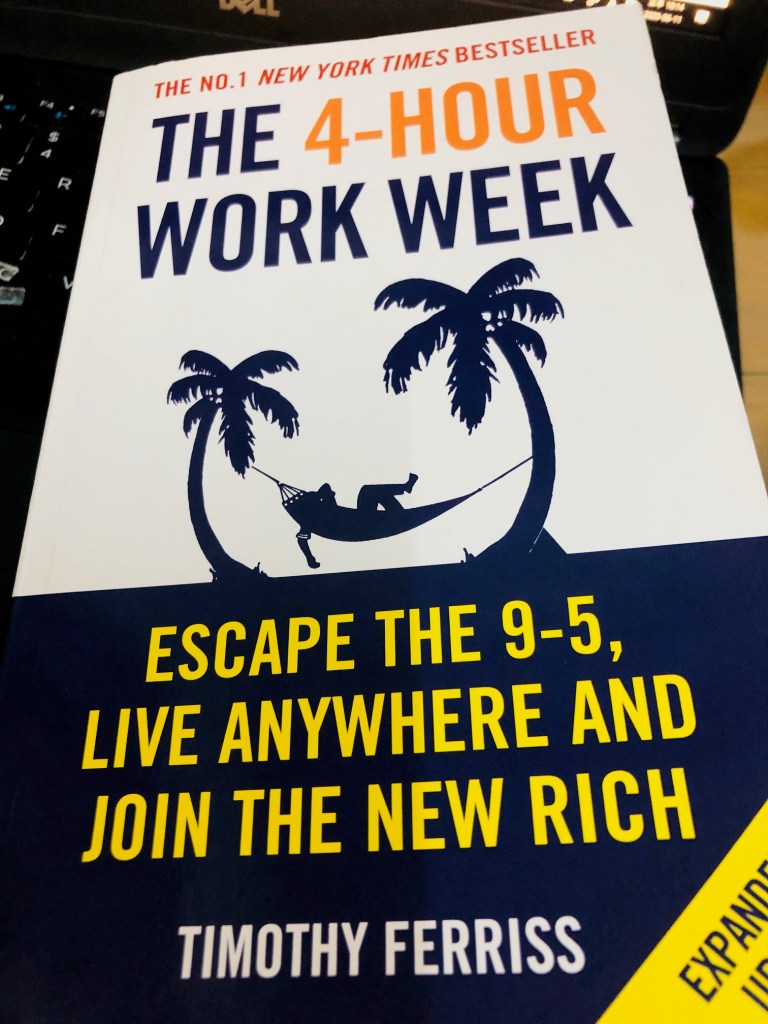
The 4-Hour Work Week
Tim Ferris
The book in short tells us to eliminate all things that are unproductive: 20% of sources make up 80% of the output. Therefore reprioritize and reduce all parts that are not bearing any outcomes for you.
Secondly, the book tells you to be outsourcing, or leveraging systems that will produce output/revenue even while you are away, sleeping, taking a vacation. Let those systems be working for you. I think of my blog, SNS, or especially youtube contents to be such systems I wish to develop. When working on these contents, I won’t have to constantly be there in person to explain to people or my students about what they have to work on, but explain once and let these outsourced resources and leveraged systems do the work for me. More work has to be put on these resources!
- Whenever you find yourself on the side of the majority, it is time to pause and reflect (Mark Twain)
- I’ve deciphered the code – simple to duplicate. There is a recipe.
- The truth, at least the truth I live and will share in this book is quite different. From leveraging currency differences to outsourcing your life and disappearing, I’ll show you how a small underground uses economic sleight-of-hand to do what most consider impossible.
- $1,000,000 in the bank isn’t the fantasy . The fantasy is the life-style of complete freedom it supposedly allows. The question is then, How can one achieve the millionaire lifestyle of complete freedom without first having $1,000,000?
- The goal is fun and profit
- Unending source of fulfillment; to free time and automate income is
- D for Definition : as relative wealth and eustress (Stress that triggers growth)
- E for Elimination: get rid of unnecessary events: to gain time
- A Automation: cash flow: outsourcing
- L Liberation: breaking the bonds: mobility
- One who shifts economic resources out of an area of lower and into an area of higher yield
- It’s time to have fun and let the rest follow
- An expert is a person who has made all the mistakes that can be made in a very narrow field
- Step 1: D is for Definition: Reality is merely an illusion, albeit a very persistent one.
- Deferrers (those who save it all for the end only to find that life has passed them by) New Rich can be separated from the crowd based on their goals, which reflect very distinct priorities and life philosophies.
- D: To work for yourself
- NR: To have others work for you
- D: TO work when you want to
- NR: TO prevent work for work’s sake and to do the minimum necessary for maximum effect (“minimum effective load” )
- D: To retire early or young
- NR: To prevent work for work’s sake, and to do the minimum necessary for maximum effect (“minimum effective load”)
- D: to retire early or young
- NR: To distribute recovery periods and adventures (mini-retirements) throughout life on a regular basis and recognize that inactivity is not the goal. Doing that which excites you is.
- D: To buy all the things you want to have.
- NR: TO do all the things you want to do, and be all the things you want to be. If this includes some tools and gadgets, so be it, but they are either means to an end or bonuses, not the focus.
- D: To be the boss instead of the employee; to be in charge.
- NR: To be neither the boss nor the employee, but the owner. To own trains and have someone else ensure they run on time.
- D: To make a ton of money.
- NR: To make a ton of money with specific reasons and defined dreams to chase, timelines and steps included. What are you working for?
- D: To have more.
- NR: TO have more quality and less clutter. To have huge financial reserves but recognize that most material wants are justifications for spending time on the things that don’t really matter, including buying things and preparing to buy things. You spent two weeks negotiating your new Infiniti with the dealership and got $10,000 off? That’s great. Doe you life have a purpose? Are you contributing anything useful to this world or just shuffling papers, banging on a keyboard, and coming home to a drunken existence on the weekends?
- D: To reach the big pay-off, whether IPO, acquisition, retirement, or other pot of gold.
- NR: To think big but ensure payday comes every day: cash flow first, big payday second.
- D: To have freedom from doing that which you dislike.
- NR: To have freedom from doing that which you dislike, but also the freedom and resolve to pursue your dreams without reverting to work for work’s sake (W4W) After years of repetitive work, you will often need to dig hard to find your passions, redefine your dreams, and revive hobbies that you let atrophy to near extinction. The goal is not to simply eliminate the bad, which does nothing more than leave you with a vacuum, but to pursue and experience the best in the world.
- Here’s the little secret I rarely tell: It all cost less than rent in the U.S If you can freed your time and location, your money is automatically worth 3-10times as such. Money is multiplied in practical value depending on the number of W’s you control in your life: what you do, when you do it, where you do it, and with whom you do it. I call this the freedom multiplier.
- Lifestyle output of their money
- Options – the ability to choose – is real power. This book is all about how to see and create those options with the least effort and cost. It just so happens, paradoxically, that you can make more money – a lot more money – by doing half of what you are doing now
- To join the movement, you will need to learn a new lexicon and recalibrate direction using a compass for an unusual world. From inverting responsibility to jettisoning the entire concept of “success’, we need to change the rules.
- Different is better when it is more effective or more fun.
- If everyone is defining a problem or solving it one way and the results and subpar, this is the time to ask, What if I did the opposite? Don’t follow a model that doesn’t work.
- Basic rules of successful NR are surprisingly uniform and predictably divergent from what the rest of the world is doing
- Alternating periods of activity and rest is necessary to survive, let alone thrive. Capacity, interest, and mental endurance all wax and wane. Plan accordingly.
- The NR aims to distribute “mini-retirements’ throughout life instead of hoarding the recovery and enjoyment for the fool’s gold of retirement. By working only when you are most effective, life is both more productive and more enjoyable. It’s the perfect example of having your cake and eating it, too.
- Personally, I now aim for one month of overseas relocation or high-intensity learning (tango, fighting, whatever) for every two months of work projects.
- 3. Less Is not Laziness
- Doing less meaningful work, so that you can focus on things of greater personal importance, is NOT laziness. This is hard for most to accept, because out culture tends to reward personal sacrifice instead of personal productivity.
- More time equals more self-worth and more reinforcement from those above and around them. The NR, despite few hours in the office, produce more meaningful results than the next dozen non-NR combined.
- If it’s important to you and you want to do it “eventually”, just do it and correct course along the way.
- Ask for forgiveness, Not permission
- If it isn’t going to devastate those around you, try it and then justify it. If the potential damage is moderate or in any way reversible, don’t given people the chance to say no. Most people are fast to stop you before you get started but hesitant to get in the way you’re moving. Get good at being a troublemaker and saying sorry when you really screw up.
- Emphasize Strengths, Don’t Fix Weaknesses.
- Most people are good at a handful of things and utterly miserable at most.
- It is far more lucrative and fun to leverage your strengths instead of attempting to fix all the clinks in your armor. The choice is between multiplication of result using strengths or incremental improvement fixing weaknesses that will, at best, become mediocre. Focus on better use of your best weapons instead of constant repair.
- Things in Excess Become their Opposite
- IT is possible to have too much of a good thing. In excess, most endeavors and possessions take on the characteristics of their opposite. Thus; Too much, to many, and too often of what you want becomes what you don’t want.
- Money alone is not the solution.
- In part, it’s laziness. If only I had more money is the easiest way to postpone the intense self-examination and decision-making necessary to create a life of enjoyment – now and not later. The problem is more than money.
- Relative Income is more important than absolute income. Absolute and relative income
- Relative income uses two variables: the dollar and time, usually hours.
- Relative income is the real measurement of wealth for the New Rich.
- Distress is Bad, Eustress is Good
- Two separate types of stress – euphoria and its seldom-mentioned opposite, dysphoria.
- Distress refers to harmful stimuli that make you weaker, less confident and less able
- Eustress on the other hand, is a word most of you have probably never hard. Eu- a Greek prefix for healthy (used in the same sense in the word “euphoria”) Role models who push us to exceed our limits, physical training that removes our spare tires, and risks that expand our sphere of comfortable action are all examples of eustress – stress that is healthful and the stimulus for growth
- How has being realistic or responsible kept you from the life you want?
- How has doing what you should resulted in subpar experiences or regret for not having done something else?
- Look at what you’re currently doing and ask yourself, “What would happen if I did the opposite of the people around me? What will I sacrifice I continue on this track for 5,10, or 20 years?”
- System Reset
- Being Unreasonable and Unambiguous
- The reasonable man adapts himself to the world; the unreasonable one persists in trying to adapt to the world to himself. There all progress depends on the unreasonable man.
- Doing the unrealistic is easier than doing the realistic
- If you are insecure, guess what? The rest of the world is, too. Do not overestimate the competition and underestimate yourself. Your are better than you think.
- I’m prepared to do battle for a dream that is worth dreaming.
- What do you want? A better question, first of all.
- Most people will never know what they want. I don’t know what I want. I f you ask me what I want to do in the next five months for language learning, on the other hand, I do know. It’s a matter of specificity. “What do you want” is too imprecise to produce a meaningful and actionable answer. Forget about it.
- Excitement is the more practical synonym for happiness, and it is precisely what you should strive to chase. It is the cure-all. When people suggest you follow your “passion” or your “bliss” (excitement)
- This brings us full circle.
- What do I want? What are my goals? What would excite me?
- Be realistic and stop pretending. Life isn’t like the movies.
- Remember – boredom is the enemy, not some abstract failure.
- Dreamlining is so named because it applies timelines to what most would consider dreams.
- The goals shifts from ambiguous wants to defined steps.
- The goals have to be unrealistic to be effective
- It focuses on activities that will fill the vacuum created when work is removed. Living like a millionaire requires doing interesting things and not just owning enviable things.
- It’s not what you know, it’s who you know
- Here’s how normal people build supernormal networks
- Fail better
- I believe that success can be measured in the number of uncomfortable conversations you’re willing to have.
- Find a personal email if possible, often through their little-known personal blogs, send a two or three paragraph email which explains that I am familiar with their work, and ask one simple to answer but thought-provoking question in that email related to their work of life philosophies. The goal is to start a dialogue so they take the time to answer future emails – not to ask for help. That can only come after at least three or four genuine email exchanges.
- I deal with rejection by persisting, not by taking business elsewhere. My maxim comes from Samuel Beckett, a personal hero of mine: “Ever tried. Every failed. No matter. Try again. Fail again. Fail better. You won’t believe what you can accomplish by attempting the impossible with the courage to repeatedly fail better
- Ferris is proud of the effort students have put into his contest. Most people can do absolutely awe-inspiring things,” he said. Sometimes they just need a little nudge.
- The existential vacuum manifests itself mainly in a state of boredom
- Life is too short to be small.
- Dreamlining will be fun, and it will be heard. The harder it is, the more you need it.
- What would you do if there were no way you could fail? If you were 10 times smarter than the rest of the world?
- Five things you dream of having (including, but not limited to, material wants: house, car, clothing), being (be a great cook, be fluent in Chinese. Etc) and doing (visiting Thailand, tracing your roots overseas, racign ostriches. Etc)
- What you would do, day to day, if you had $100 million in the bank?
- What would make you most excited to wake up in the morning to another day?
- One place to visit
- One thing to do before you die
- One thing to do daily
- One thing to do weekly
- One thing you’ve always wanted to learn
- What does “being” entail doing?
- “being” into a “doing” to make it actionable.
- What are the four dreams that would change it all?
- Highlight the four most exciting and/or important dreams from all columns. Repeat the process with the 12month timeline if desired.
- Determine the cost of these dreams and calculate your Target Monthly Income (TMI) for both timelines.
- Last, calculate your Target Monthly Income (TMI) for realizing these dreamlines.
- Determine three steps for each of the four dreams in just the 6 month timeline and take the first step now.
- Define three steps for each dream that will get you closer to its actualization
- Once you have three steps for each of the four goals, complete the three actions in the now column
- If the next stage is some form of research, get in touch with someone who knows the answer instead of spending too much time in books or online, which can turn into paralysis by analysis. The best first step, the one I recommend, is finding someone who’s done it and ask for advice on how to do the same. It’s not hard.
- Comfort Challenge
- The most important actions are never comfortable.
- Fortunately, it is possible to condition yourself to discomfort and overcome it.
- Develop the uncommon habit of making decisions, both for yourself and for others.
- E is for Elimination
- One does not accumulate but eliminate. It is not daily increase but daily decrease. The height of cultivation always runs to simplicity Bruce Lee
- The End of Time Management
- Illusions and Italians
- Perfection is not when there is no more to add, but no more to take away
- It is vain to do with more what can be done with less
- Believe it or not, it is not only possible to accomplish more by doing less, it is mandatory
- Enter the world of elimination
- How you will use productivity
- You have to free that time. To do so while maintaining or increasing your income.
- The employee is increasing productivity to increase negotiating leverage for two simultaneous objectives: pay raises and a remote working management
- This is an endless game and one you want to avoid. Hence the need for Liberation first.
- If you’re an employee, this chapter will increase your value and make it more painful for the company to fire you than to grant raises and remote working agreement.
- And use the resultant free time to fulfill dreamlines.
- The goal is to decrease the amount of work you perform while increasing revenue. This will set the stage for replacing yourself with automation, which in turn permit liberation.
- Being effective vs. being efficient
- Being efficient without regard to effectiveness is the default mode of the universe.
- 1. Doing something unimportant well does not make it important
- 2. Requiring a lot of time does not make a task important
- What do you do is infinitely more important than how you do it.
- What gets measured gets managed.
- “Pareto’s Law” or the “Pareto Distribution” in the last decade also popularly called the “80/20 Principle”
- Pareto’s Law can be summarized as follows: 80% of the outputs result form 20% of the inputs.
- 80% of the consequences flow form 20% of the causes.
- 80% of the results come from 20% of the effort and time.
- 80% of company profits come from 20% of the products and customers
- 80% of all stock market gains are realized by 20% of the investors and 20% of an individual portfolio
- Which 20% of sources are causing 80% of my problems and unhappiness?
- Which 20% of sources are resulting in 80% of my desired outcomes and happiness?
- Make no mistake, maximum income from minimal necessary effort (including minimum number of customers) is the primary goal. I duplicated my strengths, in this case my topo producers, and focused on increasing the size and frequency of their orders.
- 1. Advertising
- I identified the advertising that was generating 80% or more of revenue, identified the commonalities among them, and multiplied them, eliminating all the rest at the same time. My advertising costs dropped over 70%
- 2. Online affiliates and partners
- Online partner income increased more than 50% in that same month
- Slow down and remember this: most things make no difference. Being busy is a form of laziness – lazy thinking and indiscriminate action.
- Being selective – doing less – is the path of the productive. Focus on the important few and ignore the rest.
- Of course, before you can separate the wheat from the chaff and eliminate activities in a new environment, you will need to try a lot of identify what pulls the most weight.
- Lack of time is actually lack of priorities.
- The 9-5 illusion and parkinson’s law
- I saw a bank that said, “24-Hour Banking” but I don’t have that much time
- If you’re an employee, spending time on nonsense is, to some extent, not your fault. There is often no incentive to use time well unless you are paid on commission. You are compelled to create activities to fill that time.
- A remote work arrangement instead of just collecting a paycheck, it’s time to revisit the status quo and become effective. The best employees have the most leverage.
- Parkinson’s Law dictates that a task will swell in (perceived) importance and complexity in relation to the time allotted for its completion. It is the magic of the imminent deadline. If I give you 24 hours to complete a project, the time pressure forces you to focus on execution, and you have no choice but to do only the bare essentials.
- 1. Limit tasks to the important to shorten work time (80/20)
- 2. Shorten work time to limit tasks to the important (Parkin’s Law)
- The 80/20 Principle and Parkinson’s Law are the two cornerstone concepts that will be revisited in different forms throughout this entire section. Most inputs are useless and time is wasted in proportion to the amount that is available.
- Am I being productive or just active?
- Am I inventing things to do to avoid the important?
- We create stress for ourselves because you feel like you have to do it. You have to. I don’t feel that anymore
- The key to having more time is doing less, paths to getting there
- Definite a to do list, and not to do list
- What 20% of sources are causing 80% of my problems and unhappiness?
- What 20% of sources are resulting in 80% of my desired outcome and happiness?
- If you had a heart attack and had to work two hours per day, what would you do?
- If you had second heart attack and hard to work two hours per week, what would you do?
- IF you had gun to your head and had to stop doing 4/5 of different time-consuming activities, what would you remove?
- Simplicity requires ruthlessness. IF you had to stop 4/5 of time-consuming activities – e-mail, phone calls, conversations, paperwork, meetings, advertising, customers, suppliers, products, services, etc. – what would you eliminate to keep the negative effect on income to a minimum?
- What are the top-three activities that I use to fill time to feel as though I’ve been productive?
- Be honest with yourself, as we all do this on occasion. What are your crutch activities?
- Who are the 20% of people who produce 80% of your enjoyment and propel you forward, and which 20% cause 80% your depression, anger, and second-guessing?
- If someone isn’t making you stronger, they’re making you weaker
- Learn to ask, if this is the only thing I accomplish today, will I be satisfied with my day? Don’t ever arrive at the office or in front of your computer without a clear list of priorities.
- I use a standard piece of paper folded in half three times, which fits perfectly in a pocket and limits you to noting only a few items.
- If this is the only thing I accomplish today, will I be satisfied with my day?
- Put a post-it on you computer screen or set an outlook reminder to alert you at least three times daily with the question: are you inventing things to do to avoid the important?
- Do not multitask.
- There is no need to multitask. Doing more to feel productive while actually accomplishing less
- At most, primary goals or tasks per day
- Use Parkinson’s Law on a Macro and Micro Level
- Shorten schedules and deadlines to necessitate focused action instead of deliberation and procrastination
- Social life
- Items on your to-do list
- Force immediate action
- Learn to propose;
- Stop asking for opinions and start proposing solutions
- Offer a solution, make a decision
- Can I make a suggestion?
- I propose
- I’d like to propose…
- I suggest that… What do you think?
- Let’s try… and then try something else if that doesn’t work
- The low-information diet
- Cultivating selective ignorance
- What information consumes is rather obvious: it consumes the attention of its recipients. Hence a wealth of information creates a poverty of attention and a need to allocate attention efficiently among the overabundance of information sources that might consume it
- Reading, after a certain age, diverts the mind too much from its creative pursuits. Any many who reads too much and uses his own brain too little falls into lazy habits of thinking
- Empower others
- Cultivating selective ignorance
- There are many things of which a wise man might wish to be ignorant – Ralph Waldo Emerson
- I’m going to propose that you develop an uncanny ability to be selectively ignorant. Ignorance may be bliss, but it is also practical.
- Both too many calories and calories of not nutritional value, informational workers eat data both in excess and from the wrong sources.
- Lifestyle design is based on massive action – output. Increased output necessitates decreased input. Most information is time-consuming, negative, irrelevant to your goals, and outside of your influence.
- Who loses the forest for the trees in a sea of extraneous details.
- I only read accounts that are how I did it and autobiographical
- Using the book to generate intelligent and specific questions, I contacted 10 of the top authors and agents in the world via email and phone, with a response rate of 80%
- I only read the sections of the book that were relevant to immediate next steps, which took less than two hours.
- How to read 200% faster in 10 minutes
- 1. Two minutes: use a pen or finger to trace under each line as you read as fast as possible
- 2. Three minutes: begin each line focusing on the third word in from the first word, and end each line focusing on the third word in from the last word
- 3. Two minutes: once comfortable indenting three or four words from both sides, attempt to take only two snapshots – also known as fixations – per line on the first and last indented words
- Three Minutes; practice reading too fast for comprehension but with good technique (the above three techniques)
- Learning to ignore things is one of the great paths to inner peace
- Go on a immediate one-week media fast
- Develop the habit of asking yourself “Will I definitely use this information for something immediate or important?
- Follow your to-do short list and fill in the information gaps as you go
- Practice the art of nonfinishing
- Get phone numbers (2 days)
- Interrupting interruption and art of refusal
- Do your own thinking independently. Be the chess player, not the chess piece.
- Meeting are an addictive, highly, self-indulgent activity that corporations and other organizations habitually engage in only because they cannot actually masturbate
- Learn to be difficult when it counts. In school as in life, having a reputation for being assertive will help you receive preferential treatment without having to beg or fight for it every time.
- Not all Evils are created equal
- Start-to-finish completion of critical task, and there are three principal offenders
- Time wasters:
- Time consumers: repetitive tasks or requests that need to be completed but often interrupt high-level work
- Empowerment failures
- Time wasters: become an ignoramus
- The best defense is a good offense.
- Time wasters are the easiest to eliminate and deflect
- Limit email consumption and production
- Email to your inbox as soon as someone sends them
- Check email twice per day
- Beg for forgiveness; don’t ask for permission
- People are poor judges of importance and inflate minutiae to fill time and feel important
- The second step is to screen incoming and limit outgoing phone calls
- Meetings should only be held to make decisions about a predefined situation, not to define the problem. If someone proposes that you meet with them or “set a time to talk on the phone,” ask that person to send you an email with an agenda to define the purpose
- The cost and time effective solution, therefore, is to wait until you have a larger order, an approach called “batching” Batching is also the solution to our distracting but also the solution to our distracting but necessary time consumers, those repetitive tasks that interrupt the most important.
- Do not work harder when the solution is working smarter
- Empowerment failure: rules and readjustment
- The vision is really about empowering workers, giving them all the information about what’s going on so they can do a lot more than they’ve done in the past
- Bill gates, confounder of Microsoft, richest man in the world
- For the employee, the goal is to have full access to necessary information and as much independent decision-making ability as possible.
- Empowerment failure
- It wasn’t scalable model. Remember this word, as it will be important later. It wasn’t scalable because there was an information and decision bottleneck: me.
- I sent one single email to all the supervisors that immediately turned 200 email per day into fewer than 20 email per week
- Don’t ask me for permission. Do what you think is right, and we’ll make adjustments as we go along
- More than 90% of the issues that prompted email could be resolved for less than $20
- It’s amazing how someone’s IQ seems to double as soon as you give them responsibility and indicate that you trust them.
- People are smarter than you think. Give them a chance to prove themselves
- If you are a micromanaged employee, have a heart-to-heart with your boss and explain that you want to be more productive and interrupt him or her less.
- Empower others to act without interrupting you
- Set the rules in your favor. Limit access to your time, force people to define their requests before spending time with them, and batch routine menial tasks to prevent postponement of more important projects. Do not let people interrupt you. Find your focus and you’ll find your lifestyle.
- The bottom line is that you only have the rights you fight for. Automation, we’ll see how the New Rich create management-free money and eliminate the largest remaining obstacle of all: themselves.
- Create systems to limit your availability via e-mail and phone and deflect inappropriate contact.
- Batch activities to limit setup cost and provide more time for dreamline milestones.
- Ste or request autonomous rules and guidelines with occasional review of results
- Eliminate the decision bottleneck for all things that are nonfatal if misperformed
- Minimal and time savings are guaranteed.
- Tools and tricks
- Eliminating paper distractions, capturing everything
- Evernote: allows your to easily capture information from anywhere using whatever device is at hand, and everything is then searchable from anywhere
- Scan all agreements, paper articles
- Directly to Evernote in seconds
- One shot, one kill scheduling without email
- Doodle
- Timedriver
- Choosing the best email batching times
- Xobni: hotspots
- Emailing without entering the black hole of the inbox
- Jot
- Copytalk
- Preventing web browsing completely
- Freedom: allowing you the focus to get real work done
- Revisit the terrible twos (2 days)
- For the next two days, do as all good two-year-olds do and say “no” to all requests. Refuse to do all things that won’t get you immediately fired. Be selfish. Objective isn’t an outcome – but the process: getting comfortable with saying no.
- A is for Automation
- Scotty: She’s all yours, sir. All systems automated and ready. A chimpanzee and two trainees could run her!
- Captain Kirk: Thank you, Mr. Scott. I’ll try not to take that personally. Star Trek
- Outsourcing Life
- Off-Loading the Rest and a Taste of Geoarbitrage
- A man is rich in proportion to the number of things he can afford to let alone
- Desired satisfaction
- It’s a strange feeling having people work for you while you sleep
- Strange, but great. I’m not wasting time while I drool on my pillow; things are getting done
- Outsourcing my inner life
- Delegate my therapy
- Outsource my worry
- At a glance: where you will be
- The future is here. It’s just not widely distributed yet.
- William Gibson, author of Neuromancer, coined term cyberspace
- But I’m an employee! How does this help me?
- Nobody can give you freedom. Nobody can give you equality or justice or anything. If you’re a man, you take it.
- Remote management and communication.
- Eliminate before you delegate.
- Never automate something that can be eliminated. Delegate something that can be automated or streamlined.
- Using people to leverage a refined process multiplies production; using people as a solution to a poor process multiplies problems.
- I am not interested in picking up crumbs or compassion thrown from the table of someone who considers himself my master. I want the full menu of rights.
- Getting personal and going
- Solo vs. support team
- I don’t like being dependent on one person
- Team preference doesn’t mean that bigger is better, just that multiple people are better than one person
- Three can be more than sufficient, but two is toeing the line
- The complicated art of simplicity: common complaints
- In the world of automation, not all business models are created equal. How do you assemble a business and coordinate all its parts without lifting a finger? How do you automate cash deposits in your bank account while avoiding the most common problems? It begins with understanding the options, the art of dodging information flow, and what we will call “muses”: a product
- Start small but think big
- Moderating discussion forums
- Publishing newsletters and blog postings
- Components of new marketing initiatives or analysis of current marking results
- Don’t limit yourself
- Income autopilot I
- The man who grasps principles can successfully select his own methods. The man who tries methods, ignoring principles, is sure to have trouble.
- What would you do if you didn’t have to think about money? If you follow the advice in this chapter, you will soon have to answer this question.
- It’s time to find your muse.
- People who want to run businesses but for those who want to own businesses and spend no time on them
- Our goal is simple: to create an automated vehicle for generating cash without consuming time
- Cash flow and time
- Why to begin with the end of mind
- The more middlemen are involved, the higher your margins must be to maintain profitability for all the links in the chain
- Choosing distribution before product is just one example.
- Step one: pick an affordably reachable niche market
- Find a market – define your customers – then find or develop a product for them
- Developed products for those markets
- Understood their needs and spending habits. Be a member of your target market and don’t speculate what others need or will be willing to boy.
- Start small, think big.
- Which social, industry, and professional groups do you belong to,
- Look creatively at your resume, work experience, physical abilities, and hobbies and compile a list of all the groups, past and present, that you can associate yourself with
- Include online and offline subscriptions: what groups of people purchase the same?
- Which of the groups you identified have their own magazines
- Genius only a superior power of seeing
- The main benefit should be encapsulated in one sentence
- People can dislike you – and you often sell more by offending some – but they should never misunderstand you
- The main benefit of your product should be explainable in one sentence or phrase.
- It should take no more than 3 to 4 weeks to manufacture
- Option one: resell a product
- Purchasing an existing product at wholesale and reselling it is the easiest route but also the least profitable
- Reselling is however an excellent option for secondary back-end products that can be sold to existing customers or cross-sold to new customers online or on the phone
- Product creation
- Option three: create a product
- Creation is better means of self-expression than possession; it is through creating, not possessing, that life is revealed
- Information
- Information products are low-cost, fast to manufacture, and time-consuming for competitors to duplicate
- Information on the other hand is too time consuming for most knockoff artists to bother with when there are easier products to replicate
- But I’m not an expert!
- If you aren’t an expert, don’t sweat it.
- You know more about the topic than the purchaser. Just better than a small target number of your prospective customers.
- 1. Create the content yourself
- 2. Repurpose content
- 3. License content or compensate an expert to help create content
- Use the following questions to brainstorm potential how-to or informational product that can be sold to your markets using your expertise or borrowed expertise.
- Digital delivery is perfectly acceptable – in some cases, ideal – if you can create a high enough perceived value.
- What skills are you interested in that you – and others in your markets – would pay to learn? Become an expert in this skill for yourself and then create a product to teach the same. If you need help or want to speed up the process, consider the next question.
- What experts could you interview and record to create a sellable audio CD?
- Do you have a failure-to-success story that could be turned into a how-to product for others? Consider problems you’ve overcome in the past, both professional and personal.
- Join two or three related trade organizations
- Read the thee top-selling books
- Give one free one-to-three hour seminar
- Offer to write one or two articles for trade magazines
- Join profnet
- Failure is not an option sort of became our motto
- Confirming sufficient market size
- Funding public domain information to repurpose
- Project Gutenberg
- Librivox
- Licensing ideas to other for royalties
- Searching patens for unexploited ideas to turn into product
- Becoming an expert
- Income autopilot II testing the muse
- The moral is that intuition and experience are poor predictors of which products and businesses will be profitable. Ask ten people if they would buy your product.
- People if they would buy – ask them to buy. i
 EduContents