
IB TOK ESSAY

“…we will always learn more about human life and human personality from novels than from
scientific psychology.” (Noam Chomsky). To what extent would you agree?

             When I first read this argument, I disagreed with Noam Chomsky mainly because he makes this issue seem categorical and unquestionable – that “we will always learn more about human life…from novels than from scientific psychology.” In fact, he seems to be unduly confident in his argument that it seems like his argument has risen not from rational analysis and serious contemplation but from his whimsical desire to believe that human life and personality are too intricate and complex to be understood by using science alone.

            But after doing some more research about his argument, I found that he might actually be making a valid TOK argument. Chomsky says, “most of what we know about things that matter comes from [novels] surely not from considered rational inquiry.” He then claims that this “considered rational inquiry” “reaches unparalleled depths of profundity, but has a rather narrow scope.” Here he seems to be saying that because scientific psychology resorts to only one way of knowing: “rational inquiry” or reasoning, it has a rather “narrow scope” in terms of understanding the “full human person.” In other words, one way of knowing, reasoning isn’t comprehensive enough to fully understand the different aspects of human beings.

            And I think that even though scientific psychology encompasses the other three ways of knowing, perception, language and emotion, it does in a very superficial level compared to the novels. First of all, novels, at least the better ones, make use of intricate and profound language in order to create and communicate knowledge. And the even better ones purposefully use ambiguous language and arguments to allow readers to choose their own interpretation of the text. Novels involve a much-sophisticated use of language than scientific psychology, which merely aims for factual clarity in its use of language.

            Unlike scientific psychology that strives for emotional detachment, novels make use of emotion as another way of knowing. By using language that appeals to emotion of the readers, novelists try to recount a vivid story that would allow readers to not only understand but also relive the experience by empathizing and imagining. In fact, Joseph Conrad, the author of Heart of Darkness, claims that, “My task, which I am trying to achieve is by the power of the written word to make you hear, to make you feel – it is before all, to make you see. That-and no more, and it is everything”. When was the last time you heard a research psychologists talk about the “power of language” in her research papers or that her paper would make you “hear…feel… and see.” Conrad says he tries to write so that the words (language) can make readers hear and see (vicarious perception), and make them feel (emotion).

            Contrary to the mainstream belief that scientific psychology appeals to reason as a way of knowing much more than do novels, I think that reading novels involve much more reasoning processes. I think it is our biased conception that the essence of science is reason while arts tend to be less dependent or associated with reason as a way of knowing. Novels require reason if not more reason as when reading a book, we not only have to literally understand but also make connections, comparisons, and decode ambiguous language, trying to grasp the message that the author has created through an entire piece of art. In fact, try to remember when you have read your last novel and a psychology article/paper. Which one activated more reasoning processes in your mind – reading a science paper or reading an esoteric and arcane novel like Heart of Darkness? While reading something on science, we use logic to get a literal understanding of the concepts, when we are reading novels, in order to understand the author’s choices and his intended effects, we as readers have to engage in a much more interactive and complex reasoning processes.

            And after having read Heart of Darkness in my IB English class, I feel like I have learned more about human personality than what I have learned in my IB Psychology class. The depth and profundity of the knowledge acquired in IB English is much more revealing than the knowledge I’ve acquired in IB Psychology. While it’s true that we may have covered a wider range of topics and theories in our IB Psychology class, I have to say Conrad, with his “power of language” really made me hear Kurtz’s last words, “The Horror, The Horror,” feel the fascination of abomination, and see the ghastly reality which made Kurtz ventriloquize those last words. I find that Conrad’s portrayal of the dark areas in us, which are momentarily suppressed by the society and its laws, cannot be as delicately and intricately illustrated through scientific psychology. Novels appeal to our language and emotional capacities when psychology superficially does so. Thus if Conrad’s ideas about human personality were to be translated into scientific psychology, the impact would greatly differ and much less desirable.

            Likewise, what I’ve learned about stereotypes in Psychology class seems insignificant and rather trivial compared to the great realization I had in my IB English class concerning stereotypes on the African people, while reading Tayeb Salih’s Season of Migration to the North. The novel suggests the human’s wired tendency to form stereotypes, either positive or negative. Salih suggests that true equality cannot exist in a society in which people live in the extremes: the white people can either look down upon the African people who are different from them as people to be conquered or look upon them for the same set of dissimilarities, considering those qualities to be exotic – that there is no middle ground or that one group of people can’t believe in the virtual equality of them and others. I have to say that I’ve learned much from this book – the fact that virtual equality is hindered by our tendency to stereotype – is much more insightful and significant than what I’ve learned from my IB Psychology class of how this tendency may be caused by our schemas. 

            However I do realize that the reason why I’ve learned more in my IB English class than IB Psychology could be that I haven’t yet been exposed to the more complex and advanced types of concepts and knowledge, which isn’t taught at the high school level course. Thus my personal evidences are based on my limited exposure and experience with these two subjects.

            Moreover, I realize that I’ve taken on this argument from the “receiver’s” perspective – I’ve argued that novels have a greater impact on the readers than scientific papers have on their readers. More or less, I’ve defined the “we” in Noam Chomsky’s argument as the people in the society who are exposed to the works of scientists and novelists rather than those who create those works themselves. If we were to define this “we” as everyone in the society including the scientists and novelists, the argument could possibly go in a different path.

            Novels’ validity as a source of knowledge is often criticized as well. Novels are in fact invented using knowledge based on experience and “folk” psychology, which is also known as the “received wisdom and commonsense assumptions about human behavior and motivation.” And thus “there is no empirical reality against which we can check the truth of [the novelist’s] account of [characters’] consciousness,” claims David Lodge. However novels are in fact lies that reveal truth. These lies ironically “give us a convincing sense of what the consciousness of people other than ourselves is like.”

            The “objective” nature of scientific psychology is what I believe is one aspect which science is superior to novels. Scientific psychology allows objective approach to our assumptions and generalizations: the aforementioned “folk psychology” novelists use to write novels. Scientific psychology, through analytical and objective research, tries to uncover our assumptions and disprove our beliefs as being false many of the times. However, although science may be more objective than novels, scientific psychology cannot be absolutely impersonal and objective either. The “discovery in quantum physics disproves “that an event is ultimately inseparable from its observation, undermining the assumption that science is absolutely objective and impersonal.” In fact I’ve learned in my IB Psych class that objectivity in the results can be skewed by factors such as demand characteristics, experimenter biases and participant expectancy.

            In conclusion, I agree with Noam Chomsky we, the “receivers” of knowledge will learn more about human life and personality from novels than from scientific psychology, but I can’t say “always” due to my limitations as a knower as my ideas are confined by the limits of my experiences. I’m not an omnipresent and omniscient being that Noam Chomsky claims himself to be.  
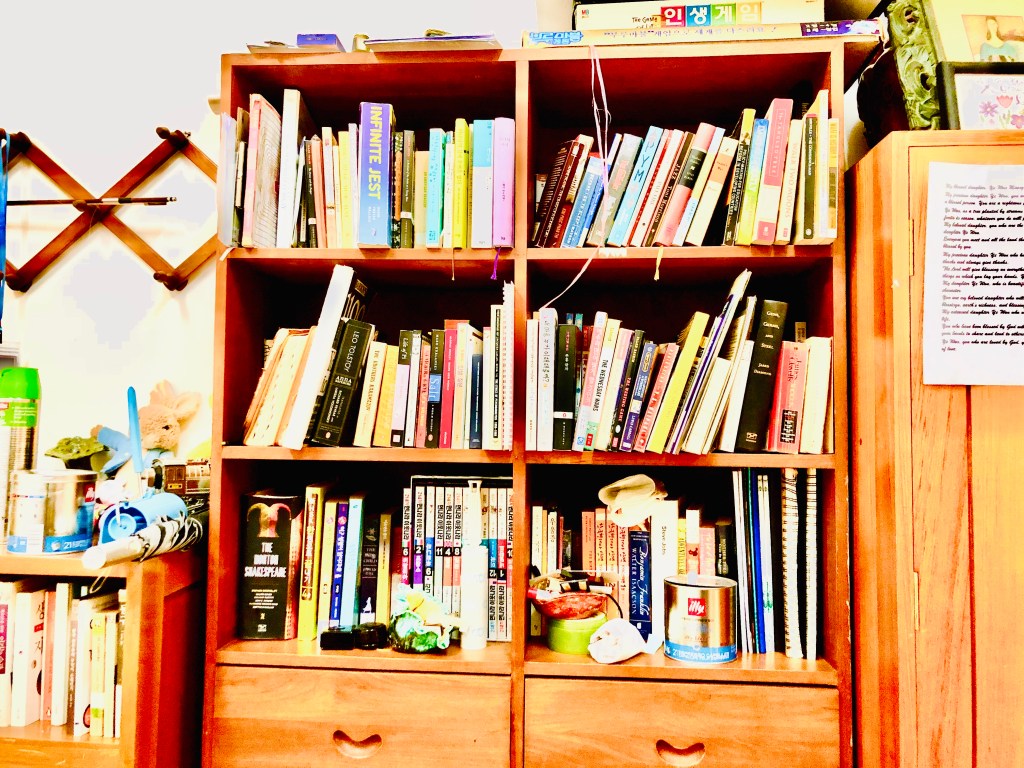
IB English World Literature Paper 2

Sex as a Key to Unlock Repressed Desires in Mishima’s The Sailor Who Fell from Grace with the Sea and Puig’s Kiss of the Spiderwoman

Both Mishima and Puig, the authors of The Sailor Who Fell from Grace with the Sea and Kiss of the Spiderwoman respectively, portray that sex unlocks desires in characters that have been repressed and obscured by the society. In The Sailor Who Fell from Grace with the Sea, Mishima shows that sex uncovers Fusako’s desires for men, which have been repressed by the societal expectations of respectable conduct. In Kiss of the Spiderwoman, Puig portrays that sex causes Molina, who has lived selflessly all his life due to societal obligations, to express his own desires. In both of the books, the authors argue that sex unlocks characters’ desires, which had been repressed by the society.

In The Sailor Who Fell from Grace with the Sea, Mishima writes that Fusako, for “five years since her husband’s death” (Mishima 27), chose not give an eye to any man, trying to maintain her respectable social status as the lady of the Kuroda household. Mishima shows that Fusako’s desire for men, sensual pleasures, and security have been suppressed by societal restraints. Mishima, by describing her bedroom, provides hint to the traces of femininity and sensual agitation that are disclosed in her private niche, in Fusako. Mishima writes, “femininity trembled in every corner [and] a faint scent lingered in the air” (Mishima 4). He also depicts that “the shocking embrace of sheer nylon [of Fusako’s pair of stockings] and the imitation damask of the couch gave the room an air of agitation” (Mishima 5). Mishima develops such agitating and sexually provocative atmosphere in Fusako’s room to show the extent to which Fusako’s femininity and sexual desires have been suppressed, inverted, and confined to her personal space, where the societal forces fail to invade. And as readers, as accomplices of perversion, squeezed in the chest next to Noboru, we are able to peer into Fusako’s personal space – the deepest areas of her mind – where resonate her suppressed self and desires. The peephole serves as a gateway for us to witness Fusako’s repressed sexual desires that are veiled under her contrived façade of a composed, blasé and respectable mistress of the Kuroda household.  

Then Mishima explains how sex reveals these suppressed desires in Fusako. When describing about the sex between Fusako and Ryuji, Mishima writes that at Fusako’s chest, “as if an inner lamp were burning, began a zone of warm, flashy white” (Mishima 7) Mishima uses the imagery of an “inner lamp” to illuminate how Fusako’s sexual desires, which have remained quiescent for five years since her husband’s death, are now ignited to delineate and highlight her “voluptuous shoulders… [and] gracious dignified shoulders” (Mishima 43). Mishima poses the detailed sensual imageries as blatant contrast to her self-possessed, self-conscious lifestyle that she leads during daytime when societal expectations dictate and orchestrate her behaviors. Later, Mishima predicts that Fusako’s “delicate fingertips, stealthy now and reluctant, would quicken into tongues of flame” (Mishima 43). The repeated fire imagery further accentuates Fusako’s fervent desires for sensual pleasures, which violently foam inside her. And the contrast between the delicacy of “fingertips” and vulgarity of “tongues” portrays the extent to which sex transforms her cultured, subdued femininity into violent, crude desires for pleasure. Mishima, through detailed descriptions of the night, shows how sex with Ryuji causes Fusako’s repressed sensual and fervent desires – bottled up inside societal expectations – to pour out and permeate the night with heat and passion.

Secondly, Mishima writes that sex discloses Fusako’s desires to rely on men for security and comfort after years of living as a widow. Mishima describes that after having sex with Ryuji, Fusako “like an insect folding its wings… lower[s] her long lashes” (Mishima 44). Mishima uses such metaphor to describe how Fusako, like an insect folding its wings to perch on something, comes to rest on Ryuji for security and comfort. This shows how sex eventually allows Fusako to uncover and gratify her desires for security and comfort under the care and provision of a man, handing over burdensome responsibilities to Ryuji, who is now the man of the household.

On the other hand, Puig, in Kiss of the Spiderwoman conveys a similar idea about sex. Puig portrays how sex unlocks the desires in Molina that have been repressed by the societal duties. Molina, all his life, has lived selflessly, subjugating his own desires for he had to take care of his sick mother. The footnotes in the book explain to us that such submissive spirit in Molina has actually been wired by society, which has obscured and deluded Molina of his own self-interests. Puig provides footnotes that explain “what has been characteristic of male homosexuals is a submissive spirit … [an attitude which has] proven not to be deliberate, but compulsive, imposed by a slow brainwashing in which heterosexual bourgeois models for conduct participate” (Puig 212). Here, Puig suggests that homosexual men during their adolescence are brainwashed by heterosexual bourgeois models where fathers play the domineering and mothers play the subservient roles. Puig thus suggests that homosexual men, as they come to identify themselves as women of the household, come to adopt this heterosexual bourgeois model as their own “‘bourgeois’ models for homosexual conduct” (Puig 212). Through the use of footnotes, Puig argues that Molina has “incorporate[d] the habits and even the quirks of his progenitors” (Puig 137) – the submissive spirit – that keeps him from expressing his own desires.

Puig further discusses such ideas presented in the footnotes during the conversations between Molina and Valentin. Towards the end of the book, Valentin says to Molina that it doesn’t matter whether he enjoys being a woman but he “shouldn’t feel any the less because of it” (Puig 244) or submit to men. But Molina responds that “but if a man is… my husband, he has to give orders so he will feel right” (Puig 244). Molina believes that “[t]hat’s the natural thing, because that makes him the…man of the house” (Puig 244). Here we can evidently see how Molina has come to be brainwashed by the heterosexual bourgeois model; he believes that a man, the head of the house, has to give orders while a woman has to submit to his orders to make him feel right. Valentin accurately points out that Molina has come to adopt such submissive spirit because he’s been “fed an old wives’ tale by whoever filled [his] head with that nonsense” (Puig 244). Valentin argues that “[n]o, the man of the house and the woman of the house have to be equal with one another” (Puig 244). Puig, by webbing the footnotes with the conversations between Molina and Valentin, demonstrates how Molina’s submissive and selfless spirit has been brainwashed and pieced together by the societal models of behavioral expectations (Puig 213). Puig thereby explains that Molina’s desires have been repressed by societal expectations.

Then Puig shows how Molina comes to realize his own desires after he has sex with Valentin. Having sex allows Molina to identify himself as someone else: “who’s neither a man nor a woman (Puig 235). Molina is no longer defined or categorized by the heterosexual model, which has perpetuated itself over many generations. Now, he is Molina – Molina who has abandoned the submissive spirit and who now expresses his own desires. In fact, Molina tells Valentin that, “the only thing [he] wants is to die” (Puig 236) if it had not been his mother. Molina confesses his frustration in having to think about his mother rather than himself. And this is in fact the first time in the book when Molina actually questions whether it is “fair, that… [he] always ended up with nothing… That [he doesn’t] have anything truly [his own] in life” (Puig 254). He further protests, “my mom has already had a life, and lived it… But when does my life start? When do I strike it lucky, and have something for my own?” (Puig 254). Molina, who had all his life prioritized his mother’s interests over his, now discloses his frustrations and discontentment with his life – or more precisely, the nonexistence of it. He tells Valentin that he doesn’t want to leave, although his mother would be waiting, but stay with Valentin in the prison. Puig shows how sex opens up Molina – whose desires have been repressed by the societal influences and expectations – and causes him to express his own desires and stand up for himself.

Both Mishima and Puig portray how sex unlocks desires that have been repressed by societal expectations. And interestingly, both authors use a form of sex that is considered a taboo or at least reprehensible or shameful when evaluated from the societal norms of that time period and region. In Mishima’s The Sailor Who Fell from Grace with the Sea, Fusako, a widow, has sex with an outside man, Ryuji; such act can be deemed disreputable even more so in her society. In Puig’s Kiss of the Spiderwoman, Molina, a homosexual man, has sex with Valentin, a man who he comes to fall in love with. As the footnotes throughout the book suggest, homosexuality back at that time and place had just started being recognized and studied and its misconceptions gradually corrected. In this manner, both Puig and Mishima discusses a form of sex that is considered taboo in its respective society, and they describe how the characters, by engaging in such taboo sexual acts, break the taboo and challenge the very societal constraints which have restrained them from being their true selves. Both authors argue that sex liberates the characters from society’s constraints, allowing them to indulge in their own desires. (1542 words)

References

Mishima, Yukio. The Sailor Who Fell from Grace with the Sea. New York: Knopf, 1965. Print.

Puig, Manuel, and Thomas Colchie. Kiss of the Spider Woman. New York: Vintage, 1991. Print.

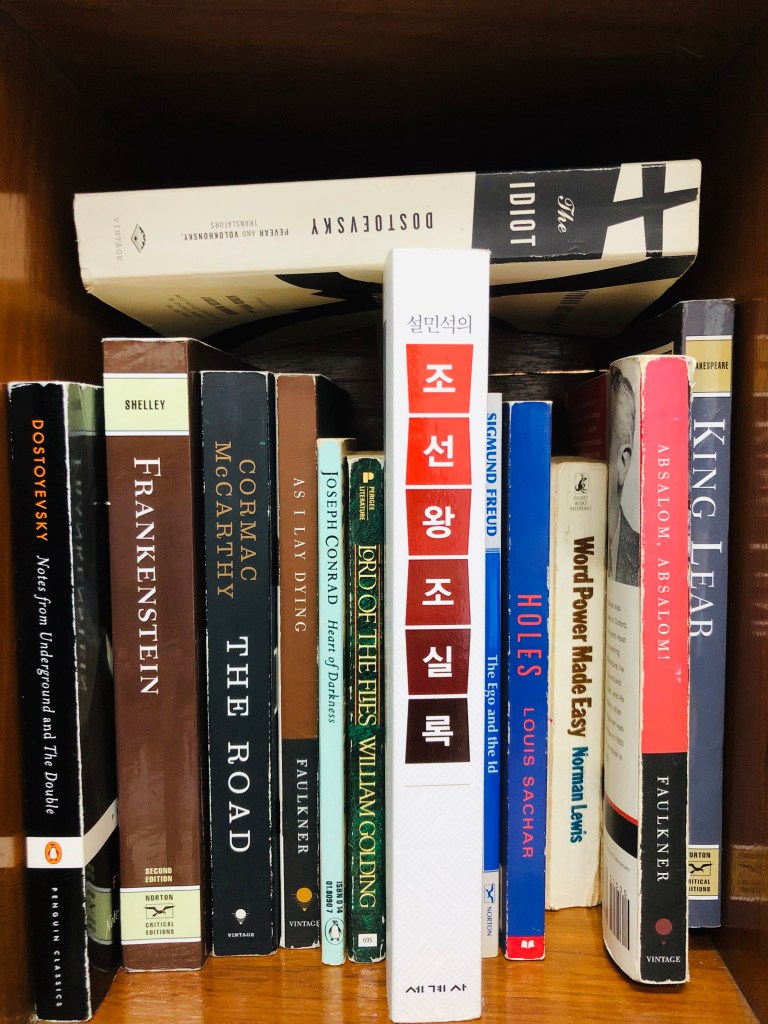
List of Must-Read Books (Part I)

Brave New World (Huxley): genre: dystopian novel, themes: genetic engineering, predictions about future

1984 (George Orwell): genre: dystopian novel (Big Brother: central controller/government: Ministry of Plenty, Peace, Peace, Love, Truth: concepts of doublethink/blackwhite)

The Catcher in the Rye (J.D. Salinger): themes: youth, innocence, growing up, characters: Holden Caulfield, Phoebe) significance of title: to think of himself as a catcher/protector of Phoebe from the phoniness of the world, from falling off the cliff in the rye

To Kill a Mockingbird (Harper Lee): characters: Atticus, Scout, Jem, themes: about race, class, youth, growing up, main conflict: Atticus, a white attorney defends a black man for a crime he is accused for but has not committed, and the conflicts that evolve in Maycomb County due to this trial in court

Lord of the Flies (William Golding): characters: Ralph (democratic ideals), Piggy (intellectual one), Jack (dictatorial ideals) themes: power, societal organization plot: how the story unravels as plane crashes in an island middle of nowhere/ocean and teenage boys have to organize society amongst themselves in the absence of adults symbols: fire (civilization), eyeglasses (science, technology, education), cone (seashell) used to bring boys together: democratic ideals significance of title: at the end of the novel, we encounter a gory scene where the pig’s head is stuck on the top of a stick and there are flies hovering over the boar’s head/ the head is supposed to symbolize the evil in human nature (as members of the boys end up killing and hurting one another during the power struggle and competition for food and resources)

The Old Man and the Sea (Ernest Hemingway): descriptions of catching fish in the sea (lengthy descriptions of catching the fish seem to be realistic depictions of the rigor and reality of catching the fish in the sea, parallels to Moby Dick could be found

Pride and Prejudice (Jane Austen) themes: class, marriage/ marriage based on class, behavior, compatibility (conflicts, misunderstandings, resolution)

Animal Farm (George Orwell): social commentary/ animal characters to represent various Russian leaders in the Russian Revolution

The Metamorphosis (Kafka) psychological/symbolic plot: main character wakes up one morning to find himself transformed into a huge insect/ responses of the family members: father: financial burden of having to work extra hours, mother: maternal instinct and sympathy vs. appall and disgust of finding his own son turned in to a bug: younger sister: mainly disgust

Frankenstein (Mary Shelley) Victor Frankenstein, a scientist creates a new creation mimicking features of a human being/ but his own creation though externally resembling features of a human being, fails to integrate into human society, yearns human contact and sense of belonging, returns to his creator for revenge of having created him (commentary about human cloning?)

Number the Stars (Lois Lowry): escape of jewish family during WWII. avoid being relocated to concentration camps. The title being reference to Old Testament reference of numbering the stars (Jewish tradition)

Hatchet (Gary Paulsen): stranded in wilderness with a hatchet (plane crashing, survival story, making tools, fire, beginning of civilization) similar to Lord of the Flies in main driving plot

The Giver (Lois Lowry): dystopian (lacking emotional concepts/depth) can’t tell difference between what is inherently good and evil (cannot have one without the other)

Dead Poets Society (Robin Williams) John Keating, the English teacher inspiring students of love for poetry

The Great Gatsby (F. Scott Fitzgerald) social commentary about the American Dream; Jay Gatsby – collected great wealth to win Daisy only to discover her married to someone else. twist in ending.

Of Mice and Men (John Steinbeck) Lennie and George: two migrant workers; Lennie strong but mentally disabled; need George to accompany him

White Tiger (Aravind Adiga) issues of religion, caste, loyalty, corruption, poverty in India

A Small Place (Jamaica Kincaid) Nonfiction: experiences of growing up in Australia; criticism of Antinguan government: tourism as an industry/ British colonial legacy

Perfume (Patrick Suskind) the story of a murderer: sense of smell: relationship to emotions/ Grenouille: master of scents: commit murder to extract their scents: born in 18th century France (significance of the ending: people consuming Grenouille “out of love”)

The Odyssey (Homer) epic poems. Ancient Greek literature; ten year journey of Odyssey, king of Ithaca after the fall of Troy (Illiad: fight between king Agamemnon and warrior Achilles lasting a few weeks during the last year of Trojan war)

The Republic (Plato) Socratic dialogue, written by Plato, around 375 B.C concerning justice (justice=power of the stronger?) characteristics of the just city (the order of society/state, a just city drawn parallel to a just man: law/conscience) work of philosophy political theory

The Stranger (Albert Camus) Mersault: citizen of France dismissed in North, yet hardly partakes in Mediterranean Africa: lack of emotions in mother’s funeral

Death and the Maiden (Ariel Dorfman) Schubert’s String Quartet: subtitled Death and the Maiden, played by the sadistic doctor during the act of murder: kills an Arab man and sentence to death. 1st personal narrative before and after the death: aftereffects of psychology/ damage of people in a country emerging from totalitarian dictatorship (end of the play/ unclear of who is innocent) Roberto’s guilt/ Paulina’s paranoia

Hamlet (Shakespeare) set in Denmark: Prince Hamlet and his revenge against his uncle, Claudius who has murdered Hamlet’s father in order to seize his throne and marry Hamlet’s mother (Freudian interpretation of Oedipus complex) (famous line “to be or not to be” that is the question)

King Lear (Shakespeare) take of a king who bequeaths his power tale of a king who bequeaths his power and to two of his three daughters after they declare their love for him in an obsequious manner. His daughter gets nothing because she will not flatter as her sisters have: later in the plot: tragedy falls on both of them/ when disrespected by both of the daughters who now have his wealth, reconciled to his third daughter

The Handmaid’s Tale (Margaret Atwood) dystopian novel: themes of subjugated women in a patriarchal society – attempt to gain individuality and independence

Macbeth (Shakespeare): tragedy/ damaging physical + psychological effects of political ambition at its extreme (seeking power for its own sake) Macbeth (gets prophecy from two of the witches that he will become King of Scotland, consumed by ambition/spurred on by his wife, Lady Macbeth, commits murders. takes Scottish throne for himself. wrecked with guilt and paranoia, commits additional murders to protect himself from enmity and suspicion) bloodbath + civil war drive Mabeth and Lady Macbeth to death + madness (the famous: life nothing but sound and fury, a tale told by an idiot) inspired Faulker to write Sound and the Fury

Sound and the Fury (William Faulkner) stream of consciousness, four sections/perspectives: From Benjy’s perspective/ Quentin/ Jason/ omniscient point of view / the notion of time highlighted throughout the book (clock/watch, passing of time) loud cry of Benjy signifying the pulsation of the universe (mentally disadvantaged, yet providing significant perspective to the perception of reality and of the world in Faulkner’s narratives)

The Perks of Being a Wallflower (Stephen Chbosky) young adult coming of age (Asking poignant questions)

The Hitchhiker’s Guide to the Galaxy (Douglas Adams)

Walden (Henry David Thoreau) reflection upon simple living in natural surroundings (independence, social experiment, self-reliance)

Othello (Shakespeare) tragedy, tragic hero: Othello a Middle Eastern general in the army; Iago, the antagonist, themes: racism, love, jealousy, betrayal, revenge, repentance (manipulates his action to perform wicked deeds) Iago: highlights the excessive time Cassio and Othello’s wife, Desdemona are spending tougher (Othello, filled with rage murder one he loves)

A Doll’s House (Henrik Ibsen): fate of a married woman/ lack of opportunities for self-fulfillment in a male-dominated world/ Nora and Torvald (their relationship dynamics/ significance of the title) genre as a play, set: emblematic representation/ resemblance of the Doll’s House itself)

The Idiot (Dostoevsky): ironic reference to the protagonist Myshkin, a young man whose goodness/ open-hearted simplicity and guilelessness led many of the more worldly characters he encounters to mistakenly assume that he lacks intelligence and insight (Russian church/Christianity/atheism/ conversion: to confront Christian faith with everything that negated it

Crime and Punishment (Dostoevsky) Raskolnikov, the main character of the novel ends up murdering his house lord, the landlady when he encounters her giving a hard time to one of the people living in the building who is struggling to pay his rent; enraged with a sense of justice, he ends up committing the murder which ends up haunting him through his conscience; the book deals with not just legal but moral repercussions of crime and punishment /relationship with Sonya (conscience, legal system) id/ego/superego (Freudian concept) superego: the conscience/ legal system

Love in the Time of Cholera: (Gabriel Garcia Marquez) theme: love as an emotional and physical disease: depiction of cholera as both as a disease and passion; two men contrasted as having too much/too little passion – what is more (lack or plethora of emotion) conducive contributive to love and happiness

The Road (Cormac McCarthy): post apocalyptic novel: journey of a father and his young son. across a landscape blasted by an unspecified cataclysm that destroyed most of civilization over several months

Sailor Who Fell From Grace with the Sea (Yukio Mishima) Ryuji, Fusako, Noboru, Japanese concepts of glory and honor (heroic death/ the sea) Paper 2: “glory is bitter stuff” Post WWII Western influence

Wide Sargasso Sea (Jean Rhys): feminist and anti-colonial response to Charlotte Bronte novel Jane Eyre – describing background to Mr. Rochester’s marriage from the point of view of his mad wife Antionette (Creole heiress) (hidden/locked up in the dungeon: inspired from the scene/character in Jane Eyre)

Jane Eyre (Charlotte Bronte): Mr. Rochester and Jane: Jane’s moral and spiritual development through 1st person narrative (psychological identity) first historian of the private consciousness. topics of class, sexuality, religion, femininity

Season of Migration to the North (Tayeb Salih): postcolonial Arabic novel by the Sudanese novelist Tayeb Salih: impact of British colonialism and European modernity on wisdom of ancestors/ rural African societies and Sudanese culture and identity (counter-narrative to Heart of Darkness)

Heart of Darkness (Joseph Conrad) voyage up the Congo River: into Congo Free State in the Heart of Africa. Marlow (narrator) narrates the story (themes: imperialism, racism) his obsession with the ivory trader Kurtz (has native wife, complete assimilation) repeated phrase: “fascination of abomination” Kurtz’s last words: “The Horror, The Horror” (narrative significance)

Moby Dick (Herman Melville): themes on class, social status, good and evil, existence of God, race, references of Shakespeare, philosophers and the Bible) Ishamael’s narrative of the obsessive, monomaniacal quest of Ahab, captain of the whaling ship Pequod, for revenge on Moby Dick – the giant white sperm wheel that bit off Ahab’s leg at the knee in the ship’s previous voyage

Beloved (Toni Morrison) inspired by true story (Margaret Garner, the African American who escaped slavery – killed her child rather than have them taken back into slavery) Sethe – likewise killed her children, the ghost of which comes to haunt her/ the house (relationship with Paul D. process o healing (romanticism of pain of finding beauty in African American blues/ Christian tradition) (scene of sitting on the steps – foundation of working class of America) consoling Sethe (definition of manhood redefined)

The Crucible (Arthur Miller) dramatized/ fictionalized story of “Salem Witch Trials in MA” allegory for McCarthyism = when the US government persecuted people accused of being communists/ witch hunting

Waiting for Godot (Samuel Beckett): two characters what for the arrival of someone named Godot, who never arrives and while waiting – the characters engage in variety of conversations/ controversy on whether Godot was intended by Beckett to represent God

Piano Tuner (Daniel Mason) protagonist commissioned to British War office to repair a grand piano, set in British India and Burma, piano slipped to him to bring union and peace amongst princes in Burma

Notes from Underground and the Double (Dostoevsky): underground man’s diary, emblematic of political climate in Russian during the time.

the Double: the human will in search for total freedom challenging ideologies of nihilism and rational egoism

Great Expectations (Charles Dickens) wealth, money, crime, social class, social alienation, imperialism, conscience, climbing up the ladder, gentility moral regeneration,

Tale of Two Cities (Charles Dickens) before and during French Revolution; conditions that led up to the Revolution: themes of resurrection, recalled to life, light and darkness (Good and evil) John Bunyan pilgrimage redeemed, progress/ suffering by one sacrifices, source of wealth (earned vs. efforts of others) potential repercussions champion for the poor

Brothers Karamazov (Dostoevsky): ethical debacle of God, free will, morality, influence on Einstein, Heidegger, Virginia Wolf, McCarthy, Murukami

Anna Karenina (Leo Tolstoy): Tolstory’s nonviolent resistance (along with Mahatma Gandhi and Martin Luther King) spiritual awakening (Christian/anarchism) themes of hypocrisy, jealousy, faith, fidelity, family, marriage, society, progress, carnal desire and passion, (agrarian connection to land) no one may build their happiness on another’s pain recurring message through characters’ conflict

Bud, not Buddy (Christopher Paul Curtis) Great Depression era, jazz, social issues like violence, racism. Bud’s journey to find his father: experience of many people during the Great Depression as they had to move around looking for work and new homes

Holes (Louis Sachar) Camp Green Lake, labor, serving in the camp for the crime of stealing shoes of a famous baseball player (juvenile Camp)

Maus I, II (Art Spiegelman) graphic novel by American cartoonist, interviewing his own father (Vladek) about his own experiences as a Polish Jew, and Holocaust survivor: postmodernist techniques: Jews as mice, Germans as cats, and Poles as pigs, memoir, biography, history, fiction, autobiography, mix of genres (Auschwitz, Nazi concentraion camps) minimalist drawing style (innovation in its pacing, structure, page layouts/ self-reflective of the process of writing, interviewing, researching for the novel

Anne Franke (The Diary of a Young Girl)

Eat, Pray Love (Elizabeth Gilbert) Pleasure of nourishment by eating in Italy, the power of prayer in India, the inner peace and balance of true love in Indonesia

The Bluest Eye (Toni Morrison): Pecola, black girlhood, white lifestyle/standards, internalized racism, religion, media and culture, shame, breakage and separation (extended essay for extended discussion)

About a Boy (Nick Hornby) Marcus (schoolboy) Fiona (suicidal mother) Will Freeman; the budding love relationship between Fiona and Will, and the transformations Marcus goes through with aging and also between their growing relationship

The Ego and the Id (Sigmund Freud) Id (natural drive, instinct) Ego (balance between Id and superego) Superego (conscience) gatekeepers of society, parents, teachers, police, law

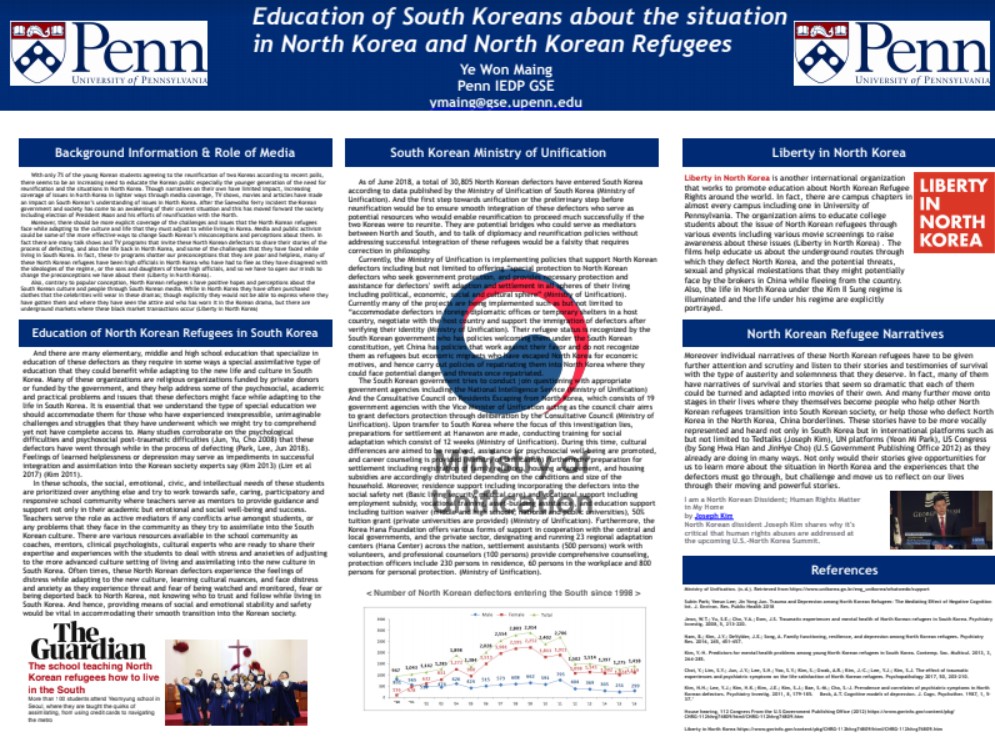
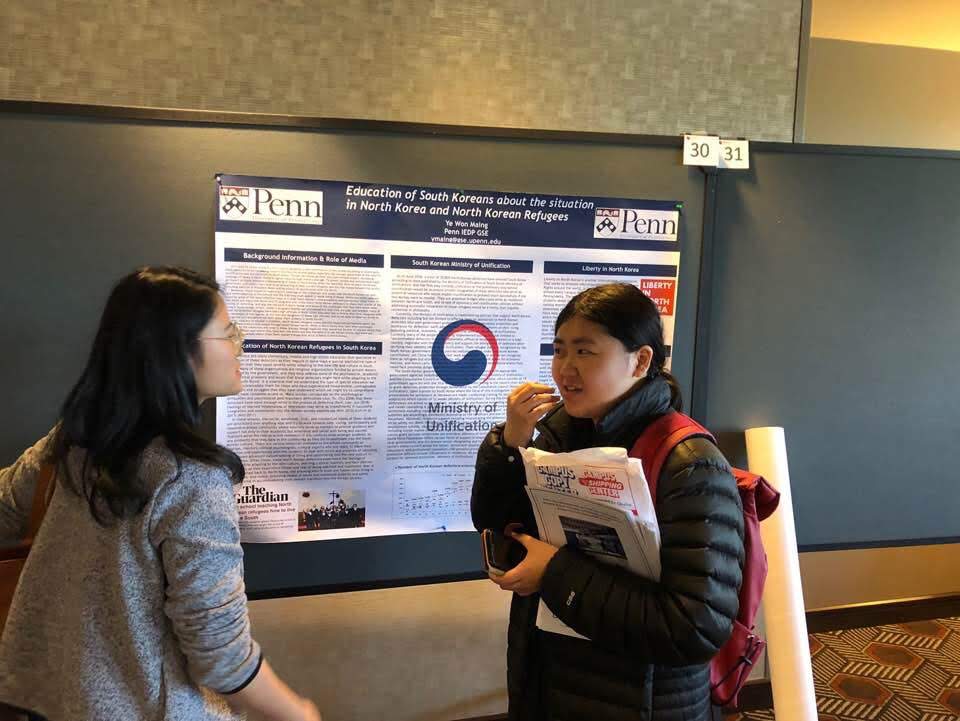
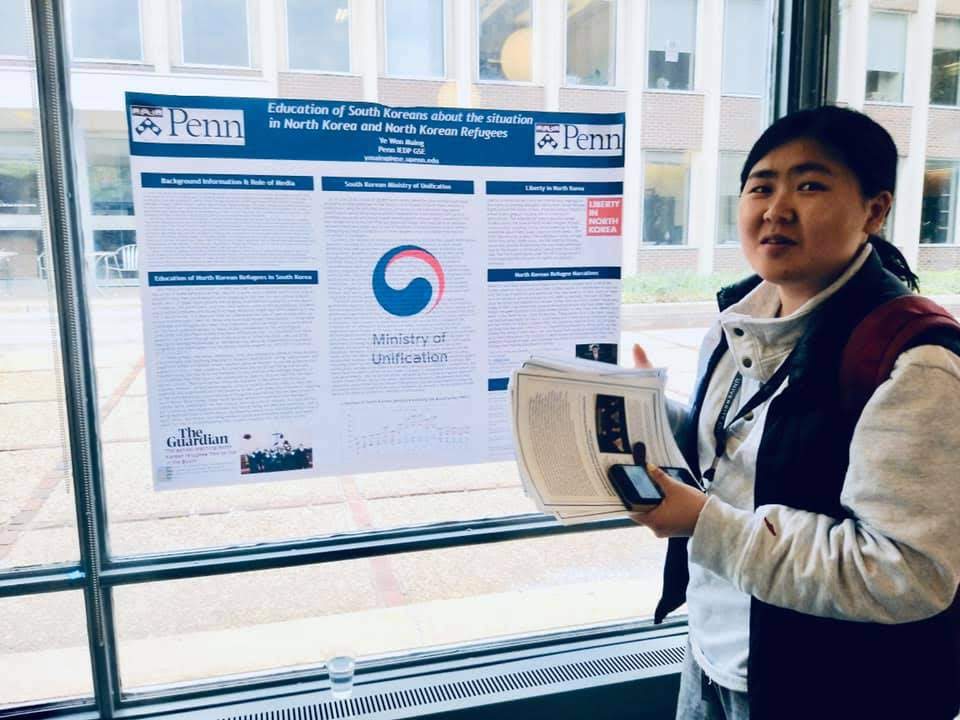
Education of North Korean Refugees in South Korea (Current Events) CIES Presentation

Background Information & Role of Media Liberty in North Korea Education of North Korean Refugees in South Korea North Korean Refugee Narratives South Korean Ministry of Unification With only 7% of the young Korean students agreeing to the reunification of two Koreas according to recent polls, there seems to be an increasing need to educate the Korean public especially the younger generation of the need for reunification and the situations in North Korea. Though narratives on their own have limited impact, increasing coverage of issues in North Korea in lighter ways through media coverage, TV shows, movies and articles have made an impact on South Korean’s understanding of issues in North Korea. After the Saewolho ferry incident the Korean government and society has come to an awakening of their current situation and this has moved forward the society including election of President Moon and his efforts of reunification with the North. Moreover, there should be more explicit coverage of the challenges and issues that the North Korean refugees face while adapting to the culture and life that they must adjust to while living in Korea. Media and public activism could be some of the more effective ways to change South Korean’s misconceptions and perceptions about them. In fact there are many talk shows and TV programs that invite these North Korean defectors to share their stories of the process of defecting, and also the life back in North Korea, and some of the challenges that they have faced while living in South Korea. In fact, these tv programs shatter our preconceptions that they are poor and helpless, many of these North Korean refugees have been high officials in North Korea who have had to flee as they have disagreed with the ideologies of the regime, or the sons and daughters of these high officials, and so we have to open our minds to change the preconceptions we have about them (Liberty in North Korea). Also, contrary to popular conception, North Korean refugees s have positive hopes and perceptions about the South Korean culture and people through South Korean media. While in North Korea they have often purchased clothes that the celebrities will wear in these dramas; though explicitly they would not be able to express where they have gotten them and where they have seen the attire and who has worn it in the Korean drama, but there are underground markets where these black market transactions occur (Liberty in North Korea) Liberty in North Korea is another international organization that works to promote education about North Korean Refugee Rights around the world. In fact, there are campus chapters in almost every campus including one in University of Pennsylvania. The organization aims to educate college students about the issue of North Korean refugees through various events including various movie screenings to raise awareness about these issues (Liberty in North Korea) . The films help educate us about the underground routes through which they defect North Korea, and the potential threats, sexual and physical molestation that they might potentially face by the brokers in China while fleeing from the country. Also, the life in North Korea under the Kim Il Sung regime is illuminated and the life under his regime are explicitly portrayed. And there are many elementary, middle and high school education that specialize in education of these defectors as they require in some ways a special assimilating type of education that they could benefit while adapting to the new life and culture in South Korea. Many of these organizations are religious organizations funded by private donors or funded by the government, and they help address some of the psycho-social, academic and practical problems and issues that these defectors might face while adapting to the life in South Korea. It is essential that we understand the type of special education we should accommodate them for those who have experienced inexpressible, unimaginable challenges and struggles that they have underwent which we might try to comprehend yet not have complete access to. Many studies corroborate on the psychological difficulties and psychosocial post-traumatic difficulties (Jun, Yu, Cho 2008) that these defectors have went through while in the process of defecting (Park, Lee, Jun 2018). Feelings of learned helplessness or depression may serve as impediments in successful integration and assimilation into the Korean society experts say (Kim 2013) (Lim et al 2017) (Kim 2011). In these schools, the social, emotional, civic, and intellectual needs of these students are prioritized over anything else and try to work towards safe, caring, participatory and responsive school community where teachers serve as mentors to provide guidance and support not only in their academic but emotional and social well-being and success. Teachers serve the role as active mediators if any conflicts arise among students, or any problems that they face in the community as they try to assimilate into the South Korean culture. There are various resources available in the school community as coaches, mentors, clinical psychologists, cultural experts who are ready to share their expertise and experiences with the students to deal with stress and anxieties of adjusting to the more advanced culture setting of living and assimilating into the new culture in South Korea. Often times, these North Korean defectors experience the feelings of distress while adapting to the new culture, learning cultural nuances, and face distress and anxiety as they experience threat and fear of being watched and monitored, fear or being deported back to North Korea, not knowing who to trust and follow while living in South Korea. And hence, providing means of social and emotional stability and safety would be vital in accommodating their smooth transition into the Korean society. Moreover individual narratives of these North Korean refugees have to be given further attention and scrutiny and listen to their stories and testimonies of survival with the type of austerity and solemnness that they deserve. In fact, many of them have narratives of survival and stories that seem so dramatic that each of them could be turned and adapted into movies of their own. And many further move onto stages in their lives where they themselves become people who help other North Korean refugees transition into South Korean society, or help those who defect North Korea in the North Korea, China borderlines. These stories have to be more vocally represented and heard not only in South Korea but in international platforms such as but not limited to Tedtalks (Joseph Kim), UN platforms (Yeon Mi Park), US Congress (by Song Hwa Han and JinHye Cho) (U.S Government Publishing Office 2012) as they already are doing in many ways. Not only would their stories give opportunities for us to learn more about the situation in North Korea and the experiences that the defectors must go through, but challenge and move us to reflect on our lives through their moving and powerful stories.

Education of South Koreans about the situation in North Korea and North Korean Refugees

As of June 2018, a total of 30,805 North Korean defectors have entered South Korea according to data published by the Ministry of Unification of South Korea (Ministry of Unification). And the first step towards unification or the preliminary step before reunification would be to ensure smooth integration of these defectors who serve as potential resources who would enable reunification to proceed much successfully if the two Koreas were to reunite. They are potential bridges who could serve as mediators between North and South, and to talk of diplomacy and reunification policies without addressing successful integration of these refugees would be a falsity that requires correction in philosophy. Currently, the Ministry of Unification is implementing policies that support North Korean defectors including but not limited to offering “special protection to North Korean defectors who seek government protection, and provides necessary protection and assistance for defectors’ swift adaption and settlement in all spheres of their living including political, economic, social and cultural sphere” (Ministry of Unification). Currently many of the projects are being implemented such as but not limited to “accommodate defectors in foreign diplomatic offices or temporary shelters in a host country, negotiate with the host country and support the immigration of defectors after verifying their identity (Ministry of Unification). Their refugee status is recognized by the South Korean government who has policies welcoming them under the South Korean constitution, yet China has policies that work against their favor and do not recognize them as refugees but economic migrants who have escaped North Korea for economic motives, and hence carry out policies of repatriating them into North Korea where they could face potential danger and threats once repatriated. The South Korean government tries to conduct join questioning with appropriate government agencies including the National Intelligence Service (Ministry of Unification) And the Consultative Council on Residents Escaping from North Korea, which consists of 19 government agencies with the Vice Minister of Unification acting as the council chair aims to grant defectors protection through deliberation by the Consultative Council (Ministry of Unification). Upon transfer to South Korea where the focus of this investigation lies, preparations for settlement at Hanawon are made, conducting training for social adaptation which consist of 12 weeks (Ministry of Unification). During this time, cultural differences are aimed to be resolved, assistance for psychosocial well-being are promoted, and career counseling is provided (Ministry of Unification) Furthermore preparation for settlement including registration of family relations, housing arrangement, and housing subsidies are accordingly distributed depending on the conditions and size of the household. Moreover, residence support including incorporating the defectors into the social safety net (Basic living security, medical care) and vocational support including employment subsidy, vocational training, asset-building assistance , and education support including tuition waiver (middle and high schools, national and public universities), 50% tuition grant (private universities are provided) (Ministry of Unification). Furthermore, the Korea Hana Foundation offers various forms of support in cooperation with the central and local governments, and the private sector, designating and running 23 regional adaptation centers (Hana Center) across the nation, settlement assistants (500 persons) work with volunteers, and professional counselors (100 persons) provide comprehensive counseling, protection officers include 230 persons in residence, 60 persons in the workplace and 800 persons for personal protection. (Ministry of Unification). < Number of North Korean defectors entering the South since 1998 >

I am a North Korean Dissident; Human Rights Matter in My Home by Joseph Kim North Korean dissident Joseph Kim shares why it’s critical that human rights abuses are addressed at the upcoming U.S.-North Korea Summit. References Ministry of Unification. (n.d.). Retrieved from https://www.unikorea.go.kr/eng_unikorea/whatwedo/support

Subin Park; Yeeun Lee; Jin Yong Jun. Trauma and Depression among North Korean Refugees: The Mediating Effect of Negative Cognition Int. J. Environ. Res. Public Health 2018 Jeon, W.T.; Yu, S.E.; Cho, Y.A.; Eom, J.S. Traumatic experiences and mental health of North Korean refugees in South Korea. Psychiatry Investig. 2008, 5, 213–220. Nam, B.; Kim, J.Y.; DeVylder, J.E.; Song, A. Family functioning, resilience, and depression among North Korean refugees. Psychiatry Res. 2016, 245, 451–457. Kim, Y.-H. Predictors for mental health problems among young North Korean refugees in South Korea. Contemp. Soc. Multicul. 2013, 3, 264–285. Choi, Y.; Lim, S.Y.; Jun, J.Y.; Lee, S.H.; Yoo, S.Y.; Kim, S.; Gwak, A.R.; Kim, J.-C.; Lee, Y.J.; Kim, S.J. The effect of traumatic experiences and psychiatric symptoms on the life satisfaction of North Korean refugees. Psychopathology 2017, 50, 203–210. Kim, H.H.; Lee, Y.J.; Kim, H.K.; Kim, J.E.; Kim, S.J.; Bae, S.-M.; Cho, S.-J. Prevalence and correlates of psychiatric symptoms in North Korean defectors. Psychiatry Investig. 2011, 8, 179–185. Beck, A.T. Cognitive models of depression. J. Cogn. Psychother. 1987, 1, 5– 37.’ House hearing, 112 Congress From the U.S Government Publishing Office (2012) https://www.govinfo.gov/content/pkg/ CHRG-112hhrg74809/html/CHRG-112hhrg74809.htm Liberty in North Korea https://www.govinfo.gov/content/pkg/CHRG-112hhrg74809/html/CHRG-112hhrg74809.htm

College Essay

               Four years have passed, yet I can still remember Mr. Stroupe thundering, “Can’t you see you’re in the Cave? Don’t you realize that it’s merely the illusory shadows on the walls that you perceive as the reality?” His voice would echo in the classroom as he relentlessly repeated Plato’s Cave allegory, entreating us to see beyond superficialities. And I, intoxicated by his charismatic aura, saw him as a savior who could redeem me from my ignorance: I was the Idiot in the Cave; he, the great Socrates, beckoning me to come out of the Cave. At the moment, I had not yet discovered the fundamental fallacy to Mr. Stroupe’s oft-repeated Cave allegory.

               I first met Mr. Stroupe in my ninth grade History class. My first memory of him was his yelling in my ear to write “C-R-A-P” in my history textbook. Mr. Stroupe then proceeded to riddle the textbook with criticism, ripping apart and calling into question nearly everything I had learned in my previous eight years of education. With his cynicism, he incessantly boggled my mind, hurling my entire belief system into a marshy bog encircled by a swarm of Socratic gadflies, bred by Mr. Stroupe himself.

               Having lived more than ten years of my life in Myanmar, a place where nothing is supposed to be questioned and everything accepted at face value, I found his provoking words even more startling. His words, ringing in the air like deafening gunshots, penetrated the silence and servility of this place and of the void inside me. And it was then I instinctively recognized my calling: I clawed my way out of the pit of ideological subservience and stumbled onto the streets. Stern and determined, I started fighting for my freedom as a thinker and my independence as an intellectual rebel.

               In my junior year, I initially hesitated to take his classes, not because I feared or resisted his unconventional ideas, but because I recognized that I had perhaps too readily accepted them. He, for instance, would argue, “Philanthropy is way too overrated in our society. In order to achieve efficiency, we should all be ruthlessly selfish,” and I would indiscriminately take in such ideas.

               But honestly speaking, I finally started to ask myself: “To what extent am I accepting his ideas solely because they are intriguing, and he is intriguing? In turn, to what extent is he endorsing unconventional ideas because he truly believes in them? Or is he doing so at times merely out of his life-goal to challenge and overthrow all conventions?” I realized that my awe and envy of him as an avant-garde iconoclast had prevented me from asking such questions and objectively examining his ideas.

               Disappointed and alarmed by the susceptibility of my mind, it gave me all the more reason to take his classes. I wanted to prove to myself that he hadn’t pieced me together into a Barbie doll, pleasing to see but docile and impressionable. Rather, I wanted him to know that he, Clark Stroupe alias Victor Frankenstein, had created a fully independent creature: a living, thinking organism beyond his captivity and control. The rebellious ego emerged from within, liberating me from the power he and his words had over me; I began to overtly disagree, question and evaluate even his ideas.

               But soon enough, I came to realize that I was at times rejecting his ideas for the same reasons I had accepted them: just because they were his ideas. Thus I was as alarmed by my newly adopted immature defiance as I was by my former naïve submission. I was frustrated at myself for not realizing that the battle was not against him and his philosophies but for my own intellectual awakening. To resolve this inner struggle, I strived to establish myself as an impartial, dignified knower and not a follower or a rebel.

               Having achieved the equilibrium of the mind, and thus the nerve and autonomy to take risks, I started to experiment by smashing my ideas onto the walls of Mr. Stroupe’s classroom, the walls of the Cave. While the more feeble ones splashed like tomatoes, the stronger, more complexly-woven ones endured the blows of critical questions from my peers and Mr. Stroupe. Ironically, as my beliefs were broken apart for scrutiny and analysis, I started to feel more confident in the strength and validity of those opinions and ideas that were left behind intact.

               And today, I burst out of my intellectual cocoon to emerge as an independent organism – grown mature through surgical introspection, major deconstruction and inspired volition – both beyond and within Mr. Stroupe’s influences.

               Four years have passed, and I’ve finally come to realize that I’m not the idiot in the Cave nor is Mr. Stroupe the great Socrates outside the Cave. In fact, no man, including Mr. Stroupe and even Socrates himself, can escape the destiny of the Cave. All men are confined, in one way or another, as we do not hold absolute knowledge, freedom or power. But even as I’m in the Cave, I no longer yearn to get out of it. Rather, I feel blessed to live in the Cave, in an imperfect society. Because I do, I can dream of a better new world: I can dare believe, I can hope, I can breathe and thus live as a human being.

               And today, holding onto the mirage of an outside world – made possible by the years of my struggle for an intellectual awakening – I strive to revolutionize the imperfect reality of the Cave, making it the better place I envision.

Sample Essay Topics

I chose to write about being a woman of paradoxical cultural backgrounds, the struggles that come with that and how I overcame them.

 “With the audacity to choose”, I choose to be everything and anything, only limited by my own choices. Like Margaret Thatcher, I choose not to settle but to seize. Like Virginia Woolf, I am empowered through the products of my compelling voice and my creative mind. Like the Lady, I choose to defy with grace, dignity, compassion and confidence.

I chose to write about someone who has significantly influenced my life as a learner.

“I wanted to prove to myself that he hadn’t pieced me together into a Barbie doll, pleasing to see but docile and impressionable. Rather, I wanted him to know that he, Clark Stroupe alias Victor Frankenstein, had created a fully independent creature: a living, thinking organism beyond his captivity and control.”

I chose to write about my experience as a SEEDs leader and my passion towards changing Burma, but also mentioning casually the details of my personal life. (A college essay should be a coherent collage of who you are.) I also shared my ideologies, principles and worldviews that have been nurtured by such experiences.”

But, my ambitions to inspire virtue, compassion, and benevolence stem from my own redemption as an individual and as a leader. Perhaps society is already too saturated with cynicism to believe in the utopian ideals and to transform the ethos of conventional thinking, but I find such cynicism futile and also difficult to conform to their ways of skepticism.”

I wrote about how my fight for asserting my independence is reflected in my signature.  

“Just as I crafted my vision of how scenes should be blocked for Noises Off, I have now crafted my own signature: a blend of my initials Tz in loopy cursive handwriting combined with a messy blob of my name written in Burmese.”

My common application essay was about my identity as an artist and how growing up in Myanmar helped shape that identity.

“To come from such a conflicted country with so many unsaid things to say is every artist’s morbid, un-confessed dream, but to be a 17-year-old with a personal opinion establishing himself as an artist interested in criticizing society is also frighteningly un-Burmese.”

I chose to write about the World Cup and how it changed my views on Africa. Instead of a personal essay, I went with something more suited to the field that I wished to pursue: International Relations. 

Through the festivities of this global sporting event, I soon began to gain awareness of the intrinsic misconception I had about the developing world. Africa was not some absolute, poverty-stricken mishmash; it was an immense continent composed of an extensive range of nations including both the wealthy and the abysmal. In a nutshell, it was a continent with vast prospects.” 

Harvard Supplement (Topic of Your Choice)

I chose to write about how books have changed my life, opened new doors for me, and helped me develop into the person I am today. And I drew parallelism between COOP (Harvard Bookstore) and the role I wish to play in Myanmar. I described how I want to be the COOP of Myanmar – the source of growth and development of my country.

It was a sunny yet fresh and gusty day in Cambridge, Massachusetts, drastically different from the typical blistering heat and humidity back home in Myanmar. I wandered around the globally renowned brick roads of Harvard Square, until I halted in front of the prominent COOP bookstore. I walked through the wooden polished doors and was immediatelyenclosed within millions of books.”

Personal Statement (Amherst + Harvard Supplement Essays)
There are two people, perspectives, values that I’ve come to merge into one – into the present day
me. The first, Aung San Suu Kyi, the political activist of Myanmar, has inspired me to believe that along with my privileges come not only the responsibility to share such privileges but also the ability to afford so – that I not only should but also can afford such compassions and virtues. The next, Hans Rosling, a Swedish economics researcher I admire, has made me realize that such compassions and virtues are not good enough; in fact, if they are channeled inappropriately, they may even do more harm than good. He influenced me to believe that good intentions in our hearts are translated into goodness in the world when we come to understand the fine differences between the situation in Mozambique and Zambia: when we come to develop a less paternalistic and more accurate, contextualized understanding of the world. Bearing the words of Suu Kyi and Rosling in mind; merging their respective viewpoints on virtues and knowledge; emotions and reason; intentions and impact; I wish to tend equally to the life of the heart and
the life of the mind. In college, I wish to, by studying economics, contextualize my rather still naïve understanding of the world. And I wish to nurture my compassion, connecting myself to other people who strive to pursue morally active lifestyles. A more refined understanding of the world, fuelled by my increasing desire and affordability to lead an ethical life, will help translate my dreams into the betterment of our society.

What is Home: English Symposium

Home is a smell. Home is a piece of what draws near to your heart. Family. Friends. Or people with whom you feel a close affinity. Home may be identified various ways in a diverse environment where various cultures intersect. What is home in an environment where people from various backgrounds and socioeconomic classes all are asking,  “What is home, and what do we want home to be like when our children and grandchildren ask why the world is how it is?” What is our legacy and what are we leaving behind in this world but just parts of it, which we call home? When the world is so interconnected that in visiting a new place you could potentially come across people who fulfill your definition of home. Perhaps this is the story of what has happened during the past four years here at Amherst and my time away – which I call apart of my Amherst experience as a whole. It is this story of making and remaking what is home that I wish to share with you. It is a story where different cultures, identities, and people come together to weave a tapestry of what is, more than individual experiences, a sense of belonging, comfort, and an ever-changing notion of home.

What began as an academic interest – Narratives of Suffering – ended up being a personal inquiry and quest for significance and identity in this sadness-stricken world. I was moved by Benjy’s cry in The Sound and the Fury in reference to Shakespeare’s famous line “it is a tale told by an idiot, full of sound and fury, signifying nothing” or Sethe’s desire in Beloved to fill in the void resulting from the loss of her daughter. Or David Foster Wallace’s Infinite Jest which questions the world’s sense of validation of meaning – which refers to Horatio as a fellow of “infinite jest”, of most excellent fancy but in the world no more. In these major canons of English literature, the questions of life, self-worth, and meaning or meaninglessness are raised in position where grounds are shaken, security divested, and a sense of home nowhere to be found. Home is an accessory, a luxury to these characters for whom life is but full of sound and fury, signifying nothing but infinite jest. Hearing echoes the “All is meaningless” rhetoric underlying Solomon’s Ecclesiastes, one is posed with existential questions of what Kurtz’s question, “The Horror, The Horror” signifies in Joseph Conrad’s Heart of Darkness, why Ahab in Moby Dick embarks on a journey to catch a whale that tore off his leg, and what sores Benjy’s heart when he bellows a loud cry from his belly – his body seems a mere instrument signifying the cosmos as a whole. All of these multifaceted layers of personal insignificance and significance, revenge and evil, failure and futility, lament and emptiness are drawn by these works, and these themes are especially relevant today, in a time of national confusion and grief. We cry out, “Absalom, Absalom” into the air, as what we had trusted have turned against us. At this time when our roots – a sense of trust, belonging, and safety – are under attack from all directions above and below we are left with the sorrowful cry: where is home? Where is the home upon whose ground we can stand on, whose fragrance assures us that we belong, whose members allow us to be who we are, where we are done and undone without threat of exile? Where is our place, and what is our home, when all we have amassed turn vanity– like elusive sand between our fingers? Or is home a luxury reserved for those who have the time to dwell on these matters? We again return to the same place to ask, where is our home?

I have asked myself a million times when people cannot recall where I am from, can’t read beyond my accents, when I have trouble giving my name in the coffee shops: where are my roots? Where do I belong? Home cannot be a corner in Frost where I constantly fight my laziness in order to keep up my grades to maintain my financial aid, even though there is no direct correlation. This is where the story begins. When life met trials, and academic work became more than just a passing thought and spilled over to real life scenarios, I had to decide for myself, what the nature of suffering was.

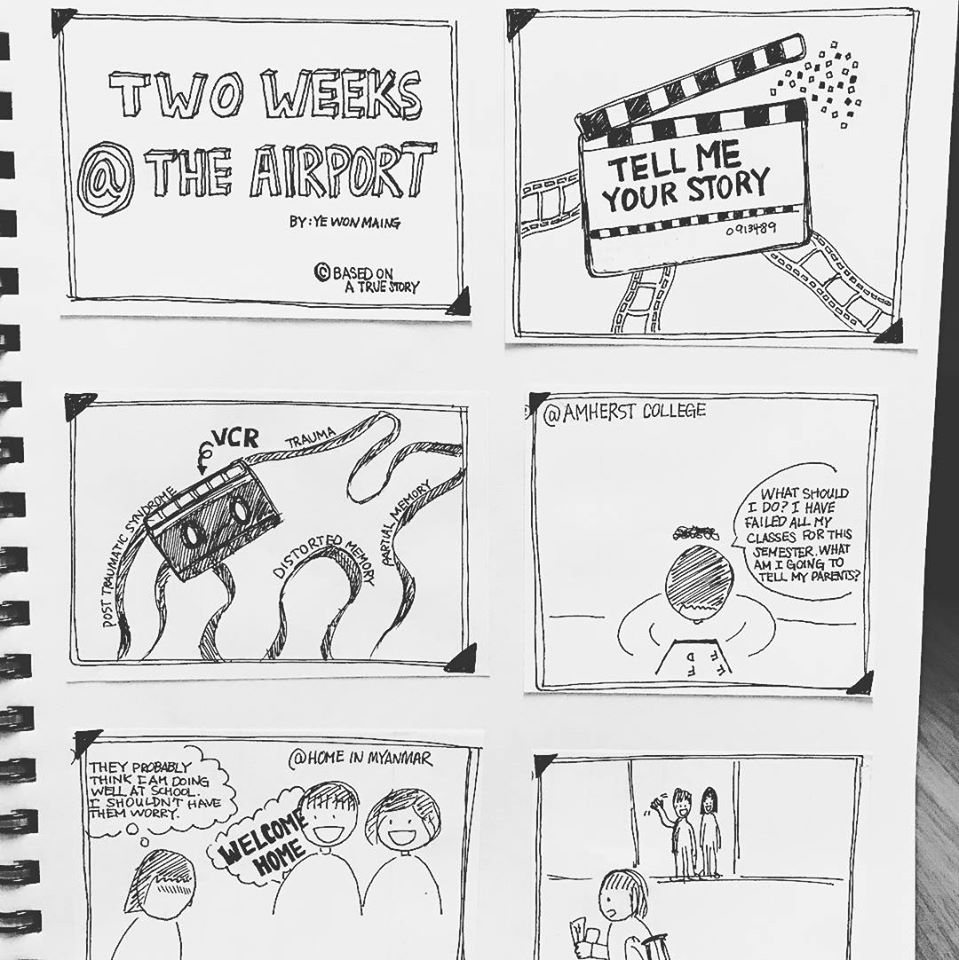
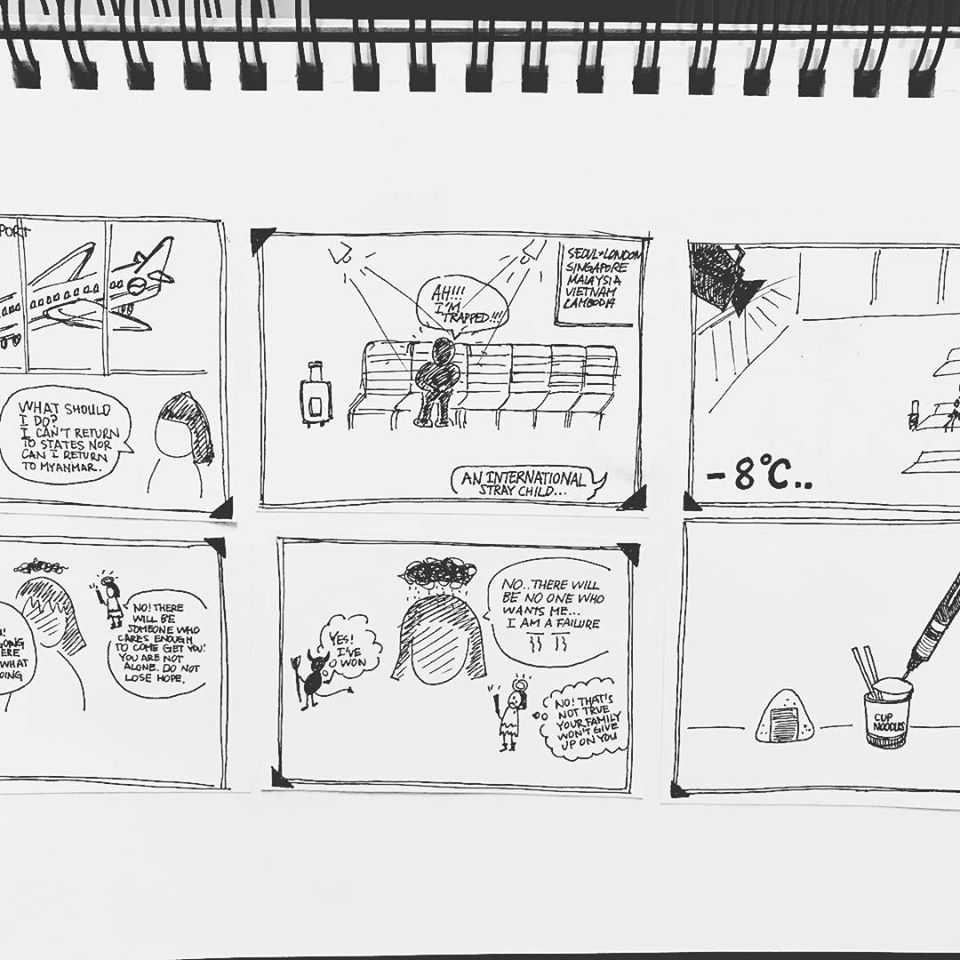
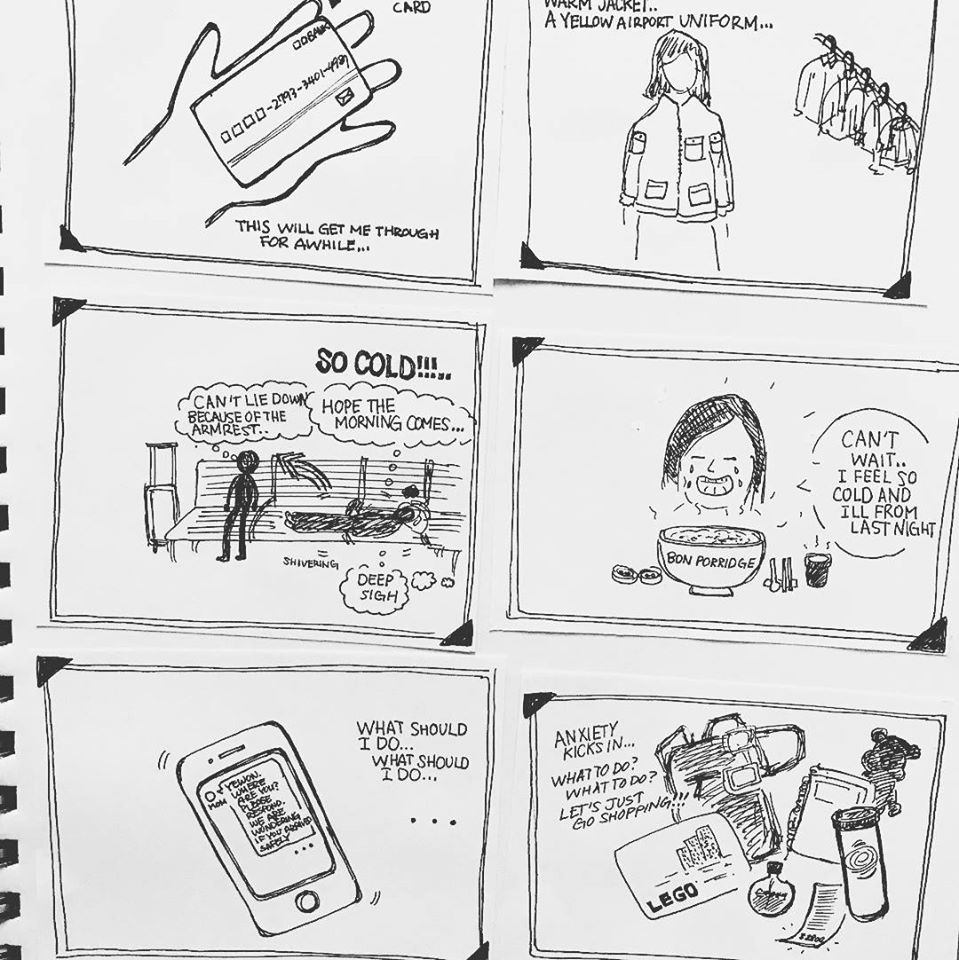
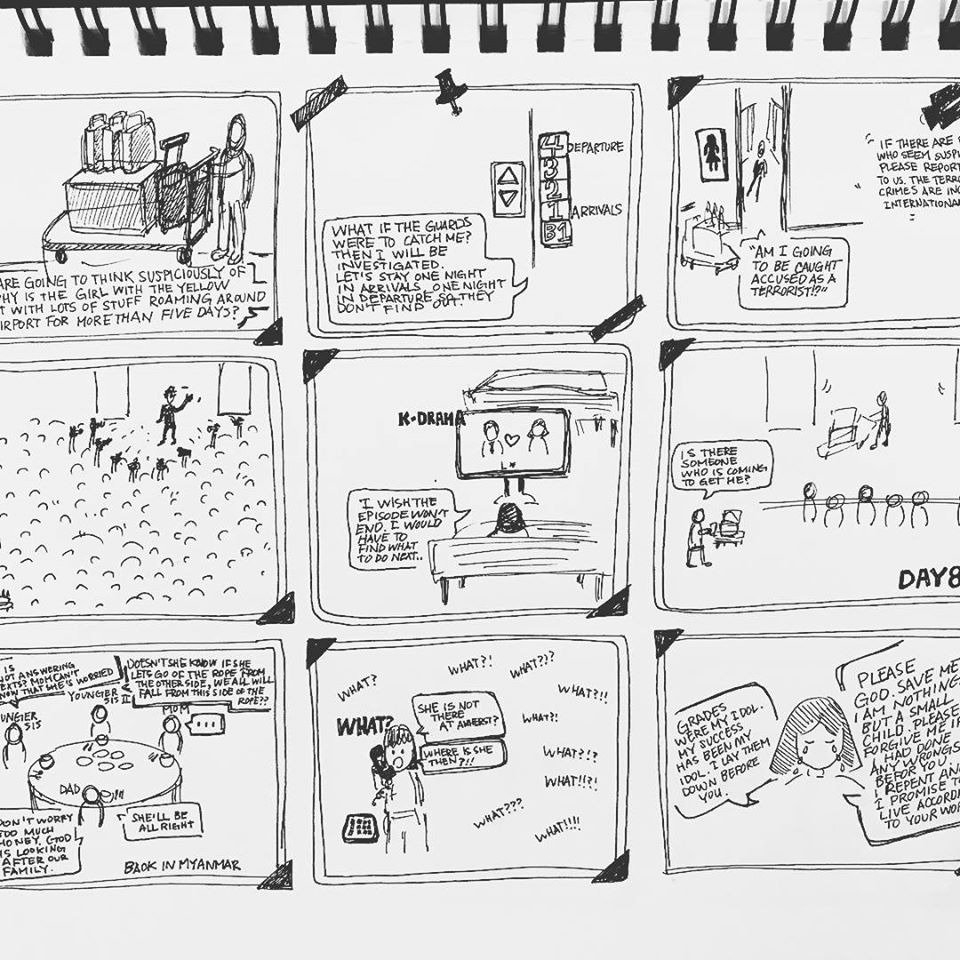
It was first semester of junior year when life became a series of events I could no longer hold on to. Away from home for the first time in college, I failed to make a sense of home and failed to let myself be vulnerable to those with whom I could have made a home. And after failing most of my classes that semester, I went to see my parents in Myanmar for winter break. I couldn’t tell my parents about the situation, so at the end of break I flew to Korea instead of the States. I was in a limbo state where I could not move forward or backwards. Home was nowhere to be found, and so for two weeks I lived at the Korean airport, using all I could from my Dad’s credit card. Eventually, my dad traced the credit card information and found me at the airport. After two weeks being stranded alone in an island uprooted from all connections and communication, I was at a horrible state mentally, not to mention hygienically, which was a side issue.  My dad had to take me back to his hometown in Korea where he grew up as a farmer’s child, and we spent hours at various coffee shops near the beach – him listening, and me speaking about what needed to be let out, both good and bad. This was the moment when home began a reconstruction from the ashes, but it was founded upon vulnerability and care, not expectation and apathy.

               And the process of rehabilitation began both in the individual and communal level. I was adopted into a bigger family than before– the paradigms and parameters of home were being reevaluated and reconstructed. What started off as a journey stranded alone in the Korean airport came to be a story of a son coming back to the father’s arms – or a father coming back for his son, a more accurate description of the parable of Prodigal Son – and a journey into and out of various places that I visited to reground and reconnect with my sense of self and belonging. U.S. to Korea to Myanmar, to all these people who I had lost touch with, it was truly a time of reconciliation and rehabilitation with my own sense of self and with others, without which a sense of self cannot ever be complete. Like an uprooted tree, my roots had to be reconnected back to the places where I belonged, back to family, back to friends and relatives who are a part of who I am. A year and half of moving around from place to place, with a year or so of medication, counseling, and Daniel Prayer – a prayer movement of having prayers three times a day like the figure from the Bible, but as a community – at a small campus church in Korea, I was able to find home in a community where they welcomed me more than I was ready to start over again.  After which, I was able to return again on campus to give myself another try of what I had already begun. When I returned, home wasn’t waiting on this side of the world – I had to labor again to find a sense of community when all the familiar people had graduated and moved on with life. With those whom I encountered only a few times before I had to begin school all over again.

               Home was for me a place where I could begin life again. I could find a part of myself and give another without fear of rejection or denial. Home was where I could be real, where I could be honest about my struggles to avoid the same mistakes again. Sometimes these places were professors’ offices, my advisor’s comfort chair, and occasionally in classrooms. But mostly I found a sense of community in Amherst Christian Fellowship where I could be undone and could share a part of my identity in Christ, which I had developed in the year I was away. Through my struggles here and while away I had realized my need of a Savior. I too needed a Savior, though having brought up in a Christian home and never realized the need for Christ myself, I discovered my wretched self and realized the need for a Savior who had died on the cross to cleanse my sins and resurrected after three days to give me eternal salvation from eternal death. Though this concept had remained theologically familiar to me, the realization of a new life redeemed in Christ was a new discovery and revelation that only struck me through my personal experiences in college.

There were also many spaces I had never really cared to set my foot in, or these spaces of vulnerability where I had to move out of my comfort zone. I was stepping into the prayer room for the first time trying to recite prayers in English as I was listening to how those around me were praying. And I met a group of faithful women of color who are leaders of Remnant, Resurrect (Gospel Choir) and various organizations around campus: areas in which I had very little crossroads with. Currently I live with a group of women from these Black Campus Ministries, entering into spaces like the African Caribbean Student Union and the Harlem Renaissance semi-formal, far beyond the notion of home I used to have for myself. And these are the communities through which I’ve come to stand here today, nearing the end of what seemed like a long and endless journey full of failures and triumphs. In Voice and Documentary we’re watching documentaries like Hungarian Passport, where the director disorients our sense of identity and sense of belonging, and in Anthropology of Food the question of home comes up naturally in an office-hour conversation. I have to stop myself and ask myself again; where is home? What is home for me? Was Benjy’s cry a plea for an eternal home where his cry could be heard and vocalized in words of meaning and significance? Is Solomon crying out all is vanity in the midst of a world where he has gained everything, yet in the end, everything amounted to nothing? Is life but a story told by an idiot, signifying nothing but sound and fury itself?

               Past is never the past – as was echoed through the walls of the classroom during Narratives of Suffering – as it breaks into the present with such violent presence that it must be noted and felt; so present and raw are these emotions. Home belongs to the past. When we began our days out of the mother’s womb. Yet, there remains the possibility of the unknown, a possibility of newness, a possibility of growth and a future. There is always the possibility of rebuilding and rehabilitation in the dimmest places. And perhaps there is where we find hope in the hopeless world Benjy finds himself lamenting over. What is to be, or not to be, perhaps fundamentally boils down to the question of where home potentially could be, and how one constructs oneself around a group of people where one could be home with. When all else fails what will remain without decay is the question. Memories reverberate in the air, pointing towards a place called home where life de-centers itself and may call itself life. Where home is for me, and for those around me is a question to be continued. 

English Extended Essay: Implications of the Media in Toni Morrison’s The Bluest Eye: How does Morrison implicate the media in the development of Pecola’s desire for the bluest eye?

Abstract

The aim of this essay is to address the following question: How does Morrison implicate the media in the development of Pecola’s desire for the bluest eye? The essay investigates how Morrison’s uses the literary devices – including imagery, diction, motifs, alliteration, consonance, contrasts, and syntax – to help portray the way in which media gradually fosters desires in Pecola for the bluest eyes in the world. The essay walks through parts of the book that make direct and indirect remarks about the influences of media. And by rigorously analyzing individual passages and webbing connections between those passages, the essay serves to explore the ways in which media causes Pecola to question the secret – the beauty in the blue eyes of pretty actresses – that she cannot grasp; to sorrow and wither in her lack of such beauty, thereby developing self-hatred; to envy icons of beauty and their perfect lives depicted by media; to come to desire blue eyes desperately enough to conjure up a mind’s view of her own blue eyes. The essay addresses the ways in which Morrison conveys how media destroys Pecola’s self-worth, inner beauty and mind and in place nurtures unrealistic desires for the bluest eye in the world.

Table of Contents

Introduction ————————————————4            

Analysis   —————————————————–8            

Conclusion  ————————————————-14            

References  ————————————————-14

Introduction

Prior to the essay, I wish to start off by engaging with the following passage, imitating the unconventional way in which Toni Morrison starts off her own novel: The Bluest Eye. The opening in-depth analysis of this passage will help us better understand how Morrison effectively uses this as the starting point to unravel the rest of the story; likewise, this discussion will add a specific perspective to the rest of the essay.

Here is the house. It is green and white. It has a red door. It is very pretty. Here is the family. Mother, Father, Dick, and Jane live in the green-and-white house. They are very happy. See Jane. She has a red dress. She wants to play. Who will play with Jane? See the cat. It goes meow-meow. Come and play. Come play with Jane. The kitten will not play. See Mother. Mother is very nice. Mother, will you play with Jane? Mother laughs. Laugh, Mother, laugh. See Father. He is big and strong. Father, will you play with Jane? Father is smiling. Smile, Father, smile. See the dog. Bowwow goes the dog. Do you want to play with Jane? See the dog run. Run, dog, run. Look, look. Here comes a friend. The friend will play with Jane. They will play a good game. Play, Jane, play.

Here is the house. It is green and white. It has a red door. It is very pretty. Here is the family. Mother, Father, Dick, and Jane live in the green-and-white house. They are very happy. See Jane. She has a red dress. She wants to play. Who will play with Jane? See the cat. It goes meow-meow. Come and play. Come play with Jane. The kitten will not play. See Mother. Mother is very nice. Mother, will you play with Jane? Mother laughs. Laugh, Mother, laugh. See Father. He is big and strong. Father, will you play with Jane? Father is smiling. Smile, Father, smile. See the dog. Bowwow goes the dog. Do you want to play with Jane? See the dog run. Run, dog, run. Look, look. Here comes a friend. The friend will play with Jane. They will play a good game. Play, Jane, play.

Hereisthehouseitisgreenandwhiteithasareddooritisveryprettyhereisthefamilymotherfatherdickandjaneliveinthegreenandwhitehousetheyareveryhappyseejaneshehasareddressshewantstoplaywhowillplaywithjaneseethecatitgoesmeowmeowcomeandplaycomeplaywithjanethekittenwillnotplayseemothermotherisverynicemotherwillyouplaywithjanemotherlaughslaughmotherlaughseefatherheisbigandstrongfatherwillyouplaywithjanefatherissmilingsmilefathersmileseethedogbowwowgoesthedogdoyouwanttoplaywithjaneseethedogrunrundogrunlooklookherecomesafriendthefriendwillplaywithjanetheywillplayagoodgameplayjaneplay (7).

The passage above is from Dick and Jane, a children’s storybook by William Gray and Zerna Sharp, which was widely read by children from 1930s to 1970s. (Morrison wrote The Bluest Eye in 1970). The passage takes an uncommon structure: it consists of three very similar (almost identical) paragraphs that vary only in their respective presentation: use of spaces, capital letters and punctuation. But prior to discussing the significance of these structural variations, let us first take a closer look at the content of the passage. The passage, a torn-out page from Dick and Jane, contains the distinctive qualities of children’s storybooks: simplicity, repetition and rhythm, which allows us to easily contextualize the passage, even if we are unfamiliar with the original piece of work.

The passage depicts the pretty, happy, and almost perfect life of Jane and her family. And the lack of realistic details and overdone repetition in the passage breed artificiality in the air – one that envelops a dreamlike life that can only be led in a dollhouse. The vivid primary colors – “green, white… [and] red” – used to describe the exterior of the house also help liken it to a dollhouse. Inside reside the characters: the “very happy” “Mother, Father, Dick and Jane” who are portrayed as being enclosed in an airy bubble that protects the surreal happiness of the place. Jane is wearing a pretty “red dress”; the “very nice…[m]other is laugh[ing]”; the “big and strong…[f]ather is smiling.” The very pretty, happy, and nice life portrayed not only reminds us of a perfect life plausible in an impeccable dollhouse, but also causes us – at least the more cynical or keenly aware of us – to suspect the wholesomeness and implausible surreality of the scene depicted in the storybook. Underneath the warmth and friendliness in the air, there lingers a sense of loneliness in Jane. The question, “Who will play with Jane?” is asked to her mother, father, and the dog. But the reply that comes back is laughter (from Mother), smile (from Father), or running away (of the dog). Although everything seems and warm and friendly on the outside, there is no one volunteering to play with Jane. Yes, at the end, a friend of Jane does arrive and the narrator says that the “friend will play with Jane. They will play a good game. Play, Jane, play”: but even then, such overdone repetition presents the portrayed action – playing with Jane – as a dictated rather than willful conduct. The repetition and rhythmic patterns developed throughout the whole passage further help create a sense that Jane’s perfect life is dictated and orchestrated, just as a pretty doll’s life in a pretty dollhouse would be designed by a young girl. The vague hints of underlying loneliness and dictated lifestyle serve as a tiny hole – in the airy bubble of perfection ­­– through which we can peep and verify our doubts about the superficiality of what appears on the outside.

               We can infer that Morrison, by presenting the distinctive features of a storybook, – its simplicity, dreamlike and trancelike quality, and picturesque features – is indirectly making a social statement about children’s storybooks. Just like any other type of media, storybooks depict an unrealistic reality or an impossible possibility, distorting the young children’s perceptions of reality (or piecing together distorted versions of reality for them to cherish) and imbuing hope that is not only unattainable but also devastating for its unattainable quality. And this particular social observation and criticism regarding media play a pivotal role throughout the whole book: Morrison writes that Pecola, the protagonist of the story, suffers from misery and hardships created and reinforced by the media. The media contorts the way reality is perceived by Pecola and consequently causes Pecola to develop unrealistic yearnings for the bluest eyes in the world.

               Now, let us move on to observe the significance of peculiar structural presentation of this passage and how Toni Morrison ingeniously ties back onto her social criticism of media. As aforementioned, the passage consists of three very similar paragraphs that differ only in their minute technicalities. The first paragraph has the greatest line and word spacing and such spacing decreases in the subsequent paragraphs. In fact, the last paragraph, lacking in its conventional use of punctuation and capital letters, looks harder for identification, if not impossible, especially to someone who hasn’t read the previous two paragraphs. Here, Morrison, by creating such effects with the unconventional experimentation with syntax, is trying to mimic the way in which media reinforces its ideals, which get distorted in the minds of the audience and in turn distort the way in which the audience perceives the reality. The content of the media is contorted and compacted into a version that looks quite different from the original; identification and association is only deemed possible because of the way in which the audience has developed familiarity and automatic response mechanisms to media in their minds, just the way the readers encode semantic patterns in our memories as we read the same paragraph three times.

Coming to the closing remarks of this analysis, we can extrapolate from Morrison’s conscious choice to start off the work in this unconventional style that she wishes that the readers continuously reflect on how media, as one of the most influential gatekeepers of the society, distorts the way in which reality is perceived by Pecola – moreover the consequent way in which such distorted perceptions affect her mind, her desires and her way of life. Also, it is my personal opinion that Morrison perhaps wanted to start off the novel with this storybook depiction of life so that its surreality serves as a blatant contrast to the reality – not excluding rape, hatred, jealousy, insecurity, racism, and other imperfections ingrained in our identity and in the society we have created – that she wishes to bravely portray, acknowledge and embrace as the first step towards making a bettered society.

The essay henceforth will be steered in a more conventional manner. The rest of the essay will serve to address the following question: How does Morrison implicate the media in the development of Pecola’s desire for the bluest eye? Presenting to us the exaggerated notions of ideal beauty upheld by the media, Morrison explains how Pecola, a black girl, comes to develop unrealistic dreams to get the bluest eyes in the world.

Analysis

Toni Morrison, throughout the book, gradually paints a complete picture of why Pecola, a black girl, comes to desire the bluest eyes in the world. She argues that the media largely contributes to the development of such desire. First, Morrison introduces us to Pecola’s special fondness for a Shirley Temple cup, which she uses to drink milk. Morrison writes that Pecola “glazed fondly at the silhouette of Shirley Temple’s dimpled face” (19). The use of consonance – the “d” sounds in “glazed”, “fondly” and “dimpled” and “s” sounds in “silhouette” and “Shirley” – highlights Pecola’s gentle fondness toward the cup for what it represents: the ideal beauty marketed by media. Moreover the “silhouette” of Shirley Temple, a mere association to such beauty, is alone enough to trigger warm and dear fondness within Pecola; Shirley Temple’s beauty, constantly broadcasted by the media, has turned her into an icon, whose silhouette alone stands as a symbol that fosters awe and envy. It is also important to note how Morrison uses color imagery; she depicts the Shirley Temple cup to be “blue-and-white” (19) and Mary Jane candy wrappers (which will be discussed later) to be “pale yellow” (43). Through the use of such colors – blue, white and pale yellow – characteristic to Caucasian physical attributes, Morrison hints at the way in which media paints hues of white supremacy.

More interestingly, to Pecola, what is more important than the content (the milk) is the container (Shirley Temple cup) that holds it. In fact, Morrison writes that Pecola “took every opportunity to drink milk out of [the cup] just to handle and see sweet Shirley’s face” (22). Pecola is mainly if not solely interested in the cup’s façade, rather than what’s inside it. By using a cup as a motif, Morrison seems to be making a social critique about the way in which media places much higher value on external appearances than on inner beauty and virtues, causing susceptible individuals like Pecola to adopt similar attitudes in leading their lives. Lastly, the idea of consumption develops at this point of the book. Pecola drinks Shirley Temple – her beauty and the beautiful world she enjoys – in order to efface and replace her own ugliness. This idea gradually develops throughout the rest of the novel.

               Later in the book, Morrison comments that Pecola “wore [her] ugliness… although it did not belong to [her]” (34). She further explains that “[y]ou looked at [her] and wondered why [she was] so ugly; you looked closely and could not find the source” (34). To support such observations, Morrison uses ambivalent imagery that neither positively nor negatively (or both positively and negatively) describes Pecola’s face. Morrison writes: “[t]he eyes, the small eyes set closely together under narrow foreheads. The low, irregular hairlines, which seemed even more irregular in contrast to the, heavy eyebrows which nearly met… [She] had high cheekbones, and [her] ears turned forward” (34). Here, Morrison describes the face by delineating shapes and figures, using words with geometrical implications such as “closely together,” “under,” “narrow,” “low,” “irregular,” “nearly met,” “high,” and “turned forward.” Rather than making judgmental statements that are based on normative ideals of beauty, she tries best to accurately and disinterestedly sketch the face the way it appears. And by doing so, Morrison seems to be suggesting how Pecola’s ugliness is not intrinsically etched in her face but extrinsically imprinted by the media that fashions and arbitrates the norms of beauty: in other words, Pecola’s ugliness only exists because of the way in which she attributes norms of beauty dictated by the media to her face, which is no more than an amalgamation of geometric figures and shapes.

Furthermore, Morrison portrays that Pecola has “[s]hapely lips which [call] attention not to themselves but to the rest of the face” (34). Here, Pecola’s beauty is portrayed to be humble and self-sacrificing as opposed to the more emphatic and self-assertive vanity of white actresses portrayed by the media. And thus Morrison seems to be suggesting that Pecola’s, although different in nature to the standards of beauty set by the media, is yet still beautiful. But Pecola sees herself ugly only because she is applying the artificial standards of beauty created by the media to herself, whose beauty is as equally valid if not more genuine and generous than that promoted by the media.

Morrison explicates that the ugliness that she wears came “from [Pecola’s] conviction” (34) which was nurtured by “every billboard, every movie, every glance [that leaned on her]” (34). Morrison creates an image of media leaning on and closing in Pecola from every side; there isn’t a way out their trap. The enveloping mental trap causes Pecola to wear and self-impose the ugliness that the media promulgates. Morrison explains that the source of her ugliness lies not in Pecola’s fundamental qualities but the convinced ugliness, tailored by the media, that Pecola chooses to wear.

               Later on in the book, Morrison uses Mary Jane candy as a motif to explain the role that media plays in Pecola’s life. Pecola, entering Mr. Yacobowski’s store, selects only Mary Janes from amongst the array of candies. Morrison reveals Pecola’s great fondness with these candies by depicting what is on the wrappers. She writes that “each pale yellow wrapper [of the candy] has a picture on it. A picture of little Mary Jane, for whom the candy is named” (43). Morrison again reiterates, “[l]ovely Mary Jane, for whom the candy is named” (43). Here, Morrison, by repeating the phrase, seems to be highlighting one of the essential reasons to why Pecola dearly loves Mary Jane: because Mary Jane, unlike Pecola herself, is significant enough for a candy to be named after her. Mary Jane’s celebrated beauty comes across as an affront to Pecola’s “anonymous misery” (35). Mary Jane’s celebrity leads Pecola to feel worthless; she gradually develops the urge to make “[herself] disappear[: l]ittle parts of her body faded away… [until o]nly her tight, tight eyes [are] left” (39). Morrison portrays how media – the candy packaging illustrating Mary Jane – extols ideal beauty, effacing Pecola’s self-worth and inner beauty, gradually expanding a vacuum inside her that aches with self-pity and self-loathing. 

In order to fill this vacuum created by the media, to put a halt to this throbbing ache of self-hatred, Pecola eats the candy. Morrison explains that “to eat the candy is somehow to eat the eyes, eat Mary Jane… and [b]e Mary Jane” (43). The idea of consumption is more apparent at this point in the book; Pecola consumes Mary Jane to fill her vacuum with Mary Jane’s happiness, her “[s]miling white face[, her b]lond hair in gentle array,

[her]

blue eye looking at [Pecola] out of a world of clean comfort” (43). Morrison portrays how divorced Pecola’s world is from that of Mary Jane; there lies a pale, thin candy wrapper – yet thicker than anything in the world – that separates Pecola from accessing happiness that lingers in Mary Jane’s world. Moreover, the use of consonance – repetition of “l” sounds in “blond” and “gentle” and “r” sounds in “hair” and array” – helps depict the life on the other side as being benign and soothing. Also the alliteration – the “c” sounds in “clean comfort” – accentuates the near perfection of the world that lies within the candy wrapper. The portrayal of a comfortable and perfect life by the media further stokes Pecola’s desire to have the bluest eyes to see the world, to enjoy the world, and to gain access to the world that Mary Jane is in. In fact, Pecola comes to develop a conviction that “as long as she looked the way she did, as long as she was ugly, she would have to stay with [Mrs. and Mr. Breedlove as she]… somehow belonged to them” (39). Pecola believes that she is confined to her miserable world while Mary Jane is liberated in her perfect world because of the most obvious quality that the media depicts is the fundamental difference between the two: the ideal beauty that Pecola herself lacks but Mary Jane has. Morrison shows how the media causes susceptible minds like Pecola’s to develop illogical connections and distorted worldviews. Morrison seems to be subtly accusing media of blatant and overworked marketing tactics that contort reality, causing individuals like Pecola to develop distorted views about her own self and the world she lives in.

Morrison then depicts a quite striking image of Pecola buying with her pennies not the candies but “nine lovely orgasms with Mary Jane” (43). Through this imagery, Morrison underscores Pecola’s pain, shame and misery that she wishes to soothe by enwrapping herself with the erotic pleasures and tenderness of being Mary Jane. Here Morrison is portraying the perverse yet pitiful extent to which Pecola wants to become one with Mary Jane, one with the perfect world she resides in. Morrison holds the media – the candy packaging illustrating Mary Jane – responsible for putting such heavy burdens on the shoulders of a miserable black girl, who has come to nonsensically believe that she is indulging in sexual pleasures when eating Mary Jane candies. Morrison implicates how the media has distorted Pecola’s mindset to the point of perversion and irrationality.

               As Pecola develops a distorted view of the world, she comes to desire those bluest eyes, which she now believes will grant her the comfort and happiness that Mary Janes and Shirley Temples of the world are entitled to. Pecola, “[t]hrown, in this way, into the binding conviction that only a miracle could relieve her, she would never know her beauty. She would see only what there was to see: the eyes of other people” (40). Morrison, by using the words “thrown” and “binding”, hints at the way in which media is like the present-day manifestation of enslavement that mistreats and fetters Pecola. Also, Morrison further attests to such idea, showing how Pecola loses her freedom and self as she sees what is around her and the eyes of other people but not her own self.

               Furthermore, Pecola further comes to believe that only “if [her] eyes were different, that is to say, she herself would be different… [and i]f she looked different, different, maybe Cholly would be different, and Mrs. Breedlove too” (40). Morrison shows how the media causes Pecola to develop illogical “if-then” scenarios, fostering her desire to replace her eyes – which holds “all of those pictures, all of those faces” (39), and all her misery – with the bluest eyes in the world. Toni Morrison holds media responsible for bewildering and distorting her mind, wheedling her to wallow in self-pity and unrealistic dreams.

               Towards the end of the essay, Morrison depicts an uncanny scene in which Pecola talks to someone, most likely the reflection of her own mind, bragging about the blue eyes she now has. The conversation is led between the two discrete selves that coexist in Pecola. By depicting such a bizarre scene, Morrison seems to be conveying how the media has come to not only distort Pecola’s worldview but also her personality and consciousness. Her mind is segregated into two: one part that believes she now possesses “Alice-and-Jerry Storybook eyes” (156) and the other that believes Pecola is “acting silly” (158). Pecola, so desperate to have blue eyes, seems to have conjured up a mind’s view of her desired-self. Through depiction of this uncanny conversation between the two ambiguous narrative voices, Morrison explains the extent to which the media distorts Pecola’s consciousness, causing her to develop schizophrenic conditions.

The conversation between the two segregated selves continues over several pages. One of the two narrative voices talks aloud, “But suppose, my eyes aren’t blue enough?” (157) But when the other self retorts, “Blue enough for what?,” the voice fails to answer the question asked, trailing: “Blue enough for… I don’t know. Blue enough for something” (158). The hints of uncertainty and confusion convey how the media has caused Pecola to blindly convince herself that what she desires is the blue eyes. When she gets those very precious eyes she has always yearned for, she is unable to articulate clearly why she had wanted them so much in the first place. Thus such uncertainties exemplify the extent to which media has deluded naïve Pecola into desiring something whose meaning and virtues she is not fully aware of.

               Furthermore, the voice echoes insecurity within Pecola. Continuously the voice utters words of fear and anxiety: “Don’t leave me… Why? Are you mad at me? … Because my eyes aren’t blue enough? Because I don’t have the bluest eyes? … [W]ill you come back if I get [the bluest eyes?]… You promise?” (158) Morrison shows how the media has bred a sense of insecurity that now seems to pester and strangle Pecola. Also, Morrison seems to be suggesting how the media has bred insatiable greed in Pecola, who will not be sufficed by the blue eyes but now yearns to get the bluest eyes in the world. Ergo, Morrison shows how the media has buoyed up Pecola’s unrealistic dreams like one does a balloon; the near impending burst of this balloon – the unrealistic dreams – as heralded by the segregation of Pecola’s consciousness, evokes concern and pity amongst the readers. Morrison ends the book, showing the extent to which media has come to deform and destroy Pecola.

Conclusion

M0rrison, throughout her book, takes us on a journey showing how the media nurtures and ultimately consummates Pecola’s desires to have the bluest eye in the world. Morison uses the motifs of cup, candy and storybook, distinguishes notions of natural and normative beauty, and analyzes the extent to which media deprives Pecola of her inner beauty, security and sanity. By integrating the various literary features, including color imagery, consonance, diction and syntax, Morrison walks us through the steps by which the media gradually instills unrealistic dreams in Pecola to have the bluest eye. From the very start – the passage from Dick and Jane storybook – to the end – the surreal portrayal of Pecola’s dual personality – Morrison implicates the media in the development of Pecola’s desire for the bluest eye. She portrays how the media’s exaggerated notions of ideal beauty cause Pecola to undergo an internal struggle to discover for herself what secret lies in such beauty – manifested in the blue eyes – that she fails to fully understand; to question and grieve the absence of such ideal beauty in herself, thereby developing self-loathing; to eventually develop love for those icons of beauty and for the life that they enjoy; to develop desires and ultimately attain such beauty by obtaining the blue eyes. Morrison reasons that the media distorts not only the way in which Pecola perceives the reality but also her desires and consciousness. She clearly explicates the way in which media inspires destructive hope – for the bluest eye – in Pecola that ultimately splits her mind and alienates her from the rest of the world. Morrison, throughout her novel, thereby implicates and holds media largely responsible for the development of unrealistic Pecola’s desire for the bluest eye.

References:

Morrison, Toni. The Bluest Eye. New York: PocketBooks-Simon, 1972. Print.