
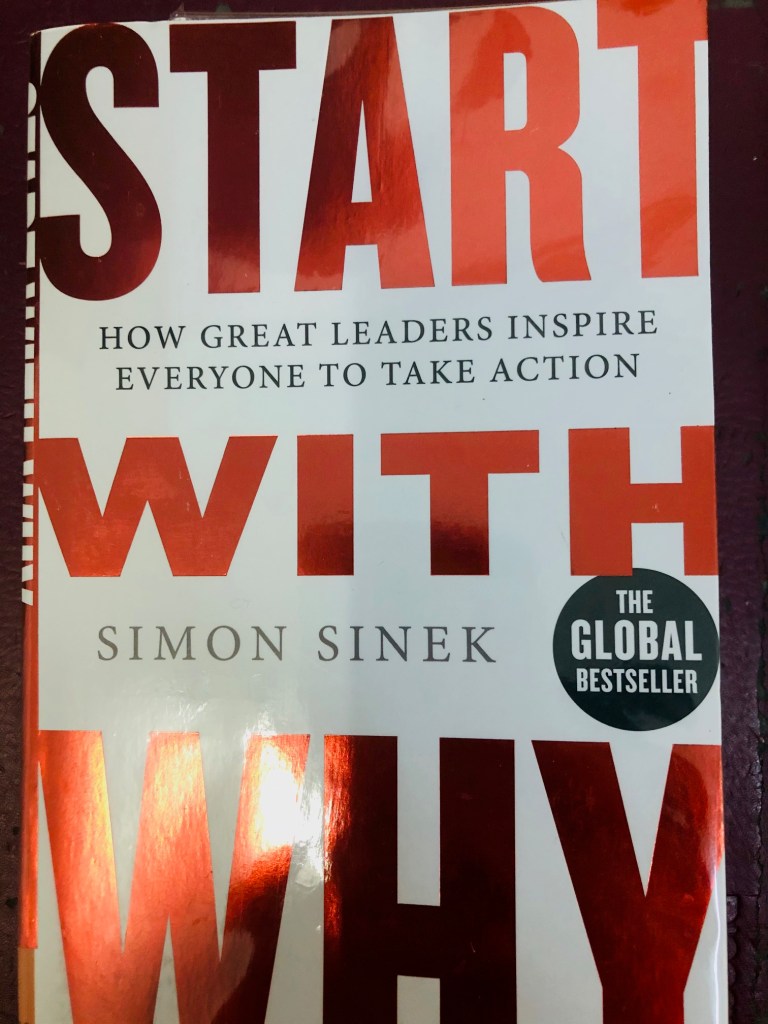
START WITH WHY
We are writing about our hopes and dreams for school this week. Why have I started this job and my calling in teaching? To inspire, give hope and tools to strengthen and equip them to be achieving their dreams in life. Why are you doing what you are doing? Start with Why to inspire action.
There are leaders and there are those who lead.
Leaders hold a position of power or influence.
Those who lead inspire us.
This is a book for those who want to inspired others and for those who want to find someone to inspire them.
It was Martin Luther King who was able to inspire a country to change not just for the good of a minority, but for the good of everyone. Martin Luther King started with Why.
They stand apart from the norm and their impact is not easily copied. They are members of a very select group of leaders who do something very, very special. They inspire us.
Great leaders in contrast are able to inspired people to act. Those who are able to inspire give people a sense of purpose or belonging that has little to do with any external incentive or benefit to be gained.
For those who are inspired, the motivation to act is deeply personal. They are less likely to be swayed by incentives.
Those who are able to inspire will create a following of people – supporters, voters, customers, workers – who act for the good of the whole not because they have to, but because they want do.
They can be found in both public and private sectors. They are in all sort s of industries – selling to consumers or to other businesses. Regardless of where they exist, they all have a disproportionate amount of influence in their industries. They have the most loyal customers and the most loyal employees.
People who love going to work are more productive and more creative. They go home happier and have happier families. They treat their colleagues and clients and customers better. Inspired employees make for stronger companies and stronger economies.
Trust and loyalty are the norm and not the exception
Its goal is to offer you the cause of action.
From now on, start with Why.
We make decisions based on what we think we know.
Now consider how organizations are formed and how decisions re made. Do we really know why some organizations succeed and why others don’t, or do we just assume?
How we go about achieving our goals is very similar. Some of us just wing it, but most of us try to at least gather some data so we can make educated decisions.
That more information and data are key.
We read books, attend conferences, listen to podcasts and ask friends and colleagues – all with the purpose of finding out more so we can figure out what to do or how to act.
There are only two ways to influence human behavior: you can manipulate it or you can inspire it.
They tend to rely on a disproportionate number of manipulations to get what they need. And for good reason. Manipulations work.
In any circumstance in which a person or organization wants more than a single transaction, however, if there is a hope for a loyal, lasting relationship, manipulations do not help.
Knowing you have a loyal customer and employee base not only reduce costs, it provides massive peace of mind. Like loyal friends, you know your customers and employees will be there for you when you need them most. It is the feeling of “we’re in this together,” shared between customer and company, voter and candidate, boss and employee, that defines great leaders.
The danger of manipulations is that they work. And because manipulations work, they have become the norm, practiced by the vast majority of companies and organizations, regardless of size or industry. Employees were manipulated with bonuses that encouraged short-sighted decision-making.
The reality is, in today’s world, manipulations are the norm.
But there is an alternative.
There are few leaders who choose to inspire rather than manipulate in order to motivate people.
The Golden Circle is an alternative perspective to existing assumptions about why some leaders and organizations have achieved such a disproportionate degree of influence.
The Golden Circle shows how these leaders were able to inspire action instead of manipulating people to act.
It even explains loyalty and how to create enough momentum to turn an idea into a social movement.
It all starts with Why.
WHAT they do.
HOWs are often given to explain how something is different or better.
WHY: Very few people or companies can clearly articulate WHY they do WHAT they do. When I say WHY, I don’t mean to make money – that’s a result. By WHY I mean what is your purpose, cause or belief? WHY does your company exist? WHY do you get out of bed every morning? And WHY should anyone care?
People don’t buy WHAT you do, they buy WHY you do it.
Everything they do works to demonstrate WHY, to challenge the status quo.
Apple’s WHY, to challenge the status quo and to empower the individual.
People don’t buy WHAT you do, they buy WHY you do it.
Knowing your WHY is not only way to be successful, but it is the only way to maintain a lasting success and have a greater blend of innovation and flexibility.
Those whom we consider great leaders all have an ability to draw us close and to command our loyalty.
And we feel a strong bond with those who are also drawn to the same leaders and organizations. Apple users feel a bond with each other.
Anyone who was drawn to hear Dr. Martin Luther King Jr. give his “I have a Dream” speech, regardless of race, religion, or sex, stood together in that crowd as brothers and sisters, bonded by their shared values and beliefs. They knew they belonged together because they could feel it in their gut.
They knew they belonged together because they could fee lit in their gut.
People don’t buy WHAT you do, they buy WHY you do it.
The ability to win hearts before minds is not easy. It’s a delicate balance of art and science – another coincidental grammatical construction.
Art of leading is about following your heart. Perhaps our brains are trying to tell us that WHY must come first.
They are those who understand the art before the science. They win hearts before minds. They are the ones who start with WHY.
We all know someone who is a die-hard Mac lover. Ask them WHY they love their Mac. They won’t tell you. “Well, I see myself as someone who likes to challenge the status quo, and it’s important for me to surround myself with the people, products, and brands that prove to the outside world who I believe I am”
“I’m a creative person.” In reality, their purchase decision and their loyalty are deeply personal. They don’t really care about Apple; it’s all about them.
Products with a clear sense of WHY give people a way to tell the outside world who they are and what they believe. Remember people don’t buy WHAT you do, they buy WHY you do it.
To inspire starts with the clarity of WHY.
HOW you do things; that’s the hardest part.
Articulating our values as very gives us a clear idea…
Everything you say and everything you do has to prove what you believe. A WHY is just a belief.
The only way people will know what you believe is by the things you say and do, and if you’re not consistent in the things you say and do, no one will know what you believe.
It is at the WHAT level that authenticity happens.
Authenticity cannot be achieved without clarity of WHY. And authenticity matters.
When salesman actually believe in the thing they are selling, then the words that come out of their mouths are authentic.
Being authentic is not a requirement for success, but it is if you want that success to be lasting success. Again, it goes back to WHY. Authenticity is when you say and do the things you actually believe. But if you don’t know Why the organization or the product exist on a level beyond WHAT you do , then it is impossible to know if the things you say or do are consistent with your WHY. Without WHY, any attempt at authenticity will almost always be inauthentic.
Starting with WHY is what inspires people to act.
People don’t buy WHAT you do, they buy Why you do it, and WHAT you do serves as tangible proof of WHY you do it. But unless you start with WHY, all people have to go on are the rational benefits.
The ability to put a WHY into words provides the emotional context for decisions.
It should be to focus on the people who believe what you believe.
Leading is not the same as being the leader. Leading, however, means that other willingly follow you – not because they have to, not because they are paid to, but because they want to.
Problems arise, however, when the metric becomes the only measure of success, when what you achieve is no longer tied to WHY you set out achieve it in the first place.
That’s what a WHY does. When it is clearly understood, it attracts people who believe the same thing.
What all great leaders have in common is the ability to find good fits to join their organizations – those who believe what they believe.
Simply having a sense of WHY changes his entire view of his job. It makes him more productive and certainly more loyal.
And that camaraderie and trust is what brings success. People working together for a common cause.
Companies with a strong sense of WHY are able to inspire their employees. Those employees are more productive and innovative, and the feeling they bring to work attracts other people eager to work as well. When people inside the company know Why they come to work, people outside the company are vastly more likely to understand WHY the company is special. In these organizations, from the management on down, no one sees themselves as any more or any less than anyone else. They all need each other.
The role of a leader is not to come up with all the great ideas. The role of a leader is to create an environment in which great ideas can happen.
If they are constantly reminded WHY the company was founded and told to always look for ways to bring that cause to life while performing their job, however, then they will do more than their job.
Companies define themselves by WHAT they do instead of WHY they do it instruct their people to be innovative around a product or service.
Companies with a clear sense of WHY tend to ignore their competition, whereas those with a fuzzy sense of WHY are obsessed with what others are doing.
People who come to work with a clear sense of WHY are less prone to giving up after a few failures because they understand the higher cause.
This is the root of passion. Passion comes from feeling like you are a part of something that you believe in, something bigger than yourself. If people do not trust that a company is organized to advance the WHY, then the passion is diluted.
If a company doesn’t manage trust, then those working for it will not trust the company, and self-interest becomes the overwhelming motivation. This may be good for the short term, but over time the organization will get weaker and weaker.
When we believe someone has our best interest in mind because it is in their benefit to do so, the whole group benefits. The advancements of societies were based a great deal on the trust between those with a common set of values and beliefs.
In his aptly named book The Tipping Point, Gladwell identifies groups of necessary populations he calls connectors and influencers.
Why an influencer tell anyone about you?
Don’t forget, loyalty is when people are willing to suffer some inconvenience or pay a premium to do business with you.
The point at which an idea becomes a movement. When that happens, the growth is not only exponential, it is automatic. It just does.
The goal of business then should not be to simply sell to anyone who wants what you have – the majority – but rather to find people who believe what you believe, the left side of the bell curve. They perceive greater value in what you do and will happily pay a premium or suffer some sort of inconvenience to be a part of your cause. They are the ones who, on their own volition, will tell others about you.
Get enough of the people on the left side (the early adopters) of the curve and they encourage the rest to follow.
If they truly believe in what you believe and if they are truly on the left side of the curve they won’t need to be incentivized; they’ll do it because they want to. It won’t take long for the group to find out that a recommendation wasn’t made with the group’s best interest in mind, but rather because of one person’s self-interest.
When you start with WHY, those who believe what you believe are drawn to you for very personal reasons. It is those who share your values and beliefs, not the quality of your products, that will cause the system to tip.
Dr. King said he had a dream, and he inspired people to make his dream their own.
WHY-types are visionaries, the ones with the overactive imaginations. They tend to be optimists who believe that all the things they imagine can actually be accomplished. HOW types live more in the here and now. They are the realists and have a clearer sense of all things practical.
There exists this special partnership between WHY and HOW.
For a WHY to have a power to move people it must not only be clear, it must be amplified to reach enough people to tip the scale.
Apple has a clear and loud megaphone and is exceptionally good at communicating its story.
It is not just WHAT or HOW you do things that matters; what matters more is that WHAT and HOW you do things is consistent with your WHY.
Simply ensuring that WHAT you do proves what you believe make it easy for those who believe what you believe to find you. You have successfully communicated your WHY based on WHAT you do.
Those with an ability to never lose sigh of WHY, no matter how little or how much they achieve, can inspire us. Those with the ability to never lose sight of WHY and also achieve the milestones that keep everyone focused in the right direction are the great leaders. For great leaders, The Golden Circle is in balance. They are in pursuit of WHY, they hold themselves accountable to HOW they do it and WHAT they do serves as tangible proof of what they believe. But most of us, unfortunately, reach a place where WHAT we are doing and WHY we are doing it eventually fall out of balance. We get a point when WHY and WHAT are not aligned. It is the separation of the tangible and the intangible that marks the split.
The reason so many small businesses fail, however, is because passion alone can’t cut it. For passion to survive, it needs structure.
Passion may need structure to survive, but for structure to grow, it needs passion.
They were to achieve those tangible results, they stopped focusing on Why they started the business in the first place.
And slowly, but surely, as the megaphone grows, the clarity of Why starts to dilute.
The moment at which the clarity of WHY starts to go fuzz is the split. At this point organizations may be loud, but they are no longer clear.
But then their WHY went fuzzy. Few people at the company today are instructed to do everything they can to help people be more productive so that they can achieve their greatest potential. Instead, Microsoft became just a software company.
But a strong brand, like all other intangible factors that contribute to the perception of value, starts with a clear sense of WHY.
I had gone through what I now know is a split, and I needed to rediscover my WHY.
Those early adopters who hear my cause see me as a tool in their arsenal to achieve their own WHY. And they introduced me to others whom they believer I could inspire.
The only thing that I do that most people don’t is I learned how to start with WHY.
No matter the size of organization, no matter the industry, no matter the product or service, if we all take some responsibility to start with WHY and inspire others to do same, then ,together, we can change the world. And that’s pretty inspiring.
WHY I teach students: give them tools to get where they’d like to be; to help them achieve their dreams and wishes

 EduContents