
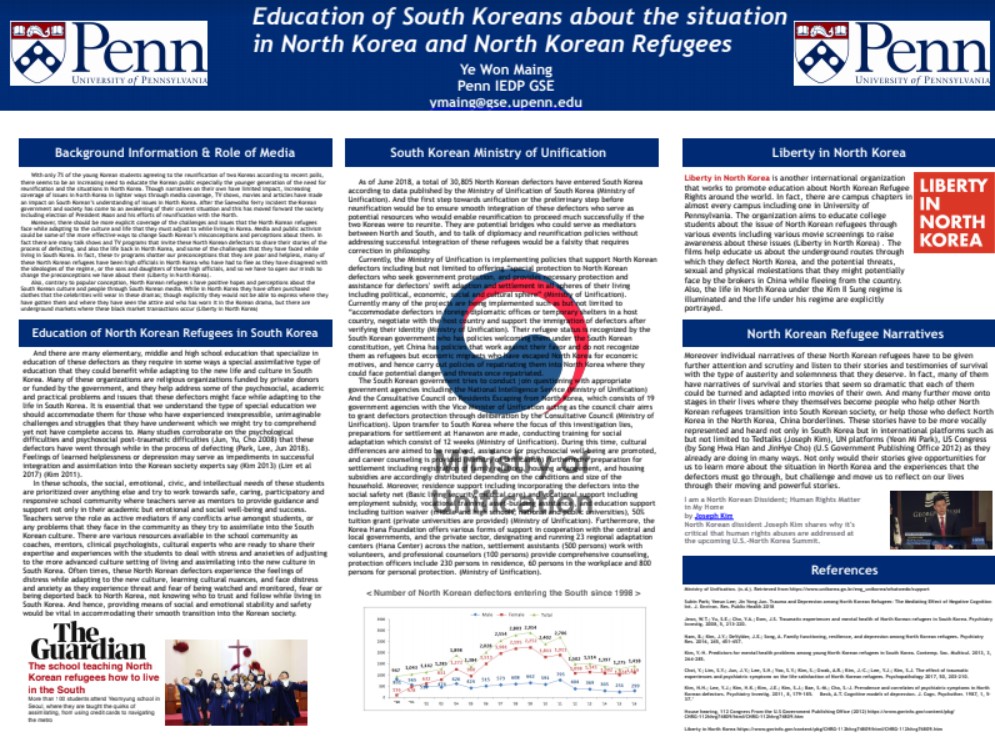
Background Information & Role of Media Liberty in North Korea Education of North Korean Refugees in South Korea North Korean Refugee Narratives South Korean Ministry of Unification With only 7% of the young Korean students agreeing to the reunification of two Koreas according to recent polls, there seems to be an increasing need to educate the Korean public especially the younger generation of the need for reunification and the situations in North Korea. Though narratives on their own have limited impact, increasing coverage of issues in North Korea in lighter ways through media coverage, TV shows, movies and articles have made an impact on South Korean’s understanding of issues in North Korea. After the Saewolho ferry incident the Korean government and society has come to an awakening of their current situation and this has moved forward the society including election of President Moon and his efforts of reunification with the North. Moreover, there should be more explicit coverage of the challenges and issues that the North Korean refugees face while adapting to the culture and life that they must adjust to while living in Korea. Media and public activism could be some of the more effective ways to change South Korean’s misconceptions and perceptions about them. In fact there are many talk shows and TV programs that invite these North Korean defectors to share their stories of the process of defecting, and also the life back in North Korea, and some of the challenges that they have faced while living in South Korea. In fact, these tv programs shatter our preconceptions that they are poor and helpless, many of these North Korean refugees have been high officials in North Korea who have had to flee as they have disagreed with the ideologies of the regime, or the sons and daughters of these high officials, and so we have to open our minds to change the preconceptions we have about them (Liberty in North Korea). Also, contrary to popular conception, North Korean refugees s have positive hopes and perceptions about the South Korean culture and people through South Korean media. While in North Korea they have often purchased clothes that the celebrities will wear in these dramas; though explicitly they would not be able to express where they have gotten them and where they have seen the attire and who has worn it in the Korean drama, but there are underground markets where these black market transactions occur (Liberty in North Korea) Liberty in North Korea is another international organization that works to promote education about North Korean Refugee Rights around the world. In fact, there are campus chapters in almost every campus including one in University of Pennsylvania. The organization aims to educate college students about the issue of North Korean refugees through various events including various movie screenings to raise awareness about these issues (Liberty in North Korea) . The films help educate us about the underground routes through which they defect North Korea, and the potential threats, sexual and physical molestation that they might potentially face by the brokers in China while fleeing from the country. Also, the life in North Korea under the Kim Il Sung regime is illuminated and the life under his regime are explicitly portrayed. And there are many elementary, middle and high school education that specialize in education of these defectors as they require in some ways a special assimilating type of education that they could benefit while adapting to the new life and culture in South Korea. Many of these organizations are religious organizations funded by private donors or funded by the government, and they help address some of the psycho-social, academic and practical problems and issues that these defectors might face while adapting to the life in South Korea. It is essential that we understand the type of special education we should accommodate them for those who have experienced inexpressible, unimaginable challenges and struggles that they have underwent which we might try to comprehend yet not have complete access to. Many studies corroborate on the psychological difficulties and psychosocial post-traumatic difficulties (Jun, Yu, Cho 2008) that these defectors have went through while in the process of defecting (Park, Lee, Jun 2018). Feelings of learned helplessness or depression may serve as impediments in successful integration and assimilation into the Korean society experts say (Kim 2013) (Lim et al 2017) (Kim 2011). In these schools, the social, emotional, civic, and intellectual needs of these students are prioritized over anything else and try to work towards safe, caring, participatory and responsive school community where teachers serve as mentors to provide guidance and support not only in their academic but emotional and social well-being and success. Teachers serve the role as active mediators if any conflicts arise among students, or any problems that they face in the community as they try to assimilate into the South Korean culture. There are various resources available in the school community as coaches, mentors, clinical psychologists, cultural experts who are ready to share their expertise and experiences with the students to deal with stress and anxieties of adjusting to the more advanced culture setting of living and assimilating into the new culture in South Korea. Often times, these North Korean defectors experience the feelings of distress while adapting to the new culture, learning cultural nuances, and face distress and anxiety as they experience threat and fear of being watched and monitored, fear or being deported back to North Korea, not knowing who to trust and follow while living in South Korea. And hence, providing means of social and emotional stability and safety would be vital in accommodating their smooth transition into the Korean society. Moreover individual narratives of these North Korean refugees have to be given further attention and scrutiny and listen to their stories and testimonies of survival with the type of austerity and solemnness that they deserve. In fact, many of them have narratives of survival and stories that seem so dramatic that each of them could be turned and adapted into movies of their own. And many further move onto stages in their lives where they themselves become people who help other North Korean refugees transition into South Korean society, or help those who defect North Korea in the North Korea, China borderlines. These stories have to be more vocally represented and heard not only in South Korea but in international platforms such as but not limited to Tedtalks (Joseph Kim), UN platforms (Yeon Mi Park), US Congress (by Song Hwa Han and JinHye Cho) (U.S Government Publishing Office 2012) as they already are doing in many ways. Not only would their stories give opportunities for us to learn more about the situation in North Korea and the experiences that the defectors must go through, but challenge and move us to reflect on our lives through their moving and powerful stories.
Education of South Koreans about the situation in North Korea and North Korean Refugees
As of June 2018, a total of 30,805 North Korean defectors have entered South Korea according to data published by the Ministry of Unification of South Korea (Ministry of Unification). And the first step towards unification or the preliminary step before reunification would be to ensure smooth integration of these defectors who serve as potential resources who would enable reunification to proceed much successfully if the two Koreas were to reunite. They are potential bridges who could serve as mediators between North and South, and to talk of diplomacy and reunification policies without addressing successful integration of these refugees would be a falsity that requires correction in philosophy. Currently, the Ministry of Unification is implementing policies that support North Korean defectors including but not limited to offering “special protection to North Korean defectors who seek government protection, and provides necessary protection and assistance for defectors’ swift adaption and settlement in all spheres of their living including political, economic, social and cultural sphere” (Ministry of Unification). Currently many of the projects are being implemented such as but not limited to “accommodate defectors in foreign diplomatic offices or temporary shelters in a host country, negotiate with the host country and support the immigration of defectors after verifying their identity (Ministry of Unification). Their refugee status is recognized by the South Korean government who has policies welcoming them under the South Korean constitution, yet China has policies that work against their favor and do not recognize them as refugees but economic migrants who have escaped North Korea for economic motives, and hence carry out policies of repatriating them into North Korea where they could face potential danger and threats once repatriated. The South Korean government tries to conduct join questioning with appropriate government agencies including the National Intelligence Service (Ministry of Unification) And the Consultative Council on Residents Escaping from North Korea, which consists of 19 government agencies with the Vice Minister of Unification acting as the council chair aims to grant defectors protection through deliberation by the Consultative Council (Ministry of Unification). Upon transfer to South Korea where the focus of this investigation lies, preparations for settlement at Hanawon are made, conducting training for social adaptation which consist of 12 weeks (Ministry of Unification). During this time, cultural differences are aimed to be resolved, assistance for psychosocial well-being are promoted, and career counseling is provided (Ministry of Unification) Furthermore preparation for settlement including registration of family relations, housing arrangement, and housing subsidies are accordingly distributed depending on the conditions and size of the household. Moreover, residence support including incorporating the defectors into the social safety net (Basic living security, medical care) and vocational support including employment subsidy, vocational training, asset-building assistance , and education support including tuition waiver (middle and high schools, national and public universities), 50% tuition grant (private universities are provided) (Ministry of Unification). Furthermore, the Korea Hana Foundation offers various forms of support in cooperation with the central and local governments, and the private sector, designating and running 23 regional adaptation centers (Hana Center) across the nation, settlement assistants (500 persons) work with volunteers, and professional counselors (100 persons) provide comprehensive counseling, protection officers include 230 persons in residence, 60 persons in the workplace and 800 persons for personal protection. (Ministry of Unification). < Number of North Korean defectors entering the South since 1998 >
I am a North Korean Dissident; Human Rights Matter in My Home by Joseph Kim North Korean dissident Joseph Kim shares why it’s critical that human rights abuses are addressed at the upcoming U.S.-North Korea Summit. References Ministry of Unification. (n.d.). Retrieved from https://www.unikorea.go.kr/eng_unikorea/whatwedo/support
Subin Park; Yeeun Lee; Jin Yong Jun. Trauma and Depression among North Korean Refugees: The Mediating Effect of Negative Cognition Int. J. Environ. Res. Public Health 2018 Jeon, W.T.; Yu, S.E.; Cho, Y.A.; Eom, J.S. Traumatic experiences and mental health of North Korean refugees in South Korea. Psychiatry Investig. 2008, 5, 213–220. Nam, B.; Kim, J.Y.; DeVylder, J.E.; Song, A. Family functioning, resilience, and depression among North Korean refugees. Psychiatry Res. 2016, 245, 451–457. Kim, Y.-H. Predictors for mental health problems among young North Korean refugees in South Korea. Contemp. Soc. Multicul. 2013, 3, 264–285. Choi, Y.; Lim, S.Y.; Jun, J.Y.; Lee, S.H.; Yoo, S.Y.; Kim, S.; Gwak, A.R.; Kim, J.-C.; Lee, Y.J.; Kim, S.J. The effect of traumatic experiences and psychiatric symptoms on the life satisfaction of North Korean refugees. Psychopathology 2017, 50, 203–210. Kim, H.H.; Lee, Y.J.; Kim, H.K.; Kim, J.E.; Kim, S.J.; Bae, S.-M.; Cho, S.-J. Prevalence and correlates of psychiatric symptoms in North Korean defectors. Psychiatry Investig. 2011, 8, 179–185. Beck, A.T. Cognitive models of depression. J. Cogn. Psychother. 1987, 1, 5– 37.’ House hearing, 112 Congress From the U.S Government Publishing Office (2012) https://www.govinfo.gov/content/pkg/ CHRG-112hhrg74809/html/CHRG-112hhrg74809.htm Liberty in North Korea https://www.govinfo.gov/content/pkg/CHRG-112hhrg74809/html/CHRG-112hhrg74809.htm

 EduContents