
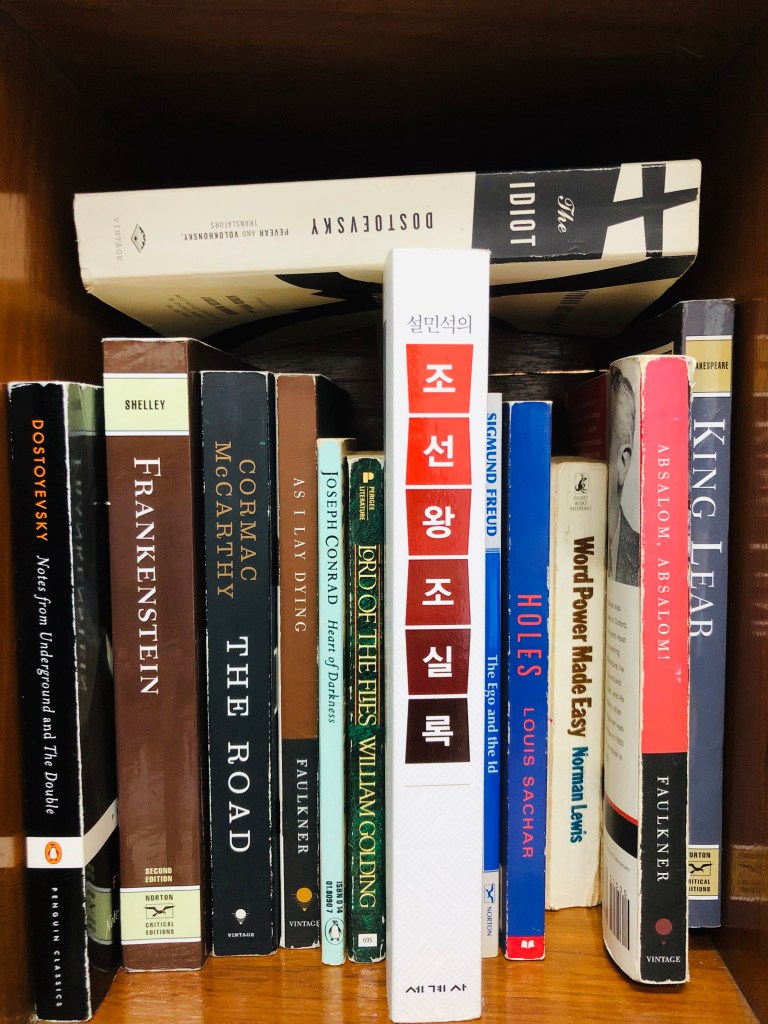
Four years have passed, yet I can still remember Mr. Stroupe thundering, “Can’t you see you’re in the Cave? Don’t you realize that it’s merely the illusory shadows on the walls that you perceive as the reality?” His voice would echo in the classroom as he relentlessly repeated Plato’s Cave allegory, entreating us to see beyond superficialities. And I, intoxicated by his charismatic aura, saw him as a savior who could redeem me from my ignorance: I was the Idiot in the Cave; he, the great Socrates, beckoning me to come out of the Cave. At the moment, I had not yet discovered the fundamental fallacy to Mr. Stroupe’s oft-repeated Cave allegory.
I first met Mr. Stroupe in my ninth grade History class. My first memory of him was his yelling in my ear to write “C-R-A-P” in my history textbook. Mr. Stroupe then proceeded to riddle the textbook with criticism, ripping apart and calling into question nearly everything I had learned in my previous eight years of education. With his cynicism, he incessantly boggled my mind, hurling my entire belief system into a marshy bog encircled by a swarm of Socratic gadflies, bred by Mr. Stroupe himself.
Having lived more than ten years of my life in Myanmar, a place where nothing is supposed to be questioned and everything accepted at face value, I found his provoking words even more startling. His words, ringing in the air like deafening gunshots, penetrated the silence and servility of this place and of the void inside me. And it was then I instinctively recognized my calling: I clawed my way out of the pit of ideological subservience and stumbled onto the streets. Stern and determined, I started fighting for my freedom as a thinker and my independence as an intellectual rebel.
In my junior year, I initially hesitated to take his classes, not because I feared or resisted his unconventional ideas, but because I recognized that I had perhaps too readily accepted them. He, for instance, would argue, “Philanthropy is way too overrated in our society. In order to achieve efficiency, we should all be ruthlessly selfish,” and I would indiscriminately take in such ideas.
But honestly speaking, I finally started to ask myself: “To what extent am I accepting his ideas solely because they are intriguing, and he is intriguing? In turn, to what extent is he endorsing unconventional ideas because he truly believes in them? Or is he doing so at times merely out of his life-goal to challenge and overthrow all conventions?” I realized that my awe and envy of him as an avant-garde iconoclast had prevented me from asking such questions and objectively examining his ideas.
Disappointed and alarmed by the susceptibility of my mind, it gave me all the more reason to take his classes. I wanted to prove to myself that he hadn’t pieced me together into a Barbie doll, pleasing to see but docile and impressionable. Rather, I wanted him to know that he, Clark Stroupe alias Victor Frankenstein, had created a fully independent creature: a living, thinking organism beyond his captivity and control. The rebellious ego emerged from within, liberating me from the power he and his words had over me; I began to overtly disagree, question and evaluate even his ideas.
But soon enough, I came to realize that I was at times rejecting his ideas for the same reasons I had accepted them: just because they were his ideas. Thus I was as alarmed by my newly adopted immature defiance as I was by my former naïve submission. I was frustrated at myself for not realizing that the battle was not against him and his philosophies but for my own intellectual awakening. To resolve this inner struggle, I strived to establish myself as an impartial, dignified knower and not a follower or a rebel.
Having achieved the equilibrium of the mind, and thus the nerve and autonomy to take risks, I started to experiment by smashing my ideas onto the walls of Mr. Stroupe’s classroom, the walls of the Cave. While the more feeble ones splashed like tomatoes, the stronger, more complexly-woven ones endured the blows of critical questions from my peers and Mr. Stroupe. Ironically, as my beliefs were broken apart for scrutiny and analysis, I started to feel more confident in the strength and validity of those opinions and ideas that were left behind intact.
And today, I burst out of my intellectual cocoon to emerge as an independent organism – grown mature through surgical introspection, major deconstruction and inspired volition – both beyond and within Mr. Stroupe’s influences.
Four years have passed, and I’ve finally come to realize that I’m not the idiot in the Cave nor is Mr. Stroupe the great Socrates outside the Cave. In fact, no man, including Mr. Stroupe and even Socrates himself, can escape the destiny of the Cave. All men are confined, in one way or another, as we do not hold absolute knowledge, freedom or power. But even as I’m in the Cave, I no longer yearn to get out of it. Rather, I feel blessed to live in the Cave, in an imperfect society. Because I do, I can dream of a better new world: I can dare believe, I can hope, I can breathe and thus live as a human being.
And today, holding onto the mirage of an outside world – made possible by the years of my struggle for an intellectual awakening – I strive to revolutionize the imperfect reality of the Cave, making it the better place I envision.
Sample Essay Topics
I chose to write about being a woman of paradoxical cultural backgrounds, the struggles that come with that and how I overcame them.
“With the audacity to choose”, I choose to be everything and anything, only limited by my own choices. Like Margaret Thatcher, I choose not to settle but to seize. Like Virginia Woolf, I am empowered through the products of my compelling voice and my creative mind. Like the Lady, I choose to defy with grace, dignity, compassion and confidence.
I chose to write about someone who has significantly influenced my life as a learner.
“I wanted to prove to myself that he hadn’t pieced me together into a Barbie doll, pleasing to see but docile and impressionable. Rather, I wanted him to know that he, Clark Stroupe alias Victor Frankenstein, had created a fully independent creature: a living, thinking organism beyond his captivity and control.”
I chose to write about my experience as a SEEDs leader and my passion towards changing Burma, but also mentioning casually the details of my personal life. (A college essay should be a coherent collage of who you are.) I also shared my ideologies, principles and worldviews that have been nurtured by such experiences.”
“But, my ambitions to inspire virtue, compassion, and benevolence stem from my own redemption as an individual and as a leader. Perhaps society is already too saturated with cynicism to believe in the utopian ideals and to transform the ethos of conventional thinking, but I find such cynicism futile and also difficult to conform to their ways of skepticism.”
I wrote about how my fight for asserting my independence is reflected in my signature.
“Just as I crafted my vision of how scenes should be blocked for Noises Off, I have now crafted my own signature: a blend of my initials Tz in loopy cursive handwriting combined with a messy blob of my name written in Burmese.”
My common application essay was about my identity as an artist and how growing up in Myanmar helped shape that identity.
“To come from such a conflicted country with so many unsaid things to say is every artist’s morbid, un-confessed dream, but to be a 17-year-old with a personal opinion establishing himself as an artist interested in criticizing society is also frighteningly un-Burmese.”
I chose to write about the World Cup and how it changed my views on Africa. Instead of a personal essay, I went with something more suited to the field that I wished to pursue: International Relations.
“Through the festivities of this global sporting event, I soon began to gain awareness of the intrinsic misconception I had about the developing world. Africa was not some absolute, poverty-stricken mishmash; it was an immense continent composed of an extensive range of nations including both the wealthy and the abysmal. In a nutshell, it was a continent with vast prospects.”
Harvard Supplement (Topic of Your Choice)
I chose to write about how books have changed my life, opened new doors for me, and helped me develop into the person I am today. And I drew parallelism between COOP (Harvard Bookstore) and the role I wish to play in Myanmar. I described how I want to be the COOP of Myanmar – the source of growth and development of my country.
“It was a sunny yet fresh and gusty day in Cambridge, Massachusetts, drastically different from the typical blistering heat and humidity back home in Myanmar. I wandered around the globally renowned brick roads of Harvard Square, until I halted in front of the prominent COOP bookstore. I walked through the wooden polished doors and was immediatelyenclosed within millions of books.”

Personal Statement (Amherst + Harvard Supplement Essays)
There are two people, perspectives, values that I’ve come to merge into one – into the present day
me. The first, Aung San Suu Kyi, the political activist of Myanmar, has inspired me to believe that along with my privileges come not only the responsibility to share such privileges but also the ability to afford so – that I not only should but also can afford such compassions and virtues. The next, Hans Rosling, a Swedish economics researcher I admire, has made me realize that such compassions and virtues are not good enough; in fact, if they are channeled inappropriately, they may even do more harm than good. He influenced me to believe that good intentions in our hearts are translated into goodness in the world when we come to understand the fine differences between the situation in Mozambique and Zambia: when we come to develop a less paternalistic and more accurate, contextualized understanding of the world. Bearing the words of Suu Kyi and Rosling in mind; merging their respective viewpoints on virtues and knowledge; emotions and reason; intentions and impact; I wish to tend equally to the life of the heart and
the life of the mind. In college, I wish to, by studying economics, contextualize my rather still naïve understanding of the world. And I wish to nurture my compassion, connecting myself to other people who strive to pursue morally active lifestyles. A more refined understanding of the world, fuelled by my increasing desire and affordability to lead an ethical life, will help translate my dreams into the betterment of our society.

 EduContents